
SpaceX's Strategic Satellite Expansion and Its Implications for the Space Economy
 Aime Summary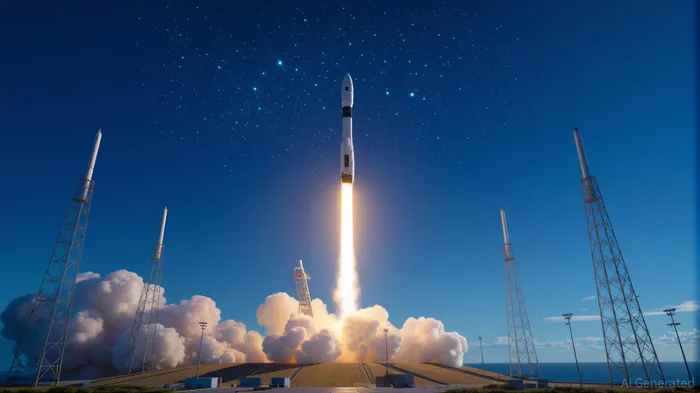
The global space economy is undergoing a seismic shift, driven by the commercialization of low Earth orbit (LEO) infrastructure. At the center of this transformation is SpaceX, whose recent polar Starlink launches and aggressive deployment cadence from Vandenberg Space Force Base (SFB) signal a pivotal moment in satellite internet commercialization. For investors, the question is no longer whether space-based infrastructure will reshape global connectivity but how quickly and who will dominate this new frontier.
The Infrastructure Flywheel: Reusability Meets Scale
SpaceX's ability to launch 27 Starlink missions from Vandenberg in 2025—accounting for 69% of its total Falcon 9 launches from the base—demonstrates a mastery of operational efficiency. By leveraging reusable rocketry (e.g., Booster 1082, which has flown 15 times), SpaceX has slashed the cost per launch to under $30 million, a fraction of traditional costs. This cost discipline, combined with a 170-launch target for 2025, enables a flywheel effect: lower costs per satellite, faster deployment, and a rapidly expanding constellation.
The polar orbit strategy is equally critical. Unlike equatorial launches from Florida, Vandenberg's location allows for trajectories that cover high-latitude regions, where terrestrial broadband is sparse. With 24 satellites deployed per mission and over 8,200 in orbit by August 2025, SpaceX is building a network that rivals terrestrial 5G in latency and bandwidth. This infrastructure is not just about connecting remote villages—it's about enabling new markets, from autonomous vehicles in Alaska to precision agriculture in Scandinavia.
Capital Allocation: A Lesson in Long-Term Value
SpaceX's capital allocation strategy mirrors the principles of infrastructure-led innovation. While competitors like Amazon's Project Kuiper and OneWeb grapple with funding shortfalls, SpaceX has reinvested profits from Starlink's $11.8 billion 2025 revenue into R&D and launch capacity. This self-funding model reduces reliance on external capital and accelerates deployment. For investors, this is a stark contrast to traditional aerospace ventures, which often require years of subsidies before turning a profit.
The financials tell a compelling story. Starlink's gross margins have surged from 7% in 2024 to 25% in 2025, driven by economies of scale and automation in satellite manufacturing. With 7.8 million subscribers across 125 countries and a projected $15.5 billion in 2025 revenue, the business is transitioning from a capital-intensive project to a cash-generative asset. This shift is critical for long-term value creation: infrastructure that pays for itself.
The Next Phase: Positioning for the Space Economy
The next phase of space infrastructure will be defined by three trends: satellite-to-device connectivity, government partnerships, and global market expansion. SpaceX is already leading in all three.
- Direct-to-Device (D2D) Innovation: By integrating with T-Mobile's 5G network, Starlink is enabling smartphones to connect directly to satellites, eliminating the need for terrestrial towers. This opens a $300 billion market for mobile connectivity in rural and disaster-affected areas.
- Government Contracts: The $3 billion in U.S. defense contracts, including the militarized Starshield project, diversifies revenue and validates the technology for high-stakes applications.
- Emerging Markets: Pricing models tailored to lower-GDP countries (e.g., $24/month in Zambia) ensure scalability. With 60% of the global population lacking reliable broadband, the upside is vast.
Risks and Realities
No investment is without risk. Regulatory hurdles, particularly in the EU and U.S., could delay spectrum allocations. Competition from AmazonAMZN-- and China's Guowang constellation is intensifying, though SpaceX's first-mover advantage and 60% LEO satellite market share provide a buffer. Environmental concerns, such as space debris, also require mitigation—SpaceX has already invested $500 million in deorbiting technologies.
Investment Thesis: Infrastructure as a Foundation
For investors, the key is to view SpaceX not as a speculative play but as a foundational infrastructure asset. The company's ability to combine technological leadership (e.g., laser inter-satellite links) with operational scalability positions it to dominate the $1 trillion space economy by 2032.
Positioning Strategies:
- Long-Term Hold: Invest in SpaceX's equity or ETFs focused on the space sector, betting on its 20–30% annual revenue growth.
- Thematic Exposure: Allocate to suppliers of satellite components (e.g., Maxar Technologies) or launch services (e.g., Rocket Lab).
- Diversification: Hedge against regulatory risks by investing in complementary sectors like satellite data analytics or space debris mitigation.
In conclusion, SpaceX's polar Starlink expansion is more than a technical achievement—it's a blueprint for capital allocation in the 21st century. By building infrastructure that scales with demand, SpaceX is not just connecting the world; it's redefining the economics of space itself. For investors, the lesson is clear: infrastructure-led innovation, when executed with discipline and vision, creates value that transcends cycles.

Delivering real-time insights and analysis on emerging financial trends and market movements.
Latest Articles
Stay ahead of the market.
Get curated U.S. market news, insights and key dates delivered to your inbox.




Comments
No comments yet