
SpaceX's Strategic Expansion of Starlink: A New Frontier for Satellite Broadband and Long-Term Returns


 Aime Summary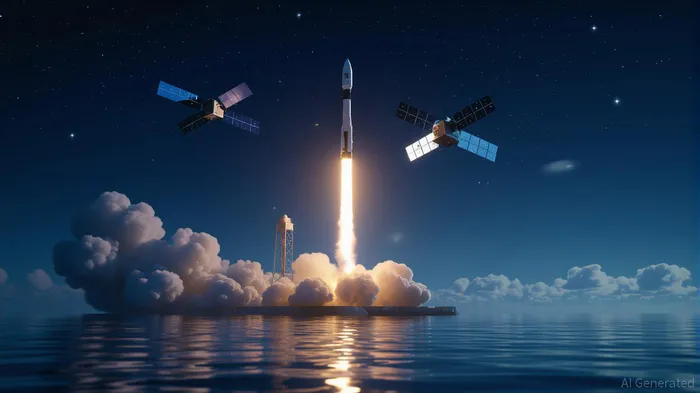
SpaceX's recent Starlink 17-7 mission, launched on August 30, 2025, isn't just a technical marvel—it's a masterstroke of financial engineering and strategic foresight. By deploying 24 Starlink V2 Mini satellites into polar orbit, Elon Musk's team has not only expanded the constellation's reach but also reinforced Starlink's position as the gold standard in satellite broadband. For investors, this mission signals a pivotal moment: the convergence of cutting-edge technology, cost efficiency, and untapped markets. Let's break down why this matters for your portfolio.
The Rocket Science Behind the Money
The Falcon 9's reusability is no longer a novelty—it's a profit center. The B1082 booster used in Starlink 17-7 completed its 15th flight, landing on the drone ship Of Course I Still Love You. This isn't just a PR win; it's a $30 million-per-launch cost reduction that SpaceX has weaponized. With 27 Starlink missions from Vandenberg Space Force Base in 2025 alone, the company is scaling at a pace that rivals like Amazon's Project Kuiper or OneWeb can't match.
The Starlink V2 Mini satellites are the real game-changers. At 740 kg each, they're four times more bandwidth-dense than their predecessors, with laser links that eliminate ground-based latency. These satellites are also cheaper to produce and deploy, thanks to streamlined designs and Argon-fueled thrusters. The result? A constellation that's not just expansive but resilient. With 8,200 satellites in orbit by 2025, Starlink is building a moat around its market share.
Financials That Speak Volumes
Starlink's revenue hit $11.8 billion in 2025, with a 25% gross margin—a rare feat in capital-intensive industries. The polar orbit strategy, targeting high-latitude regions, is unlocking $1.2 trillion in new markets. Think Arctic autonomous vehicles, Antarctic research stations, and rural broadband in Canada and Scandinavia. These aren't niche applications; they're $100 billion+ opportunities.
The math is simple: lower launch costs + higher satellite efficiency = exponential scalability. While competitors grapple with single-use rockets and fragmented constellations, SpaceX is leveraging its first-mover advantage to dominate the satellite internet sector. The 69% of Falcon 9 missions from Vandenberg in 2025 alone underscores its operational dominance.
Strategic Implications for Investors
The polar orbit deployment isn't just about geography—it's about outmaneuvering rivals. By focusing on underserved regions, SpaceX is capturing markets where terrestrial infrastructure is either too costly or impractical. This creates a flywheel effect: more satellites mean more users, which drives more data traffic and, ultimately, more revenue.
Moreover, the integration of laser-linked V2 Minis ensures Starlink's low-latency edge in applications like remote surgery, real-time gaming, and AI-driven logistics. These use cases aren't speculative—they're already in development. For investors, this means Starlink isn't just a broadband provider; it's a platform for the next industrial revolution.
The Bigger Picture: A Satellite-Driven Tech Boom
SpaceX's success is part of a broader trend: the democratization of space. With launch costs plummeting and satellite capabilities soaring, the space economy is projected to hit $1.1 trillion by 2030. Starlink is the linchpin of this boom, enabling everything from global 5G networks to intercontinental data pipelines.
For long-term investors, the key is to recognize that SpaceX isn't just building a business—it's building an ecosystem. The company's ability to iterate rapidly (V2 Minis are already being upgraded to V3 prototypes) and its vertical integration (from rocket engines to satellite software) create a durable competitive advantage.
Final Take: Buy, Hold, and Watch
SpaceX's recent milestones validate its thesis: that space is the next frontier for tech-driven disruption. While the stock may face short-term volatility, the fundamentals are unshakable. Starlink's revenue growth, margin expansion, and strategic orbital dominance make it a must-own for portfolios seeking exposure to the next industrial era.
In a world where connectivity is the new electricity, SpaceX isn't just lighting up the sky—it's wiring the globe. And for investors, the message is clear: this is where the future is being built.

Delivering real-time insights and analysis on emerging financial trends and market movements.
Latest Articles
Stay ahead of the market.
Get curated U.S. market news, insights and key dates delivered to your inbox.


AInvest
PRO
AInvest
PRO



Comments
No comments yet