
SpaceX’s Starlink Surge and Starbase Milestone Signal New Era in Rocketry
The week of April 28–May 4, 2025, marked a pivotal moment for SpaceX as the company executed its 50th Falcon 9 launch of the year while securing a critical administrative victory for its Starbase facility. These dual milestones underscore the growing commercial and geopolitical clout of Elon Musk’s rocketRCKT-- enterprise.
Lead: Falcon 9’s Record Pace and Starbase’s Cityhood
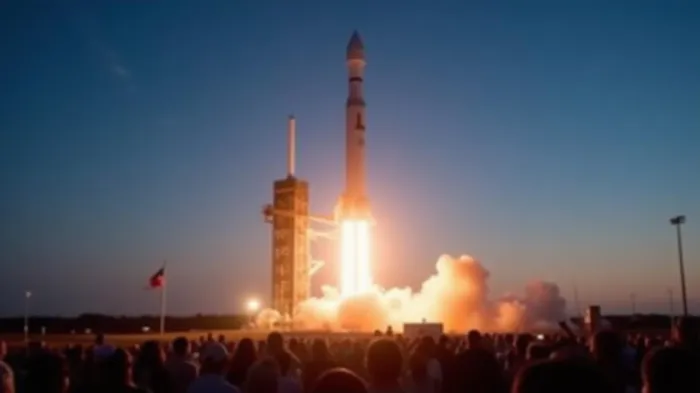
On April 28, SpaceX’s Falcon 9 rocket launched a mixed batch of Starlink v2 Mini and Direct-to-Cell satellites, marking its 50th mission of 2025—a cadence unmatched in the aerospace industry. Just days later, on May 3, voters in Texas approved the incorporation of SpaceX’s Starbase facility as an independent city, streamlining regulatory hurdles for future launches. Together, these events signal a new chapter in SpaceX’s quest to dominate low-Earth orbit and beyond.
Body 1: The Rocket Launch That Keeps Breaking Records
The April 28 mission—Starlink Group 12-10—deployed 53 satellites into a 43-degree inclined orbit at 559 km altitude, bringing SpaceX’s total deployed Starlink satellites to 8,367. This launch was notable for two reasons:
- Booster Reusability: The Falcon 9’s first-stage booster (B1094) landed successfully on the droneship A Shortfall of Gravitas, its maiden flight. This marks the 248th Falcon 9 launch from Kennedy Space Center’s LC-39A pad, a testament to SpaceX’s mastery of rapid reuse.
- Satellite Evolution: The inclusion of Direct-to-Cell satellites highlights SpaceX’s pivot toward consumer-facing services. These satellites bypass traditional telecom infrastructure, enabling Starlink to directly power smartphones—a potential $20B annual market, per industry analysts.
Body 2: Starbase’s Cityhood—A Regulatory Masterstroke
The May 3 vote to incorporate Starbase as a city was a strategic win for SpaceX. By becoming an independent municipality, the facility can bypass bureaucratic delays and fast-track permits for its Starship/Super Heavy rocket system. Key implications:
- Launch Cadence Acceleration: With its own zoning laws, Starbase can prioritize SpaceX’s needs, potentially enabling 25 annual launches from its Texas site (up from 5 in 2024).
- Environmental Mitigation: The city’s charter includes provisions to address prior criticisms, such as wildlife protection for endangered sea turtles—a nod to ongoing legal battles with environmental groups.
Body 3: The Bigger Picture—Why This Matters for Investors
SpaceX’s achievements this week are not isolated. They reflect a broader trend:
- Market Dominance: With over 7,264 active Starlink satellites, SpaceX now controls ~90% of global low-Earth orbit broadband capacity, outpacing rivals like OneWeb and Amazon’s Project Kuiper.
- Technological Leap: The Starship program, despite its $5 billion price tag, is nearing orbital readiness. A successful test could open doors to lunar missions (NASA’s Artemis program) and Mars colonization—a $100B+ market by 2040, per Morgan Stanley.
Conclusion: Betting on SpaceX’s Orbital Empire
Investors should take note: SpaceX’s dual milestones—operational speed and regulatory agility—are creating a moat around its space business. While direct investment in SpaceX is limited to private markets, public players like Rocket Lab (RKLB) and Astranis (ASTS) stand to benefit from the sector’s growth. For those tracking SpaceX itself, its 8,367 satellites and 50 launches/year are not just metrics—they’re proof of a company rewriting the rules of space exploration.
The road ahead is fraught with risks, from regulatory pushback to technical hurdles. Yet, as Musk once said, “If things are not failing, you are not innovating enough.” This week’s events suggest SpaceX is failing fast—and succeeding faster.

Stay ahead of the market.
Get curated U.S. market news, insights and key dates delivered to your inbox.


AInvest
PRO
AInvest
PRO



Comments
No comments yet