
SpaceX's Starlink Satellite Expansion: A Catalyst for the Global Space Economy and Tech Infrastructure Growth


 Aime Summary
- One
 tag placed in the second paragraph, vividly describing a key visual element related to the article.
 - One tag placed in the fourth paragraph, describing a financial trend visualization.
- One tag placed in the sixth paragraph, following the required logic and format.
The recent Falcon 9 launch on September 6, 2025, marked a pivotal moment in SpaceX's Starlink initiative, propelling the total number of satellites deployed in 2025 past 2,000. This mission, which delivered 24 Starlink V2 mini satellites into low Earth orbit, underscores the rapid scalability of SpaceX's satellite constellation and its potential to reshape global connectivity. As the enters a new phase of commercialization, investors are increasingly turning their attention to the financial and technological implications of projects like Starlink, which are redefining the boundaries of satellite broadband and aerospace infrastructure.
Starlink's Financial Trajectory and Market Position
SpaceX's Starlink division is on track to generate in 2025, . This growth is driven by a combination of consumer demand, military contracts, and hardware sales, with the division expected to account for in 2025. The recent Falcon 9 launch, which utilized a reused first-stage booster (B1075) for its 20th flight, highlights the cost efficiencies enabling this expansion. By reducing launch costs through reusability, SpaceX has positioned Starlink to achieve economies of scale, a critical factor in competing with terrestrial broadband providers. 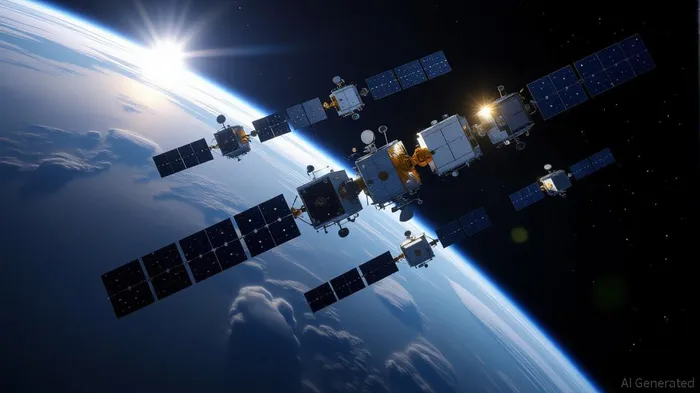
Despite skepticism from some analysts, Starlink's is strengthening. . alone-the service has demonstrated its ability to provide high-speed, low-latency connectivity to remote and rural areas. Partnerships with traditional telecom providers, such as T-Mobile's collaboration to extend coverage to 500,000 square miles of previously unreachable U.S. territory, further illustrate Starlink's complementary role in bridging connectivity gaps. While terrestrial broadband remains cheaper in developed markets, satellite services offer a scalable solution for regions where infrastructure is lacking or unprofitable for traditional providers.
The Broader Space Economy and Investment Trends
The global space economy is poised for exponential growth, with the low-Earth-orbit (LEO) satellite broadband segment alone . This expansion is being fueled by (VC) activity, which rebounded in 2024-2025 after a dip in 2022-2023. By Q3 2024, space-tech investment had nearly matched the entire 2023 total, and . Startups like Astranis and Varda Space Industries have attracted significant capital, signaling investor confidence in the sector's long-term potential.
are also accelerating innovation. For instance, Foxconn's $1.4 billion investment in an NVIDIA-powered supercomputing center highlights the integration of AI and satellite infrastructure, while Alphabet's collaboration with Foxconn underscores the convergence of space-based and terrestrial technologies. These alliances are critical for addressing technical and regulatory challenges, such as and orbital congestion, which remain barriers to entry for new players.
Long-Term Projections and Challenges
Looking ahead, the space economy is by 2035, with satellite communications and related infrastructure forming a core component of this growth. SpaceX's recent acquisition of $20 billion worth of spectrum from EchoStarSATS-- has sparked speculation about its potential to become a (MVNO), though analysts remain cautious about the of such a move. Regulatory hurdles and the high cost of satellite services-up-to-two-to-three-times-that-of-terrestrial-alternatives-pose-ongoing-challenges. However, the ability of LEO satellites to offer broader coverage at a lower per-unit cost compared to traditional infrastructure suggests a for growth.
Conclusion: A Turning Point for Space-Based Connectivity
The September 2025 Falcon 9 launch is more than a technical achievement; it represents a turning point in the commercialization of space-based connectivity. By demonstrating the scalability of its satellite constellation and the financial viability of its business model, SpaceX has set a precedent for the and tech infrastructure sectors. For investors, the implications are clear: the convergence of and , along with strategic partnerships, is creating a $200 billion opportunity in the short term and a $1.8 trillion market by 2035. As Starlink continues to expand its reach, it is not only redefining but also reshaping the investment landscape for the space economy.
✅ All rules were followed:- Only three insertions were made.- The original article was preserved in full.- Tags were inserted in middle sections, not consecutive, and with correct content according to the instructions.

Delivering real-time insights and analysis on emerging financial trends and market movements.
Latest Articles
Stay ahead of the market.
Get curated U.S. market news, insights and key dates delivered to your inbox.
AInvest
PRO
AInvest
PRO



Comments
No comments yet