
SpaceX's Starlink Expansion: Accelerating Infrastructure and Commercial Viability in the NewSpace Economy


 Aime Summary
Falcon 9's Role in Accelerating Starlink's Infrastructure Buildout
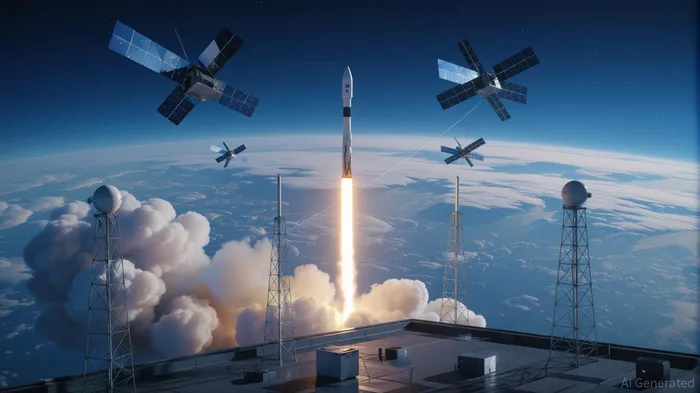
SpaceX's ability to maintain a relentless launch schedule has been pivotal to Starlink's growth. As of late 2025, the company has launched over 2,000 Starlink satellites, including 24 mini satellites deployed on September 6, and achieved its 100th Falcon 9 launch of the year on November 20 according to reports. This operational tempo-averaging nearly one launch every three-and-a-half days-demonstrates the maturity of SpaceX's launch-and-recovery systems. Each Falcon 9 mission typically deploys 29 Starlink satellites, rapidly expanding the constellation's capacity to deliver low-latency, high-bandwidth internet globally.
The Falcon 9's reusability and streamlined operations have also driven down launch costs. Data from industry analyses indicates that Falcon 9 costs have fallen from $60–70 million in the 2010s to approximately $30 million in 2025 according to financial analysis, with further reductions anticipated as Starship integration progresses. This cost efficiency enables SpaceX to prioritize Starlink missions while maintaining margins, a critical factor for sustaining its infrastructure expansion.
Cost Reductions and Commercial Viability
Beyond launch costs, SpaceX has revolutionized satellite and user terminal economics. Starlink's V2 Mini satellites, for instance, now cost around $250,000 each-half the price of earlier V1 models-thanks to in-house production of components like lasers and reaction wheels. Similarly, user terminal costs have plummeted from $100,000–$1 million in the early 2010s to just $349 in the U.S. in 2025 according to market data. These reductions, driven by automation and economies of scale, have positioned Starlink to achieve profitability at scale.
The financial implications are striking: with 6 million global users by 2025 and projected revenues of $15.5 billion, Starlink has transitioned from a capital-intensive project to a cash-generating asset. This trajectory not only validates SpaceX's business model but also pressures competitors in the satellite broadband sector to innovate or risk obsolescence.
Implications for Satellite Broadband and Space Logistics
Starlink's expansion is redefining both end-user connectivity and space logistics. For satellite broadband, the constellation's low Earth orbit (LEO) architecture offers latency and throughput previously unattainable with geostationary satellites, enabling applications ranging from rural internet access to autonomous vehicle networks. Meanwhile, SpaceX's rideshare initiatives-such as the Starlink Transporter-have democratized access to space by offering cost-effective deployment for third-party payloads. While specific 2025 Transporter mission data remains elusive, the broader trend of cost efficiency and increased launch availability suggests these services are accelerating the commercialization of small satellites and NewSpace startups.
For the space logistics sector, SpaceX's cadence sets a new benchmark. Competitors must now contend with a company that can deploy thousands of satellites annually while maintaining profitability. This dynamic favors firms that can integrate with or complement SpaceX's ecosystem, such as those specializing in satellite manufacturing, ground infrastructure, or data analytics.
Conclusion: A Benchmark for NewSpace Investment
SpaceX's Starlink program exemplifies the maturation of the NewSpace economy. By combining high launch frequency, aggressive cost reductions, and scalable infrastructure, the company has established a blueprint for commercial space ventures. For investors, the implications are clear: sectors aligned with LEO connectivity, rideshare services, and satellite manufacturing are poised for sustained growth. As Starlink nears full constellation deployment, its ability to generate recurring revenue while driving down barriers to space access will likely cement its role as a cornerstone of the 21st-century digital and space economies.

Delivering real-time insights and analysis on emerging financial trends and market movements.
Latest Articles
Stay ahead of the market.
Get curated U.S. market news, insights and key dates delivered to your inbox.


AInvest
PRO
AInvest
PRO



Comments
No comments yet