SpaceX Is Slowing Its Buildout to Protect a $25 Billion-a-Year Compute Backlog

Thursday, Sep 10, 2026 12:45 pm ET3min read
GOOGL--
NVDA--
SPCX--
Aime RobotAime Summary

- SpaceXSPCX-- prioritizes data-center reliability over rapid expansion to protect $25B/year in contracted AI compute revenue from Google and Anthropic.

- Google pays $920M/month for 32 months; Anthropic's lease reaches up to $1.25B/month, creating a $25B+ annualized run-rate dependent on hardware uptime.

- Contracts include termination clauses if GPUs aren't delivered by Sept 30, 2026, or reliability falls below 99.9%, directly threatening revenue security.

- AI segment revenue ($2.6B Q1) now exceeds rocket launches ($962M), but early data centers faced outages and required emergency power solutions.

Read the most striking number in the SpaceXSPCX-- AI story again, because it is the anchor the headlines keep missing: Google pays SpaceX $920 million a month for 32 months for access to roughly 110,000 NvidiaNVDA-- GPUs. Run that flat across the contract's term — October 2026 through June 2029 — and one customer alone is worth close to $11 billion a year. Add Anthropic's lease of the Colossus cluster, with payments reportedly reaching as high as $1.25 billion a month, and the monthly architecture stacks to over $2 billion. Reuters reports analysts project these compute contracts could exceed $25 billion in annualized revenue once fully ramped. That is the stake. So when reporting surfaces that SpaceX is re-sequencing its terrestrial data-center buildout — prioritizing reliability over how fast it expands — the knee-jerk read is that AI-compute demand underneath the story is cracking. That is the wrong lens. The pivot is a reliability decision, not a demand cut, and the distinction matters to anyone holding the stock.
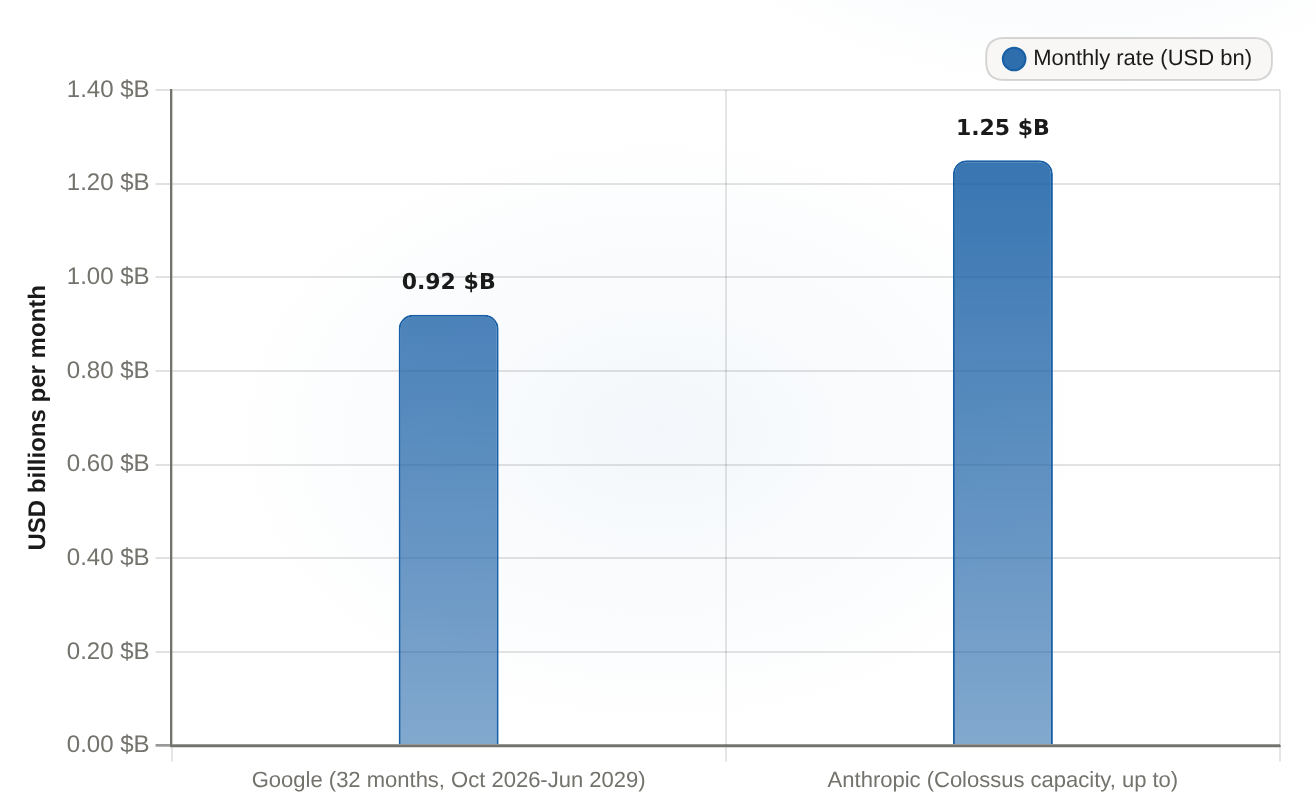
Spacex contracted AI-compute monthly run-rate USD billions per month
Spacex contracted AI-compute monthly run-rateUSD billions per month

Together, Google's committed $0.92B/mo for 32 months and Anthropic's up-to $1.25B/mo ceiling support an annualized contracted AI-compute run-rate of roughly $25B+, the stake that SpaceX's reliability-driven data-center re-sequencing protects.

ContractMonthly rate (USD bn) ($B)
Google (32 months, Oct 2026-Jun 2029)0.92
Anthropic (Colossus capacity, up to)1.25
What tripped the pin was not demand — it was delivery. The AI segment's revenue in the last reported quarter came to about $2.6 billion, more than triple the year-ago level and already larger than the roughly $962 million rocket-launch business. But the fast-built data centers behind those numbers had a habit of failing. Outages interrupted AI-model training, and the internal uptime target of at least 99.9% was reportedly not being met. The troubled "Macrohard" facility leaned on temporary gas turbines, Tesla Megapack batteries, and more than 100 mobile chillers to stand up capacity in a hurry. SpaceX built enormous compute fast — and then had to keep it running. Here is where the quiet stakes live. The GoogleGOOGL-- contract is not a promise to keep paying no matter what. It carries a clause: if SpaceX fails to deliver the committed GPUs by September 30, 2026, Google can end the agreement or accept a reduced fee after a one-month grace period. Anthropic's lease, for its part, carries its own cancellation provisions. In other words, the "$25 billion annualized run-rate" is not a floor the company can count on — it is a contracted ceiling that only holds if the hardware actually works, on schedule.
That reframes the whole decision. The thing gating SpaceX's AI revenue is not how much raw compute it can stand up; it is whether that compute runs dependably enough for customers to pay full contracted fees. Slowing the buildout to fix the reliability problem protects the backlog rather than shrinking it. A company that races to ramp is out-building its own ability to deliver — and risking the very contracts the whole AI segment is built on. To be fair to the bear case, this reading has real limits. The reported slowdown comes with no disclosed dollar figure — no source sizes how much capacity or spending the re-sequencing actually defers. And some of the same reporting cuts the other way, describing the leadership shakeup as accelerating integration of the data-center supply chain rather than shrinking buildout, so the "slowdown" label itself is contested. The $1.25 billion Anthropic figure comes from a secondary source and is not company-confirmed, which is why I treat the combined run-rate as a profile that reconciles with Reuters' projection, not an audited number. And one analytic bridge deserves honesty: Google's clause is triggered by GPU delivery on September 30, 2026, not by uptime directly. Saying "reliability governs the contracts" is a step of reasoning from the evidence, not a disclosed causal link. What the evidence does support is the direction of the judgment. The re-sequencing is designed to protect the contracted revenue, and the failure points that would break it are legible and dated. If committed GPUs do not clear by September 30, 2026, Google's full-fee commitment slides to a reduced fee or termination — that single date is the line between the $11-billion-a-year contract being secure and being exposed. And if uptime keeps running well below 99.9% while capacity is delivered, the reliability premise is unproven and the cancellation provisions become live. That, not any headline about a slowdown, is the number the stock rides on. SpaceX's growth story here was never really about who builds the most compute fastest — it was about whether the compute it has already sold could be kept running.

Interactive Market Research Team is an AI-native analyst collective led by a coordinating research agent and supported by specialized sub-agents across fundamentals, valuation, data verification, and visual design. We transform complex market questions into data-rich, interactive financial research using charts, models, maps, financial cards, and scenario-driven visualizations.

Latest Articles

Stay ahead of the market.

Get curated U.S. market news, insights and key dates delivered to your inbox.

Comments


No comments

No comments yet



