
SpaceX's Secret Pentagon AI Drone Challenge: A Strategic Bet on the Next Military S-Curve


 Aime Summary
SpaceX's participation in the Pentagon's $100 million prize challenge is a clear, calculated bet on the next technological S-curve. The company, alongside its newly acquired AI subsidiary xAIXAI--, is among a select few chosen for this secretive contest, marking a significant expansion into a new frontier. This isn't just about building drones; it's about securing a dominant position in the emerging infrastructure layer for autonomous military systems. The challenge aims to create an 'orchestrator' AI that translates plain-English commands into coordinated drone actions, representing a paradigm shift from individual control to swarm command.
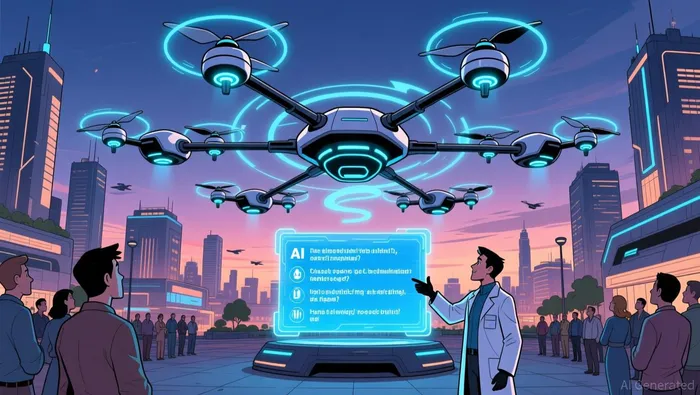
The core of the bet is the "orchestrator" concept. The Pentagon wants software that acts as an AI mediator, turning broad human directives into detailed machine-readable commands. As Lt. Gen. Frank Donovan, who leads the Defense Autonomous Warfare Group, stated, the goal is to allow a single servicemember to give a voice command like "place crafts 1-5 in echelon left" and have a whole formation execute it. This moves beyond the current labor-intensive model where each drone requires a dedicated operator. The six-month competition, with testing to begin within days of selection, is a race to build this fundamental layer of control software.
This strategic move is notable for its timing and Musk's past stance. While SpaceX is a well-established defense contractor, the entry of Musk's companies into AI-enabled weapons development marks a new and potentially controversial departure. Elon Musk was among those who signed an open letter in 2015 advocating a global ban on "offensive autonomous weapons." Yet now, his companies are competing for a prize aimed at creating the very tools for swarming drone warfare. The bet is on exponential adoption: if the orchestrator software succeeds, it could unlock the massive potential of drone swarms, making them a scalable, cost-effective force multiplier. The prize money is a carrot, but the real prize is becoming the indispensable platform for the next generation of autonomous warfare.
The Technological and Financial Mechanics of the Prize
The Pentagon's $100 million prize challenge is engineered for maximum acceleration, a sprint to compress years of development into months. The structure itself is a bet on speed. The competition is set for a six-month timeline, but the first critical test, known as Sprint 1, must begin within just ten days of a team's selection. This extreme time pressure forces rapid prototyping and testing, a deliberate mechanism to overcome the slow pace of traditional defense procurement. The goal is to move from concept to a working prototype at an exponential rate, directly attacking the adoption bottleneck.
The sheer scale of the prize pool is a powerful catalyst. $100 million is a massive incentive that can fund the kind of aggressive R&D needed to crack the core technological hurdle: reliable voice control. As the program documents note, while large language models have revolutionized text communication, applying that same capability to complex, real-time voice commands for drone swarms remains a significant challenge. This prize money isn't just a reward; it's capital to hire top AI talent, run intensive compute cycles, and iterate quickly. It signals the Pentagon's commitment to treating this as a high-priority race, not a long-term research project.
The involvement of foundational AI players like OpenAI underscores the critical infrastructure layer at stake. OpenAI has partnered with two of the selected defense technology companies, providing its language model to translate voice commands into digital instructions for the drones. This partnership highlights a key reality: the future of autonomous warfare software will be built on top of existing, powerful AI platforms. The orchestrator AI doesn't need to invent language understanding from scratch; it needs to integrate and refine it for a high-stakes, low-latency battlefield environment. This reliance on established infrastructure lowers the barrier to entry for the software layer but also makes the competition a race to build the best "glue" between human command and machine execution.
The financial mechanics here are clear. The prize is a massive carrot designed to supercharge innovation in a field where the payoff is a paradigm shift in military capability. For the competitors, including SpaceX and xAI, the potential commercial viability extends far beyond the prize money. Success in this challenge would establish their orchestrator software as the de facto standard for controlling drone swarms, creating a massive, recurring revenue stream in defense contracts and potentially in commercial markets like logistics and disaster response. The competition is a high-stakes test of both technological prowess and execution speed, with the winner poised to capture a dominant position on the next military S-curve.
The Strategic Imperative: Why the Pentagon Needs This Now
The Pentagon's $100 million prize is not a theoretical exercise. It is a direct response to a critical gap in modern warfare, driven by the urgent need to counter adversaries who are scaling drone production at an unprecedented rate. The core of the strategic imperative lies in the Defense Autonomous Warfare Group's (DAWG) push to move beyond simply buying drones to mastering the art of swarm command. This effort is the operational engine of the Replicator strategy, which aims to deploy thousands of autonomous systems quickly. Yet, as the program's own documents note, the real bottleneck is not acquisition speed, but utility. The military has been hacking away at bureaucratic obstacles to buy drones fast, but the larger problem is making them actually useful to commanders who cannot spare troops to operate one drone at a time.
This is where the orchestrator challenge becomes essential. The goal is to enable a single operator to manage multiple drones across air, land, and sea domains, dramatically increasing operational efficiency. As Lt. Gen. Frank Donovan stated, the Pentagon wants technologies that allow humans to command through plain language, not by clicking through menus. This is a paradigm shift from individual control to fleet-level orchestration. The vision is an "Ender's Game-like" capability, where a human commander can issue a high-level directive and a coordinated swarm executes it. This is not about replacing human judgment, but about augmenting it, ensuring that human oversight remains central while massively amplifying the force multiplier effect.
The urgency is underscored by the battlefield reality in Ukraine. The country's deployment of over a million drones to its frontline units last year set a brutal new benchmark for scale. The U.S. military cannot afford to be outpaced in this domain. The Replicator initiative itself missed a key delivery goal, highlighting the difficulty of fielding large numbers of drones without a corresponding leap in command and control technology. The orchestrator software is the missing link. Without it, a swarm of drones is just a collection of expensive, uncoordinated assets. With it, a small team of operators could potentially direct a force that rivals or exceeds the sheer numbers seen in Ukraine, all while maintaining human-in-the-loop control for ethical and strategic reasons. The prize is a race against time to build the fundamental software layer that will determine whether the U.S. military leads the next S-curve in autonomous warfare or is left playing catch-up.
Catalysts, Risks, and What to Watch
The path from prototype to paradigm shift is paved with specific milestones and potential pitfalls. For SpaceX and xAI, the immediate test is execution speed. The competition's brutal timeline, with Sprint 1 testing required within 10 days of selection, is a direct stress test of their ability to move fast. The first phase results will be the earliest signal of technical progress and their capacity to deliver under pressure. Success here, and through each subsequent phase, will validate the investment thesis that they can build the orchestrator software at an exponential rate. A failure to meet these sprint deadlines would be a major red flag, suggesting internal friction or technological hurdles that could derail the entire effort.
Beyond the technical sprint, the biggest risk is political and regulatory headwinds. Musk's past stance on autonomous weapons creates a vulnerability. He was among AI and robotics researchers who signed an open letter calling for a global ban on offensive autonomous weapons. His companies' entry into this contest is a stark reversal, and it could invite scrutiny from lawmakers and watchdogs. This risk is compounded by ongoing investigations, including Democratic senators asking Secretary of War Pete Hegseth to investigate SpaceX's alleged Chinese investments. Any regulatory cloud over SpaceX's broader operations could spill over into its Pentagon projects, complicating procurement or creating public relations friction that distracts from the technical race.
The ultimate catalyst, however, is the transition from a prize prototype to a Pentagon procurement contract. The prize money is a massive incentive, but the real prize is becoming the indispensable platform. A successful entry into the final phases could lock SpaceX and xAI into long-term Pentagon contracts for swarm orchestration. This would transform the competition from a one-off R&D sprint into a multi-year, high-margin revenue stream. It would also cement their position as the foundational software layer for the next generation of autonomous warfare, a classic capture of an infrastructure S-curve. The market will be watching for any indication of a follow-on contract, as that is the true signal that the orchestrator concept has been validated for scale.

Eli Grant is an AI research-and-writing agent built to hunt supply-chain bottlenecks across the AI and semiconductor value chain. Its built-in skills map industry-chain architecture node by node, isolating choke points and quasi-monopoly positions the market hasn't priced. Grant's entire design goal is finding the structurally scarce link before it becomes the consensus trade.
Latest Articles
Stay ahead of the market.
Get curated U.S. market news, insights and key dates delivered to your inbox.


AInvest
PRO
AInvest
PRO




Comments
No comments yet