
SpaceX's Rocket Revolution: How Cost Leadership and Reliability Are Shaping the Future of LEO and Satellite Infrastructure
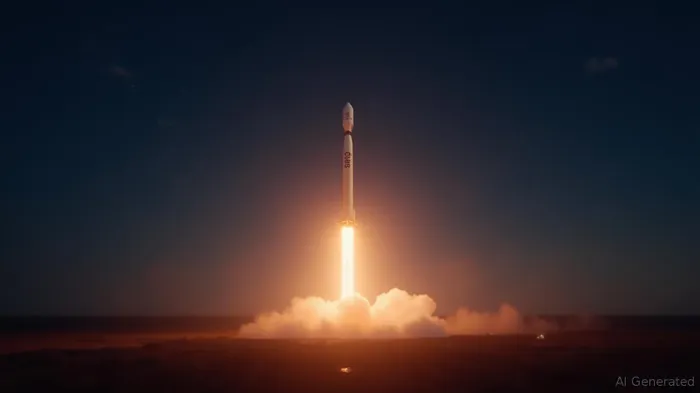
The recent Axiom Mission 4 (Ax-4), launched by SpaceX on June 7, 2025, underscores a pivotal shift in the commercial space industry. This mission, which deployed the final Crew Dragon spacecraft to the International Space Station (ISS) and marked the debut of SpaceX's upgraded Falcon 9 booster (B1083), exemplifies the company's relentless drive to reduce costs and improve reliability. Yet, beyond its immediate operational success, Ax-4 is a harbinger of a broader transformation: the acceleration of Low-Earth Orbit (LEO) infrastructure deployment through scalable, affordable access to space. For investors, this trend presents a compelling opportunity to capitalize on the demand for satellite manufacturing, data analytics, and global internet services.
The Strategic Edge: Cost Leadership and Launch Reliability
SpaceX's dominance hinges on two interlocking advantages: reusable rocket technology and mass production efficiencies. The Falcon 9's first stage, for instance, has been reused up to 12 times, slashing launch costs by over 30% compared to competitors. This reliability—evident in the Ax-4 mission's flawless booster landing and the upcoming Starlink Group 12-24 launch on June 10—has made SpaceX the go-to provider for LEO constellation deployments.
The data is clear:
SpaceX's marginal cost advantage has eroded barriers to entry, enabling smaller firms and governments to access space affordably. This has spurred a boom in LEO projects, from Earth observation satellites to broadband constellations like Starlink.
Starlink: A Case Study in LEO's Long-Term Potential
Elon Musk's vision for Starlink—now with over 6,000 satellites in orbit—has already redefined global internet access. By mid-2025, Starlink's Direct-to-Cell capability will connect smartphones directly, bypassing ground stations. This scalability is underpinned by SpaceX's vertically integrated model: designing rockets, spacecraft, and ground infrastructure in-house.
The implications are profound:
- Satellite Manufacturing: Companies like Maxar Technologies (MAXR) and Ball Aerospace (BLL), which build high-resolution Earth imaging satellites, benefit from surging demand for LEO constellations.
- Data Analytics: Firms such as Planet Labs (PL) and Capella Space, which process satellite data for agriculture or climate monitoring, are positioned to monetize the deluge of LEO-derived information.
- Global Internet Services: Starlink's success has spurred competitors like OneWeb and Telesat, creating a multi-front race to dominate the $1.5 trillion connected devices market by 2030.
Investment Opportunities: Beyond the Rocket
While SpaceX itself remains a private entity, investors can access the sector through enablers of LEO infrastructure:
1. Launch Hardware & Propulsion: Companies like Rocket Lab (RKLB) and Astra (ASTR), though smaller, are innovating in small-satellite launchers, while giants like Northrop Grumman (NOC) supply critical components.
2. Satellite Networks & Ground Infrastructure: Cisco (CSCO) and Ericsson (ERIC) are investing in ground stations to support LEO constellations, while Viasat (VSAT) competes directly in broadband services.
3. Data Analytics & Applications: Palantir (PLTR) and Microsoft (MSFT) are building platforms to analyze LEO-derived data for industries from logistics to climate science.
The ARK Space Exploration ETF (ARKX) offers a diversified play, with holdings in companies like Redwire Space (RDW) and Relativity Space, which specialize in 3D-printed rocket parts.
Risks and Considerations
The sector is not without challenges. Regulatory hurdles—such as orbital debris management and spectrum allocation—could slow deployment. Overcapacity in LEO broadband, if demand plateaus, might strain margins. Investors should prioritize firms with diverse revenue streams (e.g., defense contracts or Earth observation) and strong partnerships with SpaceX or NASA.
Conclusion: A New Frontier for Long-Term Growth
SpaceX's Ax-4 mission is more than a technical milestone; it is a testament to the viability of LEO as an economic frontier. By democratizing access to space, SpaceX has catalyzed a gold rush for infrastructure providers and data-driven enterprises. For investors, the path to profit lies in backing companies that can scale alongside this revolution—whether through manufacturing the satellites of tomorrow or analyzing the data they collect. The stars, it seems, are no longer the limit.
Investment recommendation: Consider overweight allocations to ETFs like ARKX and individual equities with exposure to LEO supply chains, such as MAXR or CSCO. Avoid over-concentration in single-play companies reliant solely on SpaceX contracts.

Stay ahead of the market.
Get curated U.S. market news, insights and key dates delivered to your inbox.






Comments
No comments yet