
SpaceX's Polar Orbit Starlink Launch and Its Strategic Implications for Satellite Internet Growth
 Aime Summary
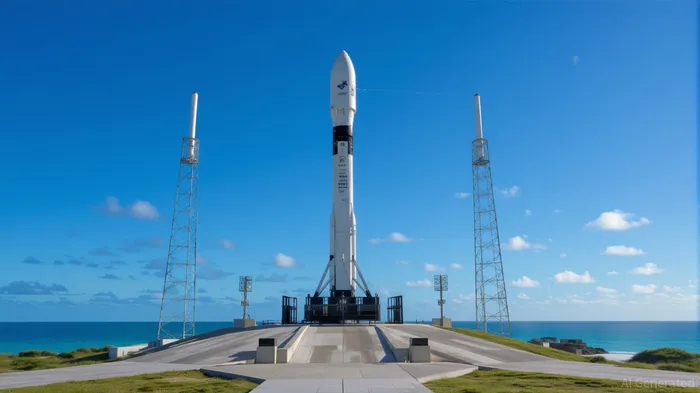
The global satellite internet market is undergoing a seismic shift, driven by SpaceX's relentless innovation and the recent deployment of its polar orbit Starlink satellites. As of July 2025, SpaceX has launched 24 Starlink satellites into polar orbit, a strategic move to bridge the digital divide in high-latitude and remote regions. This mission, part of the Starlink 17-2 launch from Vandenberg Space Force Base, underscores the company's ability to combine technical prowess with commercial pragmatism, positioning it as a dominant force in the $22.6 billion satellite internet market projected by 2030. For investors, the implications are clear: SpaceX's advancements in satellite infrastructure and space logistics are not just reshaping connectivity—they're redefining the economics of the space industry itself.
Technical and Operational Breakthroughs: A Foundation for Growth
SpaceX's polar orbit Starlink satellites are a testament to the company's engineering ingenuity. The V2 Mini satellites, deployed in this mission, are equipped with optical intersatellite lasers and phased-array antennas, enabling a low-latency mesh network. These features allow data to be routed directly between satellites, eliminating reliance on ground stations and reducing latency to as low as 25 milliseconds. This is a stark contrast to traditional geostationary (GEO) satellite services, which often suffer from latencies exceeding 600 milliseconds.
The polar orbit strategy is equally transformative. By placing satellites at altitudes of 525–535 km, SpaceX ensures consistent coverage over regions like Alaska, Scandinavia, and Antarctica—areas historically underserved by terrestrial broadband. The company's 19th-flight Falcon 9 booster, B1075, exemplifies its cost-efficiency, with reusable rocket technology slashing launch costs to $30 million per mission. This has enabled a deployment rate of 1,200 satellites annually, a pace that outstrips competitors like Amazon's Project Kuiper and OneWeb.
Market Expansion and Revenue Potential
The polar orbit launch is not just a technical milestone—it's a business strategy. By targeting high-latitude markets, SpaceX is unlocking a $28 billion opportunity in regions where rural communities, research stations, and maritime operations demand reliable connectivity. For example, Starlink's partnerships with maritime operators and airlines (e.g., JSX, Hawaiian Airlines) have expanded its reach into the $300 billion aviation and maritime connectivity market by 2030. Additionally, the company's direct-to-device (D2D) technology, which enables smartphone connectivity via satellite, is set to disrupt the $1.2 trillion telecom industry.
Financially, SpaceX's Starlink division has already demonstrated exponential growth. Revenue surged to $11.8 billion in 2025, up 53% from 2024, with gross margins expected to hit 25% by 2026. The company's 60% share of active LEO satellites and a $500 million investment in debris mitigation further solidify its competitive edge. Analysts project Starlink to achieve breakeven EBITDA by 2026 and capture 60% of the satellite internet market by 2030.
Strategic Partnerships and Diversification
SpaceX's success is also fueled by strategic alliances and diversification into high-margin sectors. The company's $3 billion in defense contracts, including battlefield connectivity for Ukraine, highlights its role in national security. Meanwhile, partnerships with telecom giants like T-MobileTMUS-- and VodafoneVOD-- are expanding Starlink's terrestrial integration, creating a hybrid network that enhances reliability and coverage.
The polar orbit satellites also support SpaceX's broader infrastructure ambitions. Over 1,200 global gateway stations, including hubs in Svalbard and northern Quebec, ensure seamless data downlinks even in extreme conditions. These gateways are critical for maintaining service quality in polar regions, where traditional infrastructure is either nonexistent or prohibitively expensive.
Investment Implications: A Sector on the Rise
For investors, the long-term potential of satellite infrastructure and space logistics is undeniable. The global satellite internet market is expected to grow at a 13.9% CAGR from 2024 to 2030, driven by SpaceX's leadership and the proliferation of LEO constellations. Key sectors to watch include:
- Satellite Manufacturing: Companies like Astranis and MinoSpace, which supply components for small satellites, stand to benefit from SpaceX's aggressive deployment cadence.
- Launch Services: SpaceX's reusable rocket technology has reduced costs to $30 million per mission, a trend that could pressure competitors like Rocket LabRKLB-- and Blue Origin to innovate or risk obsolescence.
- Orbital Logistics: Investments in debris mitigation and on-orbit servicing, such as AST SpaceMobile's satellite servicing initiatives, align with SpaceX's focus on sustainable space operations.
However, risks remain. Regulatory hurdles in emerging markets like India and Brazil could slow expansion, while competition from AmazonAMZN-- and OneWeb may intensify. Yet, SpaceX's first-mover advantage, technological lead, and strategic partnerships provide a buffer against these challenges.
Conclusion: A New Era of Connectivity
SpaceX's polar orbit Starlink launch is more than a technical achievement—it's a strategic masterstroke that redefines the economics of satellite internet. By combining reusable rocket technology, advanced satellite design, and a focus on underserved markets, SpaceX is not only bridging the digital divide but also creating a durable competitive moat. For investors, the message is clear: the satellite infrastructure and space logistics sectors are entering a golden age, and SpaceX is at the forefront of this revolution. Those who recognize this shift early—by allocating capital to SpaceX's ecosystem or broader infrastructure ETFs—stand to benefit from a sector poised for exponential growth.
As the satellite internet market matures, the company's ability to balance innovation with commercial scalability will likely drive outsized returns. The future of global connectivity is no longer confined to Earth—it's orbiting 550 km above it, and SpaceX is leading the way.

Delivering real-time insights and analysis on emerging financial trends and market movements.
Latest Articles
Stay ahead of the market.
Get curated U.S. market news, insights and key dates delivered to your inbox.


AInvest
PRO
AInvest
PRO



Comments
No comments yet