
SpaceX's Polar Orbit Starlink Launch: Redefining Global Connectivity and Reshaping Telecom Markets
 Aime Summary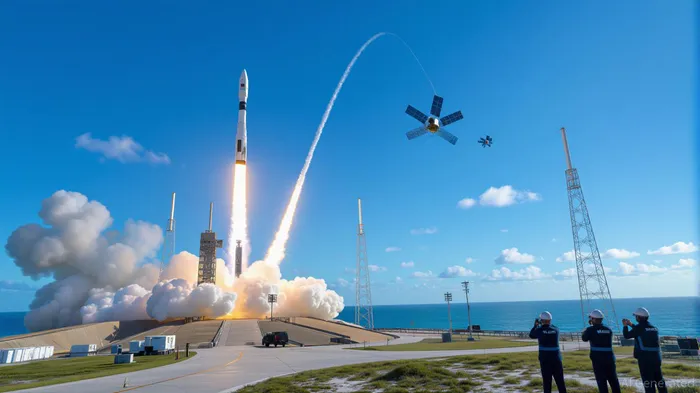
On July 26, 2025, SpaceX executed a mission that marked a pivotal shift in the satellite broadband industry. The launch of 24 Starlink satellites into a polar orbit—designated Starlink 17-2—underscored the company's relentless pursuit of global internet parity. This mission, the first polar deployment since Group 3, leveraged the advanced V2-mini satellite design, a technological leap that outpaces traditional geostationary (GEO) satellite systems in speed, latency, and scalability. For investors, this move signals not just a technical milestone but a strategic inflection pointIPCX-- in the race to democratize internet access and disrupt legacy telecom infrastructure.
The Technical Edge: V2-Mini and the New Era of Satellite Broadband
The V2-mini satellites deployed in July 2025 are a testament to SpaceX's iterative innovation. These satellites feature phased-array antennas, E-band backhaul, and argon Hall-effect thrusters that deliver 2.4x the thrust of earlier models. Crucially, they operate in a Sun-synchronous orbit (SSO) at a 97-degree inclination, ensuring consistent coverage over high-latitude regions. At 550 km altitude, the satellites balance global reach with low latency (as low as 25 ms), a critical advantage over traditional GEO providers like ViasatVSAT-- and Hughes, which suffer from latency exceeding 600 ms.
This technological leap is not merely academic. The V2-mini satellites provide four times the capacity per unit compared to previous generations, enabling SpaceX to deliver 200 Mbps speeds in remote areas. For context, HughesNet, a leading GEO provider, offers 15–25 Mbps with strict data caps. The economic implications are staggering: Starlink's marginal cost per user is estimated at $1,000 per gigabit of bandwidthBAND--, versus $5,000–$10,000 for traditional providers.
Strategic Implications: Polar Orbits as a Trojan Horse for Telecom Disruption
The July 2025 polar launch was more than a technical feat—it was a calculated strike against the assumptions of terrestrial telecom operators. By targeting regions like Alaska, Scandinavia, and Antarctica, SpaceX is addressing a $28 billion market gap where traditional infrastructure is either absent or unprofitable. These areas, home to over 50 million people, have long been underserved by fiber and 5G. Now, Starlink's polar constellation offers a scalable, high-margin solution.
The impact is already visible. In the U.S., Starlink now serves 2.5 million rural users, a segment where traditional providers have historically struggled to justify infrastructure costs. Internationally, tailored pricing models (e.g., $24/month in Zambia, $30/month in Brazil) have accelerated adoption, contributing to a projected 15% of Starlink's revenue by 2030 from polar regions alone. This shift is forcing traditional telecoms to pivot. Viasat, for instance, is investing $2 billion in its Jupiter-3 satellite to increase capacity, but such efforts are hamstrung by the high costs and long lead times of GEO satellite deployment.
The Flywheel Effect: Reusability and Manufacturing Efficiency as Competitive Barriers
SpaceX's dominance in this arena is underpinned by two flywheels: reusable rocketry and automated satellite production. The Falcon 9's 19th flight (B1075) during the July 2025 mission exemplifies the cost advantages of reusability, with launch costs now below $30 million per mission. Meanwhile, Starlink's satellite manufacturing, increasingly automated, has slashed production times from 30 days to under 10. These efficiencies create a self-reinforcing cycle: more satellites reduce per-unit costs, which in turn drive subscriber growth and revenue.
The financial metrics are equally compelling. Starlink's revenue grew 53% in 2025 to $11.8 billion, with a 60% share of the satellite broadband market projected by 2030. By comparison, Amazon's Project Kuiper and OneWeb are still in the early deployment phase, with no revenue to date. For investors, this first-mover advantage is critical. SpaceX's ability to scale its polar constellation while maintaining profitability—its net cash flow reached $2.1 billion in Q2 2025—positions it as a defensible long-term play.
Investment Considerations: Risks and Rewards in the Satellite Gold Rush
While the case for Starlink is strong, investors must weigh several risks. Regulatory hurdles in countries like India and Brazil could delay market entry, and public concerns over space debris remain unresolved. Additionally, the entry of competitors like Project Kuiper and OneWeb, though nascent, could erode margins in the long term. However, SpaceX's 60% share of active LEO satellites and its $500 million investment in debris mitigation provide a significant moat.
For those with a long-term horizon, the rewards outweigh the risks. Starlink's third-generation satellites, set to launch in 2026, will offer over a terabit per second of downlink capacity—10x the current generation. This will further cement SpaceX's dominance in high-growth verticals like maritime, aviation, and government contracts. Moreover, partnerships with T-MobileTMUS-- and VodafoneVOD-- to integrate Starlink with 5G networks are creating hybrid ecosystems that blur the lines between satellite and terrestrial infrastructure.
Conclusion: A New Paradigm in Connectivity
SpaceX's polar orbit Starlink launch is not just a technical achievement—it is a strategic masterstroke that redefines the economics of global connectivity. By targeting underserved markets with superior technology and cost efficiency, SpaceX is forcing traditional telecom operators to either innovate or fade into obsolescence. For investors, the key takeaway is clear: the future of broadband is no longer bound to Earth. As Starlink's constellation grows, so too does its potential to deliver outsized returns. The question is no longer if satellite broadband will disrupt telecom—it's how quickly the market will adapt.

Delivering real-time insights and analysis on emerging financial trends and market movements.
Latest Articles
Stay ahead of the market.
Get curated U.S. market news, insights and key dates delivered to your inbox.




Comments
No comments yet