
SpaceX's Polar Orbit Starlink Expansion: Strategic Implications for Satellite Internet and Defense Markets


 Aime Summary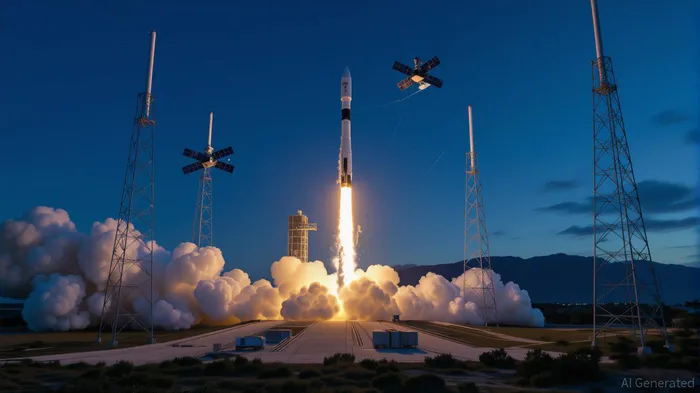
SpaceX's recent polar orbit Starlink launches have redefined the landscape of satellite internet and defense infrastructure. In August 2025 alone, the company deployed 24 Starlink V2 Mini satellites into polar orbits from Vandenberg Space Force Base, marking the fourth such mission in the month. These launches, part of the Starlink 17-2 and 17-7 missions, underscore SpaceX's strategic pivot to address underserved high-latitude markets and bolster military-grade communication networks. With over 8,200 Starlink satellites now in orbit, the constellation's expansion is not just a technical milestone but a financial and geopolitical game-changer.
Operational Advancements: Polar Orbits and V2 Mini Satellites
The polar orbit configuration is critical for global coverage, particularly in regions where traditional geostationary (GEO) satellites falter. By placing satellites at 525–535 km altitude, SpaceX ensures low-latency connectivity (as low as 25ms) for remote and high-latitude areas. The V2 Mini satellites, with their laser inter-satellite links and phased-array antennas, enable a mesh network that outperforms legacy systems by 95%. This technological leap has unlocked a $28 billion market opportunity, targeting rural communities, maritime operators, and research stations in polar regions.
The operational efficiency of SpaceX's Falcon 9 rocket further amplifies this strategy. Reusable boosters have slashed launch costs to $30 million per mission, enabling a deployment rate of 1,200 satellites annually. This scalability has allowed SpaceX to maintain a 60% share of active low Earth orbit (LEO) satellites, outpacing competitors like Amazon's Project Kuiper and OneWeb.
Defense Market Integration: Starshield and Strategic Contracts
SpaceX's military contracts have become a cornerstone of its growth. The U.S. Space Force's $900 million Starshield program, awarded in September 2023, is a prime example. Starshield, a government-controlled variant of Starlink, provides encrypted, anti-jamming communication for the Army, Navy, Air Force, and Coast Guard. By 2025, the program had secured $3 billion in defense-related contracts, including battlefield connectivity for Ukraine and support for the Department of Homeland Security.
The strategic value of polar-orbit satellites in defense applications cannot be overstated. High-latitude regions like Alaska and Scandinavia are critical for monitoring Arctic activities and supporting NATO operations. Starlink's ability to deliver real-time data transfer and command-and-control capabilities in contested environments has made it indispensable for modern warfare. The U.S. Army's shift to a Strategy and Transformation Directorate further highlights the institutionalization of satellite-based intelligence, aligning with SpaceX's long-term vision.
Financial Impact and Investor Outlook
The financial implications of SpaceX's polar orbit expansion are staggering. In 2025, the Starlink division reported $11.8 billion in revenue, a 53% year-over-year increase, with gross margins projected to hit 25% by 2026. Analysts predict breakeven EBITDA by 2026 and 60% market share in satellite internet by 2030. The company's dominance in LEO—60% of active satellites—is reinforced by partnerships with telecom giants like T-MobileTMUS-- and VodafoneVOD--, which integrate Starlink into hybrid terrestrial-satellite networks.
Investors should also consider the defense sector's contribution. With $3 billion in military contracts and a $900 million Starshield deal, SpaceX is diversifying its revenue streams beyond consumer broadband. The direct-to-device (D2D) technology, enabling smartphone connectivity via satellite, further expands its addressable market into the $1.2 trillion telecom industry.
Strategic Risks and Opportunities
While SpaceX's trajectory is robust, challenges remain. Regulatory scrutiny over space debris and spectrum allocation could slow deployment. Additionally, competition from AmazonAMZN-- and OneWeb may intensify as they ramp up their constellations. However, SpaceX's first-mover advantage, reusable rocket technology, and military partnerships provide a moat that is hard to replicate.
For investors, the key is to balance short-term volatility with long-term potential. The satellite internet market is projected to grow at a 13.9% CAGR through 2030, reaching $22.6 billion. SpaceX's polar orbit expansion, coupled with its defense contracts, positions it to capture a significant portion of this growth.
Conclusion: A High-Conviction Play in Space Tech
SpaceX's polar orbit Starlink expansion is a masterclass in strategic execution. By addressing technical, commercial, and defense gaps, the company is not only building a global connectivity network but also securing its role as a critical infrastructure provider for national security. For investors, this represents a high-conviction opportunity in the space tech sector, where innovation and market demand align to create enduring value. As the global space economy approaches $1 trillion by 2030, SpaceX's dual focus on consumer and defense markets makes it a compelling long-term investment.

Delivering real-time insights and analysis on emerging financial trends and market movements.
Latest Articles
Stay ahead of the market.
Get curated U.S. market news, insights and key dates delivered to your inbox.


AInvest
PRO
AInvest
PRO



Comments
No comments yet