
SpaceX's O3b mPOWER Launch: A Catalyst for the Expanding Commercial Space Economy
 Aime Summary
The recent launch of SpaceX's O3b mPOWER 9 and 10 satellites on July 22, 2025, marks a pivotal moment in the commercial space sector. These satellites, part of SES's O3b mPOWER constellation, are designed to deliver high-capacity, low-latency broadband to underserved regions, bridging the global digital divide. This mission, executed with SpaceX's reusable Falcon 9 rocket, underscores the company's dominance in reducing launch costs while accelerating the deployment of next-generation space infrastructure. For investors, it signals a broader trend: the commercial space economy is no longer a speculative frontier but a rapidly maturing market ripe for strategic investment.
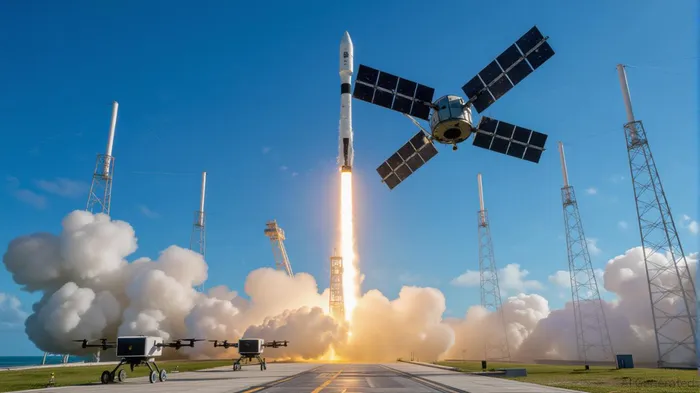
The Rocket That Made Space Affordable
SpaceX's Falcon 9 has revolutionized the economics of spaceflight. The O3b mPOWER mission reused a first-stage booster for its sixth time, demonstrating the viability of cost-effective, rapid-turnaround launches. This capability has slashed the price per kilogram to orbit by over 90% since 2010, enabling a surge in satellite deployments and smallsat rideshares. The Transporter-14 mission, which launched 70 payloads in June 2025, exemplifies this shift. By offering affordable access to orbit, SpaceX has transformed the space industry from a capital-intensive, government-dominated domain into a dynamic ecosystem of startups, research institutions, and commercial enterprises.
A $2 Trillion Horizon: Where to Invest in the Space Economy
The global space economy, valued at $570 billion in 2023, is projected to reach $2 trillion by 2040. This growth is driven by three key pillars:
1. Satellite Services: The satellite industry accounts for 71% of the current market. LEO constellations like Starlink, OneWeb, and SES's O3b mPOWER are expanding broadband access, enabling applications in agriculture, disaster response, and 5G backhaul. Investors should prioritize companies with expertise in satellite manufacturing, phased-array antennas, and low-latency network infrastructure.
2. In-Orbit Manufacturing and Resource Utilization: Companies like RedwireRDW-- and Nanoracks are pioneering 3D printing and microgravity experiments, while lunar mining ventures (e.g., Astrobotic, iSpace) aim to extract water-ice for fuel production. These innovations could reduce reliance on Earth-based supply chains and enable sustainable deep-space missions.
3. Space Infrastructure: The development of orbital fuel depots, robotic servicing systems, and modular habitats is critical for cislunar operations. Players like Maxar Technologies and Northrop GrummanNOC-- are leading in this domain, while startups like MomentusMNTS-- and Orbit Fab are building the “space highway” of tomorrow.
Mitigating Risks and Seizing Opportunities
While the sector's growth is undeniable, investors must navigate challenges such as regulatory bottlenecks, space debris, and geopolitical tensions. However, these risks also create opportunities for companies specializing in debris mitigation (e.g., Astroscale), spectrum management, and international collaboration. For example, the recent Transporter-14 mission showcased the viability of multi-customer payloads, a trend that could democratize access to space for emerging markets.
Strategic Investment Advice
- Allocate to High-Growth Sectors: Prioritize companies involved in satellite constellations, launch services, and in-orbit logistics. SpaceX's continued dominance in launch services, combined with its Starlink expansion, makes it a cornerstone holding.
- Diversify into Emerging Niches: Consider early-stage opportunities in lunar resource extraction, space-based solar power, and quantum communication satellites. These sectors are still in their infancy but could deliver outsized returns as infrastructure scales.
- Monitor Government Contracts: SpaceX's $160 million NRO deal (NROL-69) highlights the importance of defense and intelligence contracts. Companies with dual-use technologies (civilian and military applications) are well-positioned for long-term stability.
Conclusion
SpaceX's recent launches are more than technical milestones—they are proof of concept for a commercial space economy that is no longer speculative. As the industry transitions from “getting to space” to “operating in space,” investors who align with the right technologies and partnerships will reap the rewards of this new frontier. The time to act is now: the stars are no longer out of reach, and the market is ready to follow.

Delivering real-time insights and analysis on emerging financial trends and market movements.
Latest Articles
Stay ahead of the market.
Get curated U.S. market news, insights and key dates delivered to your inbox.
AInvest
PRO
AInvest
PRO



Comments
No comments yet