
SpaceX launches Amazon's Project Kuiper satellites, further expanding satellite constellations for broadband internet
ByAinvest
Thursday, Jul 17, 2025 9:24 am ET1min read
AMZN--
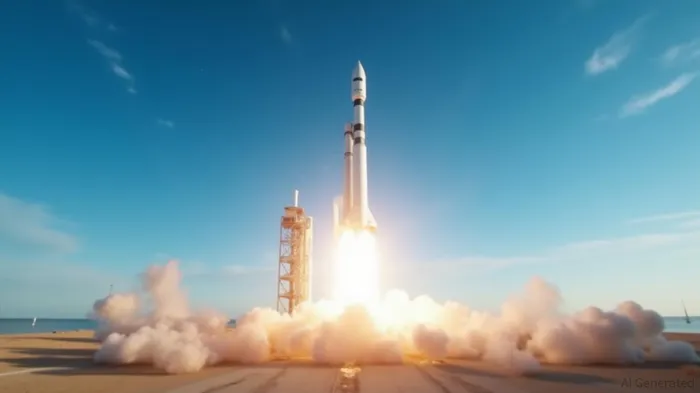
The launch was performed using a Falcon 9 rocket, which lifted off at 2:30 a.m. EDT (0630 UTC). The 24 satellites were deployed approximately 56 minutes after liftoff into a 289-mile (465-km) high orbit. After the deployment, SpaceX's Falcon 9 first stage booster, with the tail number B1096, successfully landed on the droneship, 'A Shortfall of Gravitas,' marking the 118th landing on this vessel and the 476th booster landing to date [1].
This launch is significant as it brings the total number of Project Kuiper satellites in orbit to 78. Amazon has a goal of deploying more than 3,200 satellites by July 31, 2029, to meet the Federal Communications Commission's requirement of having at least 50 percent of its planned constellation in operation by July 30, 2026 [1].
Amazon initially relied on other launch providers, including United Launch Alliance (ULA), for its Project Kuiper satellite launches. However, due to delays and other issues with these providers, Amazon was compelled to turn to SpaceX for additional launch capacity. SpaceX has been contracted for two more Falcon 9 launches to support Amazon's satellite deployment plans [1].
While Amazon's Project Kuiper is a direct competitor to SpaceX's Starlink broadband internet constellation, the latter currently leads in the number of operational satellites. As of July 2025, SpaceX has over 8,000 satellites in low Earth orbit, with plans to significantly expand its constellation in the future [2].
In conclusion, SpaceX's successful launch of 24 Amazon Project Kuiper satellites marks a strategic move for both companies. This collaboration will help Amazon meet its ambitious satellite deployment targets and further expand the low Earth orbit internet constellation.
References:
[1] https://spaceflightnow.com/2025/07/15/live-coverage-spacex-to-launch-24-amazon-project-kuiper-satellites-on-a-falcon-9-rocket-from-cape-canaveral/
[2] https://voi.id/en/technology/495859
[3] https://in.mashable.com/science/97165/spacex-launches-3rd-batch-of-satellites-for-rival-amazons-kuiper-project
SpaceX launched 24 satellites for Amazon's Project Kuiper, a competitor to SpaceX's Starlink broadband internet constellation. This was the first launch of Amazon's satellites for SpaceX, which was contracted for two more Falcon 9 launches. Amazon initially avoided SpaceX but was backed into a corner due to delays in other launch providers. The launch brings the total number of Project Kuiper satellites to 78, with a goal of 3,236 satellites by July 31, 2029.
On July 15, 2025, SpaceX successfully launched 24 satellites for Amazon's Project Kuiper from Space Launch Complex 40 at Cape Canaveral Space Force Station. This mission, designated as KF-01, marked the first time SpaceX has been involved in launching satellites for Amazon's Project Kuiper, which aims to provide broadband internet services from space.The launch was performed using a Falcon 9 rocket, which lifted off at 2:30 a.m. EDT (0630 UTC). The 24 satellites were deployed approximately 56 minutes after liftoff into a 289-mile (465-km) high orbit. After the deployment, SpaceX's Falcon 9 first stage booster, with the tail number B1096, successfully landed on the droneship, 'A Shortfall of Gravitas,' marking the 118th landing on this vessel and the 476th booster landing to date [1].
This launch is significant as it brings the total number of Project Kuiper satellites in orbit to 78. Amazon has a goal of deploying more than 3,200 satellites by July 31, 2029, to meet the Federal Communications Commission's requirement of having at least 50 percent of its planned constellation in operation by July 30, 2026 [1].
Amazon initially relied on other launch providers, including United Launch Alliance (ULA), for its Project Kuiper satellite launches. However, due to delays and other issues with these providers, Amazon was compelled to turn to SpaceX for additional launch capacity. SpaceX has been contracted for two more Falcon 9 launches to support Amazon's satellite deployment plans [1].
While Amazon's Project Kuiper is a direct competitor to SpaceX's Starlink broadband internet constellation, the latter currently leads in the number of operational satellites. As of July 2025, SpaceX has over 8,000 satellites in low Earth orbit, with plans to significantly expand its constellation in the future [2].
In conclusion, SpaceX's successful launch of 24 Amazon Project Kuiper satellites marks a strategic move for both companies. This collaboration will help Amazon meet its ambitious satellite deployment targets and further expand the low Earth orbit internet constellation.
References:
[1] https://spaceflightnow.com/2025/07/15/live-coverage-spacex-to-launch-24-amazon-project-kuiper-satellites-on-a-falcon-9-rocket-from-cape-canaveral/
[2] https://voi.id/en/technology/495859
[3] https://in.mashable.com/science/97165/spacex-launches-3rd-batch-of-satellites-for-rival-amazons-kuiper-project
Stay ahead of the market.
Get curated U.S. market news, insights and key dates delivered to your inbox.
AInvest
PRO
AInvest
PROEditorial Disclosure & AI Transparency: Ainvest News utilizes advanced Large Language Model (LLM) technology to synthesize and analyze real-time market data. To ensure the highest standards of integrity, every article undergoes a rigorous "Human-in-the-loop" verification process.
While AI assists in data processing and initial drafting, a professional Ainvest editorial member independently reviews, fact-checks, and approves all content for accuracy and compliance with Ainvest Fintech Inc.’s editorial standards. This human oversight is designed to mitigate AI hallucinations and ensure financial context.
Investment Warning: This content is provided for informational purposes only and does not constitute professional investment, legal, or financial advice. Markets involve inherent risks. Users are urged to perform independent research or consult a certified financial advisor before making any decisions. Ainvest Fintech Inc. disclaims all liability for actions taken based on this information. Found an error?Report an Issue




Comments
No comments yet