SpaceX Launch Surges Amid Historic Tripleheader, Pushing 109th Florida Space Coast Mission for Commercial Satellite Demand

Generated by AI AgentWord on the StreetReviewed byTianhao Xu
Sunday, Dec 14, 2025 3:08 am ET2min read
Aime RobotAime Summary

- Florida's Space Coast hosts historic tripleheader of SpaceX and ULA launches (Dec 14-15), deploying Starlink and

satellites.

- Rapid 6h28m-14h28m launch intervals highlight commercial spaceflight acceleration driven by low-Earth orbit satellite constellation demand.

- SpaceX aims for 550th booster landing during Starlink mission, adding 27 V2 Mini satellites to its expanding broadband network.

- Region's 109th launch of 2024 breaks records, demonstrating commercial space operations' normalization and infrastructure capabilities.

- Industry experts note growing competition in satellite deployment, with private companies redefining launch cadence and operational complexity.

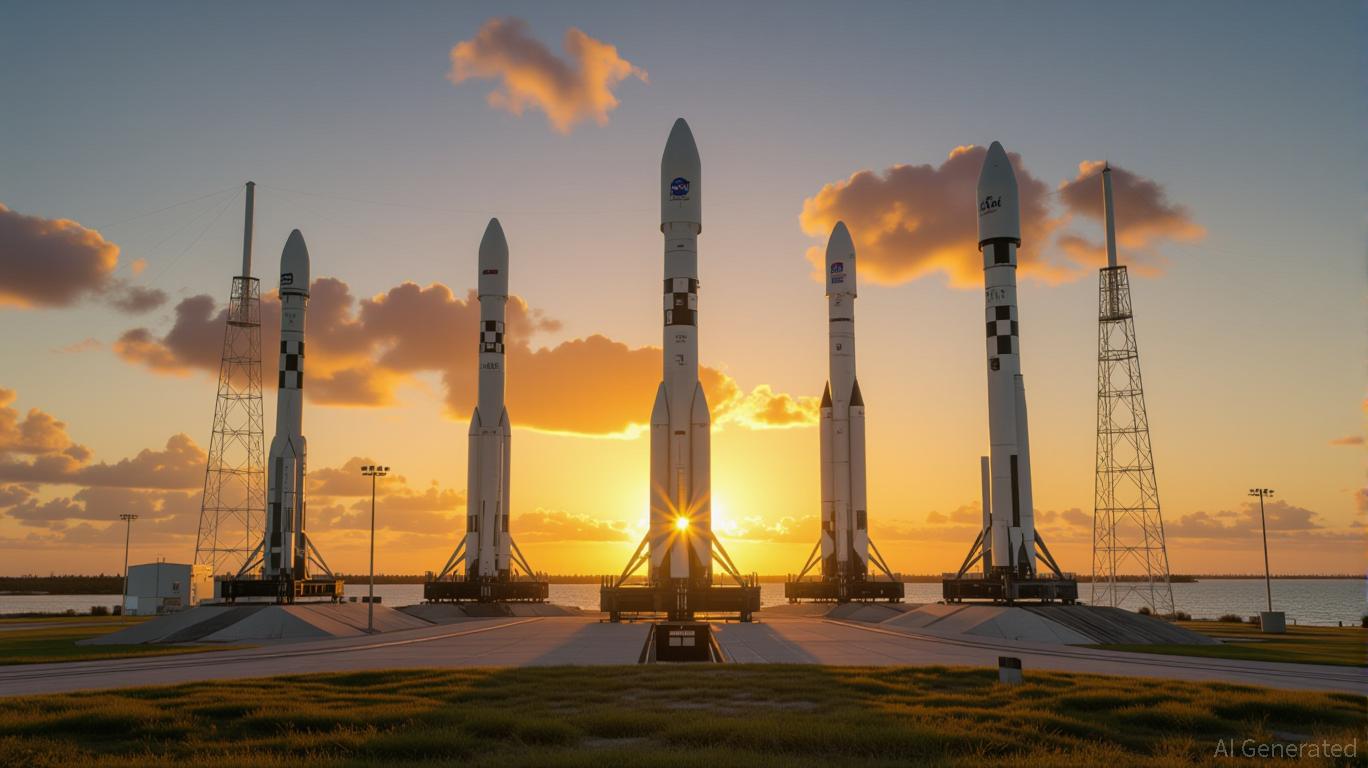
A historic tripleheader of space launches is set to unfold along Florida's Space Coast, , Dec. 14, to early Monday, Dec. . The missions will carry Starlink and Amazon Leo internet satellites into orbit, marking the 107th, 108th, . This rapid-fire sequence of liftoffs underscores the accelerating pace of commercial spaceflight, driven by demand for large satellite constellations in low-Earth orbit [according to reports](https://floridatoday.com/space). ## Mission Overview and Scheduling The first launch will see a SpaceX Falcon 9 rocket carrying Starlink satellites liftoff between 9:43 p.m. . Monday from Launch Complex 40 at Cape Canaveral Space Force Station.
This mission will be followed by a ULA Atlas V rocket, equipped with five solid rocket boosters, . . Monday from Launch Complex 41. A second SpaceX Falcon 9 mission, also carrying Starlink satellites, . to 12:11 p.m. Monday from NASA's Kennedy Space Center. The shortest interval between launch windows is six hours and 28 minutes, while the longest spans 14 hours and 28 minutes [according to the schedule](https://floridatoday.com/space). ## Technical Challenges and Operational Coordination The condensed timeline presents logistical and technical challenges for both companies and the Space Coast infrastructure. SpaceX, which has been a dominant force in reusable rocketry, will attempt its 550th successful booster landing during a separate Starlink mission on Saturday night. The Falcon 9 booster, , will target a landing on the drone ship *Of Course I Still Love You* approximately 8.5 minutes after liftoff. This mission, part of the Starlink 15-12 payload, will add 27 Starlink V2 Mini satellites to SpaceX's constellation [according to spaceflight data](https://www.spaceflightnow.com). ## Industry Implications and Future Trends The surge in launch activity reflects broader industry trends, including the proliferation of commercial satellite networks and the need for rapid deployment to maintain competitive advantages. SpaceX , , highlighted the role of demand in driving this growth, noting the "proliferation of large constellations in low-Earth orbit for commercial communications" as a key factor. The Space Coast's record-breaking 109 launches this year—surpassing the previous record of 93—demonstrate the region's central role in global space operations [according to local reports](https://floridatoday.com/space). ## Public and Media Engagement Live coverage of the tripleheader will be provided by Florida Today's Space Team, with updates starting 90 minutes before each launch window. The high-frequency launch schedule also aligns with SpaceX's broader plans, including a Starlink mission scheduled for Dec. . These events highlight the increasing normalization of commercial spaceflight, where rapid turnaround and multi-vehicle operations are becoming routine [according to industry analysis](https://floridatoday.com/space). The tripleheader underscores the evolving dynamics of the space industry, where private companies are redefining launch cadence and mission complexity. As SpaceX and ULA continue to push the boundaries of operational efficiency, the implications for global satellite infrastructure and broadband access are profound.

Comments


Add a public comment...
No comments

No comments yet