
SpaceX's Growing Dominance in the Commercial Space Sector: Strategic Investment Opportunities in Aerospace and Satellite Infrastructure


 Aime Summary
The commercial space sector is undergoing a seismic shift, driven by technological breakthroughs and the rapid expansion of satellite infrastructure. At the forefront of this transformation is SpaceX, whose recent achievements underscore its unparalleled position in the industry. From the 500th mission milestone using a reusable rocket to the explosive growth of its Starlink broadband service, SpaceX is not only reshaping space logistics but also unlocking new investment opportunities in aerospace and satellite infrastructure.
A Milestone in Reusability and Environmental Monitoring
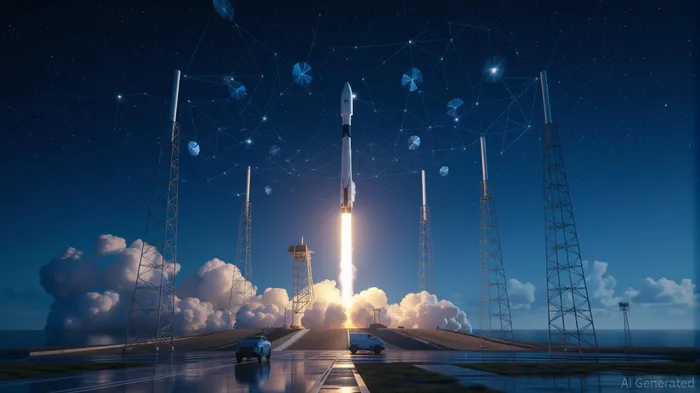
SpaceX's recent launch of the Sentinel-6B satellite aboard a Falcon 9 rocket marked its
500th mission using a reusable rocket, a testament to the company's mastery of cost-effective spaceflight. This mission, part of a joint NASA-European project,
deployed a satellite designed to monitor global sea level changes with an accuracy of one inch, leveraging cloud-penetrating radar technology. Sentinel-6B builds on the legacy of Sentinel-6A (launched in 2020) and contributes to decades of climate data critical for understanding oceanic and atmospheric trends. The Falcon 9's reusability-demonstrated by the third flight of the first-stage booster-has
slashed launch costs and accelerated mission frequency, reinforcing SpaceX's role as a linchpin in environmental research and global climate monitoring.
Market Reactions and the Rise of Space Logistics
 The market has responded enthusiastically to SpaceX's milestones.
According to market analysis, , a figure that underscores its dominance in the global space industry. This growth is further amplified by SpaceX's expanding international partnerships, such as
its role in launching a homegrown satellite for Taiwan, which highlights its ability to create economic opportunities in emerging aerospace markets.
The broader space logistics market is poised for exponential growth. According to a report by Global Market Insights,
, . This surge is fueled by the proliferation of satellite constellations, advancements in reusable launch technologies, and the rise of commercial ventures like space tourism and mining. Innovations such as autonomous robotics and debris removal systems are also emerging as key drivers, with
companies like Sierra Space securing contracts to develop orbital infrastructure under programs like (REGAL).
Starlink's Aviation Breakthrough and Revenue Potential
SpaceX's Starlink service is a cornerstone of its long-term value creation strategy.
The recent announcement that Emirates plans to adopt Starlink for onboard Wi-Fi across its fleet-a potential game-changer for the aviation sector-highlights the service's growing appeal. While regulatory hurdles remain, similar partnerships with Qatar Airways and Saudia indicate a broader industry shift toward high-speed satellite internet. These developments position Starlink to capture a significant share of the aviation connectivity market, which is expected to grow alongside the expansion of global air travel.
Financially, Starlink is already a powerhouse.
By September 2025, . In 2024, , .
, Starlink's expansion into direct-to-cell connectivity and partnerships with telecom giants like T-Mobile further solidify its dominance in the satellite broadband market.
Strategic Investment Opportunities
For investors, the confluence of SpaceX's technological leadership and the explosive growth of the space logistics and satellite broadband markets presents compelling opportunities. Key areas to consider include:
1. Reusable Launch Systems: SpaceX's reusability technology has set a new standard, reducing costs and enabling more frequent missions. Companies developing complementary technologies or infrastructure (e.g., launch pads, tracking systems) could benefit from this trend.
2. Satellite Broadband Infrastructure: The demand for high-speed, low-latency connectivity-driven by Starlink's aviation and maritime partnerships-will require significant investment in ground stations, user terminals, and network optimization.
3. Orbital Debris Management and Sustainability: As satellite constellations expand, the need for debris removal and sustainable practices will grow, creating opportunities for firms specializing in orbital logistics and environmental solutions.
Conclusion
SpaceX's 500th mission and the meteoric rise of Starlink are not isolated achievements but symptoms of a larger paradigm shift in the commercial space sector. By leveraging reusability, environmental monitoring, and satellite broadband, SpaceX is not only reducing the cost of access to space but also building a foundation for long-term value creation. For investors, the path forward lies in aligning with companies that can capitalize on the accelerating convergence of aerospace innovation and global connectivity. As the space logistics market surges toward $7.5 billion by 2034, the time to act is now.

Stay ahead of the market.
Get curated U.S. market news, insights and key dates delivered to your inbox.


AInvest
PRO
AInvest
PRO



Comments
No comments yet