
SpaceX's Falcon 9 Launch and the Future of Satellite Internet


 Aime Summary
A Market on the Cusp of Disruption
The satellite internet infrastructure market is projected to grow at a compound annual growth rate (CAGR) of 18.1% from 2025 to 2030, expanding from an estimated $14.56 billion in 2025 to $33.44 billion by 2030 according to research. This acceleration is driven by the deployment of low Earth orbit (LEO) constellations, which reduce latency and enable high-speed broadband for remote and underserved regions. According to a report by Grand View Research, the high-speed segment (>100 Mbps) will dominate growth, fueled by demand for video streaming, cloud services, and IoT applications.
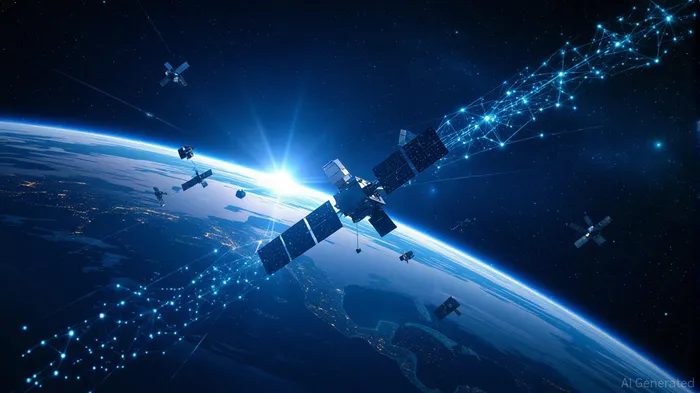 SpaceX's Starlink is at the forefront, leveraging reusable Falcon 9 rockets to slash launch costs. The recent mission at Vandenberg Space Force Base, which reused a booster for its 20th flight, exemplifies the operational efficiency now achievable in satellite deployment according to UPI. Competitors like Amazon's Project Kuiper, ViasatVSAT--, and Eutelsat are also ramping up, but SpaceX's first-mover advantage and aggressive expansion - such as its partnerships in India and the UK - position it as a market leader.
Strategic Partnerships and Regulatory Tailwinds
Government and private investments are further accelerating adoption. The U.S. Federal Communications Commission (FCC) has allocated $18 billion to support rural broadband, while India's Jio Platforms and Bharti Airtel are collaborating with SpaceX to bridge connectivity gaps according to Grand View Research. In the UK, the Space Agency is funding next-generation satellite terminals, enhancing the viability of satellite internet in remote areas according to the same report. These initiatives mitigate the high upfront costs of ground infrastructure, a critical barrier to mass adoption.
However, the market is not without risks. Launch and maintenance costs remain substantial, and LEO satellites have a lifespan of only 5–7 years, necessitating frequent replacements. Bandwidth limitations also persist: even with Starlink, OneWeb, and Kuiper combined, global satellite capacity is projected to reach just 584 Tbps by 2022-less than 10% of terrestrial demand. Regulatory uncertainties, including space debris concerns, add another layer of complexity.
Investment Opportunities: Stocks, ETFs, and Private Equity
For investors, the satellite internet boom offers multiple avenues. Publicly traded companies like ViaSat (NASDAQ: VSAT) are attracting attention. Raymond James recently upgraded ViaSat to "Outperform," citing its SOTP valuation and upcoming Viasat-3 satellite launches. Meanwhile, SpaceX's parent company, Elon Musk's ventures, remain indirect beneficiaries through broader tech and infrastructure ETFs.
Direct exposure is available via ETFs focused on digital infrastructure. The Global X Data Center and Digital Infrastructure ETF (DTCR) and the Pacer Data and Digital Revolution ETF (TRFK) have delivered strong returns in 2025, reflecting investor appetite for connectivity-related assets according to ETFdb. For private equity, KKR's Asia fund-targeting $15 billion-has shown resilience in sectors like infrastructure, though it does not explicitly focus on satellite internet according to Business Standard.
The Road Ahead
The satellite internet market is a high-stakes arena where technological innovation and regulatory agility will determine winners. While SpaceX's Falcon 9 and Starlink lead the charge, investors must balance optimism with caution. The sector's growth hinges on overcoming technical hurdles, reducing ground equipment costs, and navigating a crowded competitive landscape.
For those willing to take calculated risks, the rewards are substantial. As Alphabet's investments suggest, tech giants are already positioning for a future where satellite internet is indispensable. For individual investors, the key is to diversify across stocks, ETFs, and private equity while staying attuned to the sector's evolving risks.
In the end, the Falcon 9's latest launch is more than a technical milestone-it is a harbinger of a new era in global connectivity. The question for investors is whether they will ride the wave or be left behind.

Delivering real-time insights and analysis on emerging financial trends and market movements.
Latest Articles
Stay ahead of the market.
Get curated U.S. market news, insights and key dates delivered to your inbox.




Comments
No comments yet