
SpaceX Eyes $1.5 Trillion June Valuation: Musk's Ambition is More Than Just An IPO
 Aime Summary
On January 30, 2026, reports from Bloomberg and Reuters ignited a firestorm in the capital markets, revealing that SpaceX is weighing a massive strategic pivot ahead of a targeted June initial public offering. The aerospace giant is reportedly considering a merger with either Tesla Inc.TSLA-- or the artificial intelligence startup xAIXAI--, aiming for a valuation of approximately $1.5 trillion. Following the news, TeslaTSLA-- shares, which had closed down 3.5% at $1.56 trillion market cap, rebounded sharply, jumping 4.5% in after-hours trading. While the market initially reacted to the Tesla headline, deeper analysis suggests a tie-up with xAI is the more logical path. The synergy between heavy-lift launch capabilities and AI infrastructureAIIA-- presents a cleaner narrative for investors than the complex regulatory web of a Tesla merger. This report analyzes why an xAI consolidation is the likely precursor to the summer listing.
The Road to June: IPO Targets and Corporate Restructuring
The timeline for what could be the largest IPO in history is rapidly crystallizing. According to sources familiar with the matter cited by Bloomberg, SpaceX is eyeing a June listing window—strategically timed around Elon Musk’s birthday—and could seek to raise up to $50 billion. This capital injection is intended to fuel the "insane flight rate" of the Starship program and the development of lunar base infrastructure.
However, this is not a standard public offering. The structural maneuvers occurring in the background suggest a consolidation of the "Muskonomy" is underway. Public records from Nevada’s business portal indicate that on January 21, 2026, two legal entities containing the phrase "merger sub" were established, listing SpaceX CFO Bret Johnsen as an officer. In corporate finance, merger subsidiaries are standard vehicles used to facilitate the acquisition of one company by another, allowing the parent company to shield itself from the target's liabilities while effecting a stock swap.
According to Ainvest analysis, the corporate structure below illustrates the potential consolidation paths. While Tesla sits as a separate publicly traded entity, xAI operates within the private sphere, making it a more fluid target for integration into a pre-IPO SpaceX.
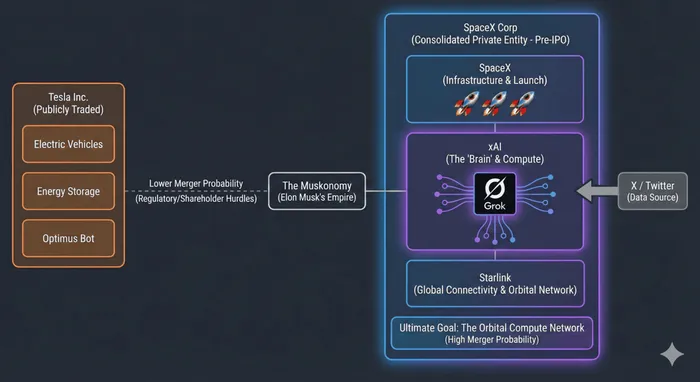
Wall Street heavyweights are already lining up for the event. Bank of America, Goldman Sachs, JPMorgan Chase, and Morgan Stanley are expected to hold senior roles in the underwriting syndicate. Furthermore, platforms like Robinhood are reportedly vying for a key role in retail distribution, capitalizing on the immense retail investor interest in Musk-led ventures. The establishment of the Nevada entities strongly implies that the decision to merge is not merely theoretical but operational.
Resource Integration: The Case for xAI and Orbital Compute
While the firm has discussed the feasibility of a tie-up between SpaceX and Tesla—an idea pushed by some investors—the regulatory complexity of merging two trillion-dollar public/semi-public entities is immense. Conversely, exploring a tie-up between SpaceX and xAI ahead of an IPO offers a compelling industrial logic that regulators may find less contentious.
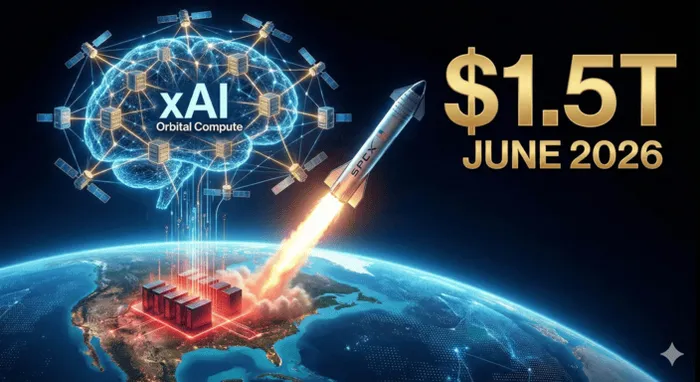
The core argument for this merger lies in the ultimate resource integration. Reports indicate that different parts of Musk’s grand vision involve putting data centers into space to handle complex computing for AI. A merger with xAI would allow the combined entity to internalize the demand for this infrastructure.
By moving data centers to orbit, the combined company can bypass the terrestrial constraints that currently plague the AI industry: land availability, power grid stability, and environmental impact. In space, the primary resource—solar energy—is unlimited and available 24/7, providing the massive power required for training large language models without taxing Earth's electrical grids. Furthermore, the unique environment of space offers distinct advantages for thermal management. With the infinite heat sink of the cosmos and the absence of atmospheric convection, specialized radiative cooling arrays—launched economically via Starship—can manage the thermal load of high-performance GPUs efficiently. This turns the vacuum of space from a challenge into a strategic asset, ensuring that heat dissipation is no longer a bottleneck for scaling compute power.
xAI would benefit enormously from this computing capacity provided by SpaceX’s orbital assets. This symbiosis creates a closed-loop ecosystem: SpaceX provides the launch and power (via Starship and solar), while xAI provides the demand and the software value layer.
Valuation Dynamics: Breaking the Trillion-Dollar Ceiling
The valuation targets being floated are aggressive, yet they reflect the scarcity premium of SpaceX equity. The company is targeting a $1.5 trillion valuation, a figure that places it in the rarefied air of tech giants like Nvidia, Apple, and Microsoft.
If SpaceX were to IPO alone, a $1.5 trillion valuation implies a massive multiple on future cash flows from Starlink and launch services. However, by absorbing xAI (currently valued around $50 billion in private markets), the combined entity acts as a multiplier. Investors would not just be buying a space company; they would be buying the infrastructure backbone of the AI economy.
According to Aime predict, the valuation chart below compares the standalone estimates against the potential combined entity and its tech peers.
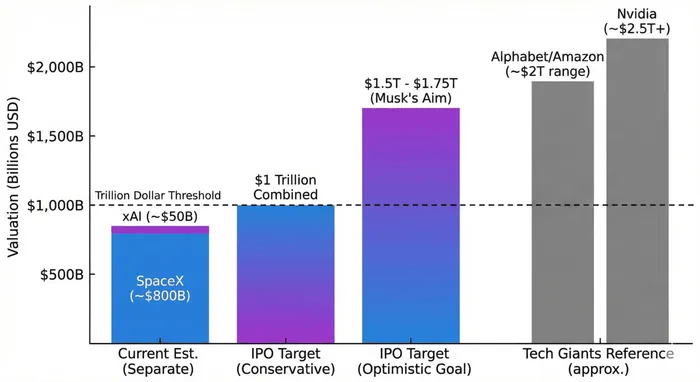
The "Optimistic Goal" of $1.75 trillion becomes plausible only if the company can demonstrate that it is not just a carrier (SpaceX) but also a value-added service provider (xAI). Citigroup and Morgan Stanley analysts have previously noted that for SpaceX to reach multi-trillion dollar status, Starlink must transition from simple connectivity to complex edge computing. Merging with xAI provides the software stack and the logic for that transition.
Furthermore, Reuters reports that some xAI executives may have the option to cash out, but the primary mechanism will be a stock-for-stock exchange. This locks in talent and aligns incentives across the Musk ecosystem. For the IPO, this "AI halo" is essential. Pure hardware plays often trade at lower multiples than software or AI platforms. A combined SpaceX-xAI entity commands a software multiple on hardware assets.
Conclusion
As we approach the June 2026 window, the market should prepare for a reshaping of the technology landscape. While the knee-jerk reaction in Tesla’s stock price reflects the market's hunger for exposure to SpaceX, the regulatory and structural realities point toward an xAI merger. The formation of merger subsidiaries in Nevada is the clearest signal yet that the wheels are in motion.
For investors, the implications are twofold. First, a SpaceX-xAI IPO would likely drain liquidity from other speculative tech assets as institutional capital reallocates to this new mega-cap. Second, the "Orbital Compute" narrative will likely become a dominant theme in the second half of 2026, challenging traditional cloud providers who are bound by terrestrial energy constraints. Elon Musk appears ready to bet that the future of AI lies not in data centers on the ground, but in the server farms orbiting above it.

Tianhao Xu is currently a financial content editor, focusing on fintech and market analysis. Previously, he worked as a full-time forex trader for several years, specializing in global currency trading and risk management. He holds a master’s degree in Financial Analysis.
Latest Articles
Stay ahead of the market.
Get curated U.S. market news, insights and key dates delivered to your inbox.
AInvest
PRO
AInvest
PRO



Comments
No comments yet