
SpaceX's Dragon Capsule: Pioneering Scalable Commercial Space Infrastructure
A SpaceX Dragon capsule docked at the International Space Station (ISS), flanked by solar arrays and Earth's horizon in the background, epitomizes the transformative shift in space exploration now driven by commercial innovation. (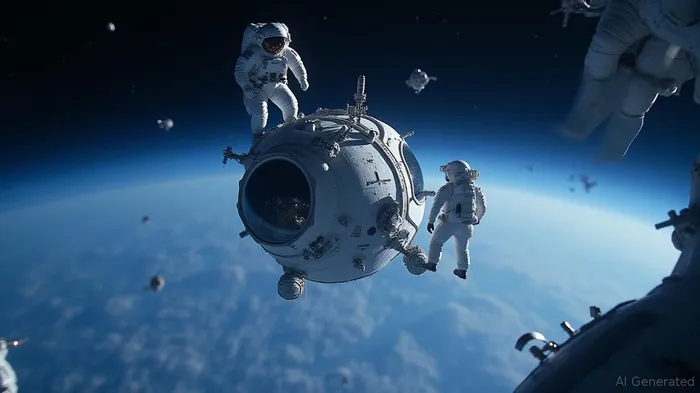 ). Over the past five years, the Dragon has become the workhorseWKHS-- of low-Earth orbit, enabling a paradigm shift from government-led space programs to a dynamic marketplace for human and cargo transportation. For investors, this represents a rare opportunity to capitalize on the maturation of space infrastructure—a sector poised to grow as costs decline and demand for orbital services rises.
The Dragon's Mission Success: A Foundation for Commercialization
The Dragon's recent track record underscores its reliability as a cornerstone of modern space operations. Its upcoming Ax-4 mission on June 10, 2025, will carry astronauts from India, Poland, and Hungary—countries making their first government-sponsored crewed spaceflights in decades. This mission, led by Axiom Space, highlights the Dragon's role in democratizing access to space. The spacecraft's ability to autonomously dock with the ISS and return cargo to Earth has also enabled over 60 experiments on Ax-4 alone, from diabetes management studies to cancer research, underscoring its value as a scientific platform.
For investors, these missions signal a market expansion: Axiom Space plans to build its own commercial space station by 2027, and the Dragon's versatility positions it as the likely transportation partner. Meanwhile, SpaceX's Crew-6 mission (March 2023) and Ax-2 (May 2023) demonstrated the Dragon's capacity to carry seven astronauts, including the first Saudi Arabian crew members, establishing it as NASA's primary crew vehicle. With Boeing's Starliner grounded due to technical failures, the Dragon's dominance in crewed missions is unchallenged, securing a steady revenue stream from NASA contracts.
Cost Efficiency: The Reusable Rocket Revolution
The Dragon's true innovation lies in its integration with SpaceX's Falcon 9 rocket, which has achieved a 99.2% success rate over 376 launches since 2010. The Falcon's reusable first-stage boosters—landed 341 times out of 352 attempts—have slashed launch costs by over 80% compared to traditional rockets. This efficiency is critical to SpaceX's business model: a Dragon cargo mission costs $160 million, less than half the price of a Russian Soyuz flight. ().
The cost advantage extends to satellite deployment. While the Dragon primarily focuses on crew and ISS resupply, its Falcon 9 rocket has launched over 7,800 Starlink satellites since 2019, demonstrating scalability. By reducing the marginal cost of each launch, SpaceX has created a virtuous cycle: cheaper launches enable more frequent missions, which in turn drive demand for services like satellite internet, space tourism, and scientific research.
Strategic Partnerships and Future Contracts
SpaceX's partnerships with NASA and commercial entities like Axiom Space underscore its ecosystem-driven strategy. NASA's $2.8 billion contract for SpaceX to deorbit the ISS by 2031 ensures Dragon's role in the next decade. Meanwhile, Axiom's plan to construct a commercial space station will rely on Dragon for crew transport and cargo deliveries.
The Dragon's versatility also extends to lunar missions. Under NASA's Artemis program, SpaceX's Starship is expected to land astronauts on the moon by 2026, but the Dragon remains critical for transporting payloads and personnel to lunar orbit. This dual role in near-Earth and deep-space missions solidifies SpaceX's position as a one-stop provider for governments and corporations seeking orbital access.
Political Risks and Mitigation
Elon Musk's 2023 threat to decommission the Dragon due to political tensions with former President Trump briefly rattled investors. However, Musk later retracted the threat, acknowledging the Dragon's irreplaceable role in ISS operations. While geopolitical risks persist—especially regarding reliance on Russia's Soyuz—the Dragon's operational record and lack of viable alternatives make its decommissioning unlikely.
Investment Implications: A Scalable Asset in a Nascent Market
For investors, the Dragon's success points to three opportunities:
Space Infrastructure as a Service: The Dragon's low marginal costs and high reusability (e.g., a single Dragon capsule flying up to 10 times) make it ideal for recurring revenue streams. Investors should look for companies like Axiom Space, which will depend on SpaceX's technology to build its station, or firms offering complementary services like satellite manufacturing.
Space Tourism and Data: Axiom's Ax-4 mission includes paying passengers, hinting at a growing market for orbital tourism. Meanwhile, the Dragon's cargo capacity enables data collection for Earth observation and biotech research—areas where SpaceX could partner with firms like Planet Labs or biopharmaceutical companies.
Future IPOs and Equity Plays: While SpaceX remains private, its success could spur acquisitions or spin-offs. For example, a potential IPO of Starlink—a $100 billion revenue opportunity by 2030—could provide liquidity for investors while reinforcing SpaceX's ecosystem.
Conclusion: The Dragon's Legacy in Orbit
The Dragon's journey from a crewed spacecraft to a linchpin of commercial space infrastructure mirrors the broader industry's evolution. Its reliability, cost efficiency, and strategic partnerships have created a scalable platform for everything from satellite launches to lunar exploration. For investors, this is more than a bet on SpaceX—it's an investment in the foundational technologies that will unlock the next trillion-dollar markets in space. As the Ax-4 mission lifts off, it's clear that the Dragon is no longer just a capsule; it's the engine of a new economy.

Stay ahead of the market.
Get curated U.S. market news, insights and key dates delivered to your inbox.






Comments
No comments yet