
SpaceX's Accelerating Launch Cadence and Its Implications for the Satellite Economy


 Aime Summary
SpaceX's Launch Cadence: A Catalyst for Growth
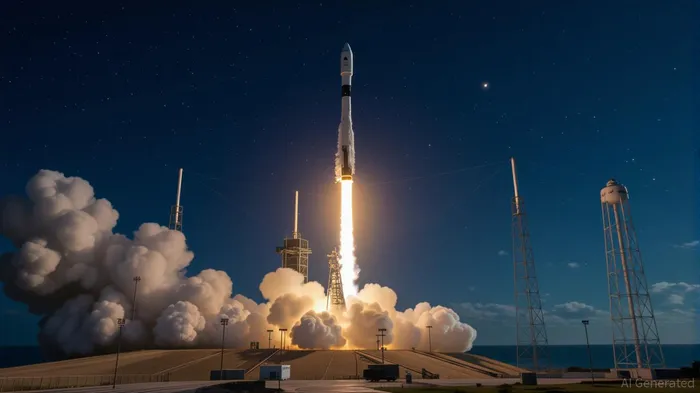
SpaceX's Falcon 9 has become the workhorse of the modern satellite economy, with its Block 5 variant achieving a 99.79% mission success rate. The rocket's reusability and cost efficiency have slashed the price of accessing orbit, enabling the deployment of thousands of satellites for Starlink, government contracts, and commercial clients. By November 2025, the U.S. alone had supported 94 launches in the year, with SpaceX accounting for a significant portion. This frequency is not merely a technical achievement but a strategic lever: by reducing the cost per launch, SpaceX lowers barriers for satellite operators, accelerating the proliferation of LEO-based services.
The economic impact is already evident. The global launch market surpassed previous annual records in 2025, with over 260 orbital attempts year-to-date. SpaceX's 81 launches in the first half of 2025 alone represented over 54% of the 149 global launches. This dominance has positioned the company to capture a disproportionate share of the satellite economy, particularly in communications and navigation, sectors projected to grow from $19.32 billion in 2024 to $80.22 billion by 2034.
Starlink's Market Dominance and Diversification
At the heart of SpaceX's strategy is Starlink, its satellite broadband network. By Q2 2025, Starlink had secured a 72% market share in U.S. residential satellite broadband, connecting over 2.4 million households. The service's expansion into direct-to-cell (D2C) connectivity-enabled by $17 billion in spectrum acquisitions and 600+ satellites dedicated to mobile networks-has further diversified its revenue streams. Partnerships with carriers like T-Mobile, Rogers, and KDDI are now delivering voice and data services to remote and underserved regions, a market segment expected to grow exponentially.
Starlink's success is not just a product of technical innovation but of strategic pricing and scalability. With average speeds of 100–200 Mbps, the service competes directly with terrestrial providers in rural areas, where traditional infrastructure is lacking. For investors, this represents a dual opportunity: recurring revenue from residential and business users, and a platform for expanding into enterprise, maritime, and aviation markets. Analysts project that Starlink's D2C capabilities alone could generate $10 billion in annual revenue by 2030.
The Broader LEO Ecosystem and Market Projections
SpaceX's activities are part of a larger trend: the commercialization of LEO. By 2025, LEO satellite constellations accounted for the majority of global launch activity, with competitors like Amazon's Project Kuiper and China's Thousands Sails Constellation vying for market share. However, SpaceX's head start-its 5000+ Starlink satellites in orbit as of late 2025-gives it a critical advantage.
Market forecasts highlight the sector's explosive potential. The LEO satellite market, valued at $7.71 billion in 2024, is projected to grow to $7.93 billion in 2025 and $11.53 billion by 2032, with a compound annual growth rate (CAGR) of 5.5%. More aggressive estimates suggest a 14% CAGR through 2033, driven by demand for hybrid connectivity solutions that integrate LEO with geostationary (GEO) and medium-Earth orbit (MEO) satellites. North America, led by the U.S., remains the epicenter of this growth, with SpaceX and Amazon's AWS Ground Station forming the backbone of infrastructure investments.
Competitive Dynamics and Market Concentration
While SpaceX's dominance is undeniable, it has also sparked concerns about market concentration. Competitors like United Launch Alliance (ULA), Blue Origin, and Rocket Lab are ramping up their launch cadence to capture a slice of the $80 billion global launch services market. However, SpaceX's cost advantages-enabled by Falcon 9 reusability and Starship's upcoming heavy-lift capabilities-make it difficult for rivals to match its price points.
This dynamic creates a paradox for investors: SpaceX's leadership accelerates industry growth but also raises questions about long-term profitability for smaller players. For now, the market's expansion appears to outweigh these risks. As one industry leader noted, "The race to LEO is less about competition and more about scaling infrastructure to meet demand".
Strategic Investment Opportunities
For investors, the satellite economy offers multiple entry points:
1. Launch Infrastructure: Companies developing reusable rockets, propulsion systems, or launchpad services stand to benefit from SpaceX's cadence-driven demand.
2. Satellite Manufacturing: The need for thousands of satellites annually creates opportunities for firms specializing in modular, cost-effective designs.
3. Ground Equipment and Services: As LEO networks expand, demand for user terminals, data processing, and network management will surge.
4. D2C/D2D Ecosystems: Partnerships between satellite operators and mobile carriers represent a high-growth niche, particularly in emerging markets.
However, risks remain. Regulatory scrutiny over spectrum allocation, orbital debris, and market monopolization could slow growth. Investors must also weigh the capital intensity of space ventures against their long-term payoffs.
Conclusion
SpaceX's accelerating launch cadence is not just a technical milestone-it is a harbinger of a new economic era. By democratizing access to LEO, the company has unlocked value across industries, from broadband to logistics to national security. For investors, the satellite economy now represents a compelling frontier, where strategic bets on infrastructure and services can yield outsized returns. Yet, as with any high-growth sector, success will require balancing optimism with pragmatism, and innovation with regulation.

Delivering real-time insights and analysis on emerging financial trends and market movements.
Latest Articles
Stay ahead of the market.
Get curated U.S. market news, insights and key dates delivered to your inbox.
AInvest
PRO
AInvest
PRO



Comments
No comments yet