
SpaceX's Accelerating Launch Cadence and the Future of Commercial Space Investment


 Aime Summary
The commercial space industry is undergoing a seismic shift, driven by SpaceX's relentless pace of Falcon 9 launches and the rapid expansion of its Starlink satellite constellation. With over 150 Falcon 9 missions projected for 2025 alone, SpaceX continues to redefine cost efficiency and operational scalability in space infrastructure. This acceleration not only solidifies its dominance but also reshapes investment opportunities across satellite services, launch systems, and spaceport operations.
The Falcon 9 Advantage: Cost Efficiency and Reusability
SpaceX's ability to reuse Falcon 9 booster stages has been a game-changer, slashing launch costs to as low as $29 million per mission. While precise cost-per-kilogram figures for 2025 Starlink missions remain undisclosed, industry analysts estimate that the company's economies of scale could reduce satellite deployment costs by 30% year-over-year. This efficiency is critical for Starlink's global broadband ambitions, which require deploying thousands of satellites to achieve low-latency, high-speed internet coverage.
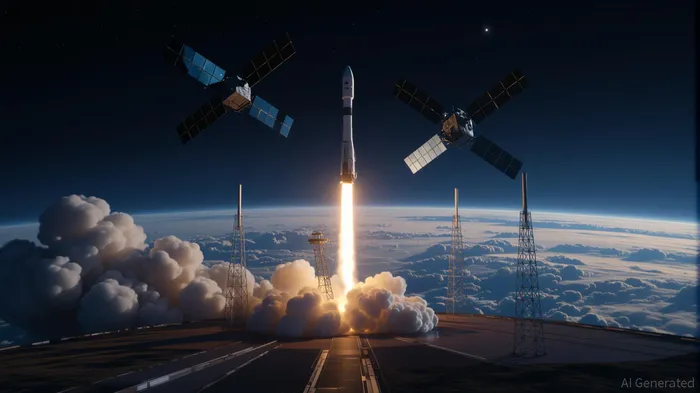
A recent Falcon 9 launch, part of the 58th Starlink mission in 2025, exemplifies this trend. Though specific payload mass data for this mission is unavailable, the Falcon 9's standard capacity of 22,800 kg to low Earth orbit (LEO) underscores its role as the workhorse of the satellite industry. By comparison, Blue Origin's New Glenn rocket-launched from Cape Canaveral in late 2025-offers higher payload capacity but lacks the Falcon 9's proven reusability.
Cape Canaveral: The Epicenter of Space Commerce
Cape Canaveral remains the world's busiest spaceport in 2025, hosting over 40 launches year-to-date, including SpaceX's Starlink missions and Blue Origin's New Glenn debut. This concentration of activity reflects the region's strategic infrastructure and regulatory advantages, making it a prime location for companies seeking to capitalize on the $1.2 trillion global space economy. Investors should monitor Cape Canaveral's evolving role as a hub for both commercial and government contracts, which could drive ancillary investments in ground systems, fuel production, and workforce development.
Investment Opportunities Beyond SpaceX
While SpaceX dominates headlines, emerging players like Firefly Aerospace and Rocket Lab are carving niches in the market. Firefly, for instance, forecasts $150–$158 million in 2025 revenue, targeting small-satellite launches with its Alpha rocket. Rocket Lab, valued at $31 billion, has already demonstrated profitability with its Electron rocket and is expanding into lunar and deep-space missions. Analysts at Morgan Stanley and Bank of America have yet to issue direct commentary on these firms, but their growth trajectories suggest untapped potential for investors seeking diversification in the space sector.
The Road Ahead
SpaceX's 2025 launch cadence and Starlink expansion are not just technical milestones-they are catalysts for a broader commercial space renaissance. As reusable rocketry becomes the norm and satellite constellations proliferate, the industry will likely see increased competition and innovation. For investors, this means opportunities in both established players and agile startups, alongside infrastructure plays tied to spaceports like Cape Canaveral.
However, risks persist. Regulatory hurdles, technical delays in next-generation systems like Starship, and geopolitical tensions could slow progress. Yet, for those with a long-term horizon, the commercial space sector's growth trajectory remains compelling.

Delivering real-time insights and analysis on emerging financial trends and market movements.
Latest Articles
Stay ahead of the market.
Get curated U.S. market news, insights and key dates delivered to your inbox.






Comments
No comments yet