
SpaceX's Accelerated Starlink Deployment and Its Implications for Satellite Internet Infrastructure


 Aime Summary
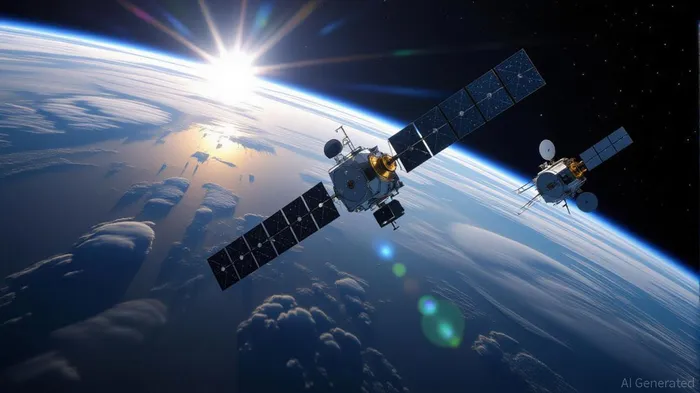
The space economy is undergoing a seismic shift, driven by SpaceX's relentless expansion of its Starlink satellite internet constellation. As of August 2025, the project has deployed over 8,000 satellites, with 6 million active users spanning 130 countries. This rapid deployment is not just a technical milestone—it's a strategic inflection pointIPCX-- for the global satellite internet infrastructure market, creating both challenges and opportunities for investors.
Strategic Inflection Points in the Space Economy
Starlink's growth is redefining the economics of satellite internet. By leveraging reusable Falcon 9 rockets, laser-linked satellites, and direct-to-cellular technology, SpaceX has slashed costs and latency while expanding coverage to remote and disaster-affected regions. The company's 2025 revenue hit $11.8 billion, with a projected 25% gross margin by 2026. These metrics signal a maturing infrastructure capable of competing with terrestrial networks.
The most transformative development is Starlink's partnership with T-MobileTMUS-- to enable direct-to-cellular connectivity. By integrating Starlink's satellites with T-Mobile's spectrum, the collaboration aims to eliminate mobile dead zones, particularly in rural and underserved areas. This innovation could disrupt the $1.2 trillion telecom industry, enabling 4G phones to switch seamlessly between terrestrial and satellite networks.
However, Starlink's dominance is not unchallenged. Amazon's Project Kuiper and Telesat's Lightspeed are advancing rapidly, while traditional geostationary (GEO) providers like ViasatVSAT-- and HughesNet continue to compete with high-speed, low-cost offerings. The market is also grappling with regulatory and environmental concerns, including light pollution and space debris.
Investment Opportunities in Satellite and Ground Network Providers
The satellite internet infrastructure market is projected to grow from $8.09 billion in 2025 to $25.67 billion by 2032, driven by demand for LEO-based connectivity. Ground network providers—companies supplying user terminals, ground stations, and software-defined networking solutions—are poised to benefit most from this expansion.
1. T-Mobile (TMUS): The telecom giant's collaboration with Starlink positions it as a key player in the direct-to-cellular revolution. T-Mobile's stock has surged 45% year-to-date, reflecting investor confidence in its ability to monetize satellite connectivity.
2. Viasat (VSAT): As a leader in satellite broadband, Viasat is expanding its ground infrastructure to support LEO constellations. With a 2025 revenue forecast of $2.1 billion and a 30% EBITDA margin, Viasat offers a compelling long-term buy opportunity.
3. Thales Group (THALES.PA): A major supplier of satellite ground equipment, Thales is capitalizing on defense and government contracts. Its 2025 revenue is expected to grow by 12%, driven by demand for secure satellite communication systems.
4. Ground Equipment Manufacturers: Companies like Gilat Satellite NetworksGILT-- and Orbcomm Inc. are critical to deploying and managing LEO satellite networks. The global satellite ground equipment market is projected to reach $104.11 billion by 2030, with a 12.12% CAGR.
The Road Ahead: Balancing Growth and Sustainability
While Starlink's expansion is reshaping the space economy, investors must remain mindful of risks. Regulatory hurdles, technical challenges in scaling direct-to-cellular networks, and environmental concerns could slow growth. However, SpaceX's proactive engagement with astronomers and its adoption of debris-mitigation protocols suggest a commitment to sustainable practices.
For long-term investors, the key is to focus on companies that are not only aligned with Starlink's trajectory but also positioned to adapt to evolving market dynamics. T-Mobile and Viasat, for instance, offer diversified revenue streams and strong balance sheets, while ground equipment manufacturers like Thales and Gilat benefit from the broader LEO satellite boom.
Conclusion: A New Era of Connectivity
SpaceX's Starlink is more than a satellite internet service—it's a catalyst for a new era of global connectivity. By bridging the digital divide and enabling real-time communication in remote regions, the project is unlocking economic value across industries. For investors, the strategic inflection points created by Starlink's deployment present a unique opportunity to capitalize on the space economy's next phase.
As the market matures, those who invest in companies at the intersection of satellite technology and terrestrial infrastructure—particularly T-Mobile, Viasat, and ground equipment manufacturers—stand to reap significant rewards. The future of connectivity is no longer bound to Earth; it's orbiting above us, and the time to act is now.

Delivering real-time insights and analysis on emerging financial trends and market movements.
Latest Articles
Stay ahead of the market.
Get curated U.S. market news, insights and key dates delivered to your inbox.




Comments
No comments yet