
SpaceX's Accelerated Launch Cadence and Its Implications for the Space Economy


 Aime Summary
Operational Efficiency: The Falcon 9's Reusability Revolution
SpaceX's ability to reuse Falcon 9 first-stage boosters has become a cornerstone of its competitive advantage. The Bandwagon-2 mission, launched in November 2025, showcased this prowess: its booster had already completed 20 prior flights, underscoring SpaceX's capacity to maximize hardware reuse while maintaining mission success rates. This approach has , a reduction that directly enhances margins and enables high-frequency launch cadences.
The efficiency gains extend beyond cost savings. By streamlining mission execution-such as rapid turnaround times between launches-SpaceX has created a scalable model for commercial and government clients. For instance, the company's collaboration with Vast to deploy private astronaut missions and commercial space stations like Haven-1 highlights how Falcon 9's versatility supports a nascent low-Earth-orbit (LEO) economy. These developments position SpaceX as a critical enabler of space's next frontier, from scientific research to commercial habitation.
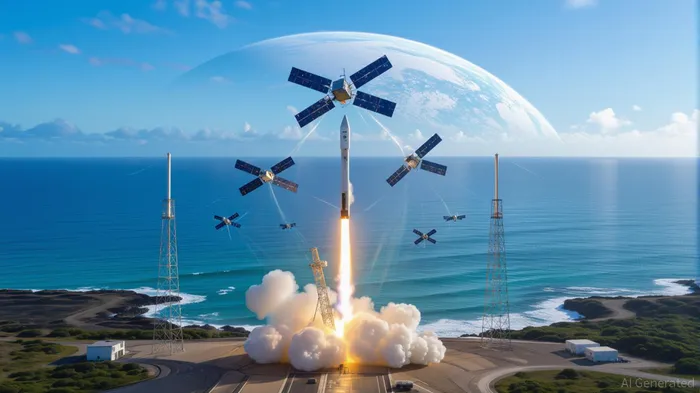
Starlink's Global Expansion: From Broadband to Aviation
While reusable rockets underpin the infrastructure of the space economy, Starlink is rapidly becoming its lifeblood. The service's expansion into private aviation marks a pivotal milestone. By November 2025, Pegasus Elite Aviation had equipped two long-range jets-Bombardier Global 5000 and Gulfstream V-with Starlink connectivity, . This capability, which supports HD video conferencing and real-time data transfers, is transforming private aviation into a premium market for satellite broadband.
Such commercial traction underscores Starlink's potential to diversify revenue streams beyond consumer and maritime markets. With over 5,000 satellites in orbit and plans for thousands more, the network is also gaining regulatory traction. For example, the Federal Aviation Administration's (FAA) approval of Starlink for aviation use in 2024 reflects growing institutional confidence in the technology-a critical factor for sustained investment.
Competitive Dynamics: Blue Origin, Rocket LabRKLB--, and the Reusability Race
SpaceX's dominance is being challenged by emerging players, but the barriers to entry remain formidable. Blue Origin's New Glenn rocket, which successfully landed its first-stage booster in November 2025 represents a direct threat to Falcon 9's market leadership. However, New Glenn's nine-month gap between its first and second launches highlights the technical and operational hurdles of achieving reusability at scale. Meanwhile, Rocket Lab has opted for a more cautious approach, delaying its Neutron rocket's debut to 2026 while leveraging its Electron rocket's strong financial performance.
Despite these challenges, competition is accelerating innovation. Rocket Lab's acquisitions of Geost and Mynaric, for instance, signal a strategic pivot toward satellite manufacturing and -sectors poised to benefit from the growing demand for in-orbit services. For investors, this fragmentation suggests a diversified portfolio approach: betting on both established leaders like SpaceX and agile innovators like Rocket Lab.
Investment Outlook: Capitalizing on Sector Momentum
The space logistics market, driven by reusable rocket technology and satellite constellations, , . North America currently dominates this market, but the Asia-Pacific region is surging ahead, fueled by China's AI-satellite deployments and India's initiatives. This regional divergence offers investors opportunities to align with geographies experiencing policy tailwinds and infrastructure investment.
In satellite broadband, Starlink's first-mover advantage is hard to overstate. However, rivals like Amazon's Project Kuiper and OneWeb are closing the gap, necessitating continued capital infusion into network expansion and ground infrastructure. For reusable rocket technology, the focus should remain on companies with proven reusability (SpaceX, Blue Origin) and those with robust R&D pipelines (Rocket Lab).
Strategic Allocation: Where to Place Capital in 2026
Given the sector's momentum, strategic capital allocation should prioritize three areas:
1. Space Logistics: Companies enabling cargo transport, in-orbit servicing, and satellite maintenance will benefit from falling launch costs and growing LEO activity.
2. Satellite Broadband: Investments in ground infrastructure and partnerships with aviation/telecom firms will drive adoption.
3. Reusable Rocket Tech: While SpaceX remains the leader, long-term bets on firms like Blue Origin and Rocket Lab could pay off as they scale reusability.
The risks, however, are non-trivial. Regulatory delays, technical failures, and market saturation in satellite constellations could dampen returns. Yet, for investors with a multi-year horizon, the space economy's growth trajectory-anchored by SpaceX's operational excellence and Starlink's commercial traction-offers a compelling case for allocation.

Delivering real-time insights and analysis on emerging financial trends and market movements.
Latest Articles
Stay ahead of the market.
Get curated U.S. market news, insights and key dates delivered to your inbox.




Comments
No comments yet