
SpaceX's $75B Prospectus Could Drop As Soon As This Week: Ready for a $1.75T Debut?
 Aime Summary
SpaceX aims to file a prospectus for an initial public offering as soon as this week, the Information reported, kicking off one of the year’s most-anticipated market debuts. Elon Musk’s company could try to raise more than $75 billion, the media outlet said, citing a person with direct knowledge of the plans. If executed at the targeted valuation range of $1.5 trillion to $1.75 trillion , this capital-raising would shatter the previous high watermark set by Saudi Aramco’s $29.4 billion listing in 2019. From a market perspective, this aggressive pivot is a highly bullish indicator for heavy-lift aerospace and AI infrastructure, consolidating two capital-intensive sectors into a single mega-entity. However, the sheer scale of the capital requirement demands careful scrutiny of the underlying business model.
Unpacking the Latest Disclosures: A Shift in Scale
The latest disclosures highlight a significant escalation in SpaceX's financial ambitions. According to the recent report from The Information, the timeline is immediate, with a filing expected between March 24 and March 30, 2026. The planned fundraising size of over $75 billion represents a massive upward revision from the previous consensus. Just months earlier, in January 2026, reports from the Financial Times indicated a targeted June IPO aiming to raise a maximum of $50 billion at an approximate $1.5 trillion valuation.
The primary difference revealed today is that the company is demanding considerably more capital. This increased liquidity requirement is accompanied by a unique structural offering: retail investor allocations may exceed 20%, an unusually high proportion for a deal of this magnitude. While a $1.75 trillion valuation seems exorbitant for a traditional aerospace manufacturer, institutional analysts at firms like PitchBook have suggested that this figure can be rationalized within a three to five-year perspective, provided the company transitions from a launch provider to the backbone of the AI economy.
The Accelerated Timeline and Strategic Restructuring
The path to this week's impending filing has been marked by rapid strategic shifts and corporate restructuring. The timeline below illustrates the evolution of this historic offering:
- December 9, 2025: Initial reports from Reuters and Bloomberg disclosed that SpaceX was discussing a 2026 IPO to raise over $25 billion to $30 billion, with funds earmarked for the Starship program and space data centers.
- January 28, 2026: Leaks indicated the company was considering a mid-June IPO, boosting funding targets to $50 billion and aiming for a $1.5 trillion valuation. During this period, Tesla shares reacted to consolidation rumors, jumping 4.5% in after-hours trading to a $1.56 trillion market cap.
- February 2, 2026: SpaceX officially announced its merger with xAI. The combined entity was valued at a staggering $1.25 trillion, merging SpaceX's $1 trillion valuation with xAI's $250 billion valuation.
- March 24, 2026: The Information reported the plan to file the IPO prospectus this week, increasing the funding goal past $75 billion.
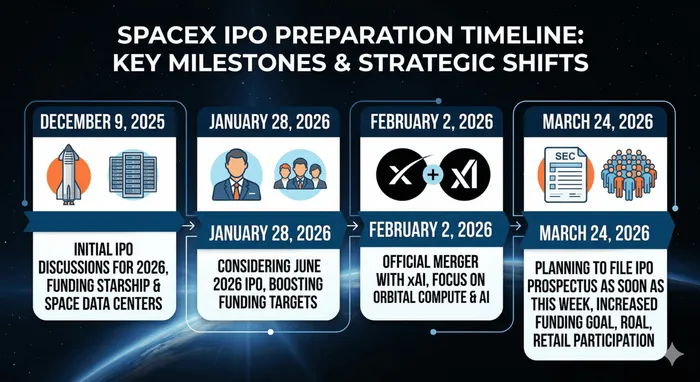
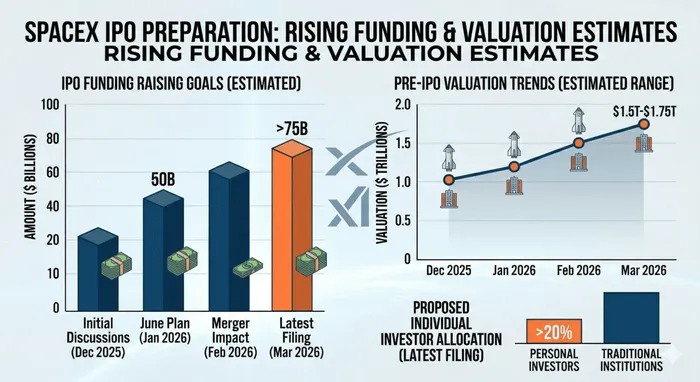
According to Ainvest analysis, the timeline and valuation adjustments illustrate this aggressive upward trajectory, demonstrating how the integration of xAI acted as a multiplier for the company's public market potential.
The Core Narrative: Starship, Starlink, and Orbital Compute
To justify a valuation approaching $1.75 trillion, SpaceX is presenting a narrative that integrates its three core pillars: Starship, Starlink, and xAI.
The Starship program is positioned as the only system with the potential to achieve million-ton payload capacities. This heavy-lift capability is not merely for planetary exploration; it is the delivery mechanism for massive orbital infrastructure. Starlink serves as the immediate financial engine. With over 9 million users and revenues exceeding $10 billion, it is a high-margin cash flow machine. The upcoming rollouts of V3 satellites and direct-to-cell technology lay the foundational network for future edge computing in space.
The merger with xAI provides the essential demand side of the equation. By internalizing xAI, SpaceX creates a closed-loop ecosystem. The core thesis driving this is the impending energy crisis on Earth; global electricity demand for AI simply cannot be met with terrestrial solutions without imposing hardship on communities.
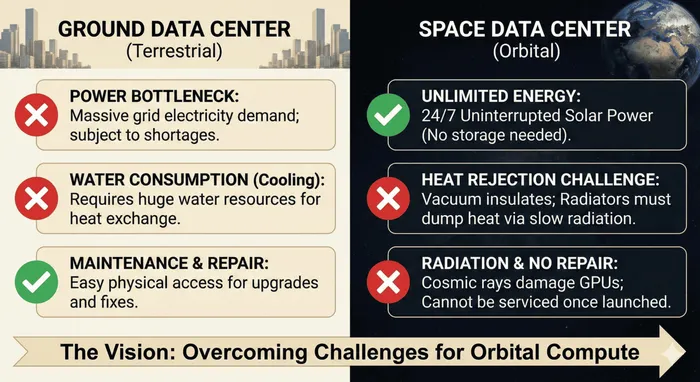
According to Ainvest analysis, the physical constraints of terrestrial computing—such as massive grid electricity demand and huge water consumption for cooling—are juxtaposed against the advantages of space. In orbit, solar energy is unlimited and available 24/7, and the vacuum of space acts as an infinite heat sink for specialized radiative cooling arrays. This shift turns the vacuum of space from a challenge into a strategic asset.
Conclusion: Implications for the Capital Markets
As SpaceX prepares to file its prospectus, the market must brace for what will likely be one of the most important technology IPOs of 2026. The transition from terrestrial data centers to orbital compute fundamentally challenges traditional cloud providers who remain bound by Earth's energy constraints.
For investors, navigating this event requires strategic positioning. The expected high retail allocation of over 20% offers direct participation opportunities. Prior to the public listing, accessing the company requires navigating strict regulations through Special Purpose Vehicles (SPVs) on platforms like Hiive or Rainmaker Securities, typically restricted to accredited investors.
In the secondary market, exposure can be gained through mutual funds such as the Baron Partners Fund (BPTIX) and interval funds like Cathie Wood’s ARK Venture Fund, which hold significant portfolio allocations to the company. ETFs like the ERShares Private-Public Crossover ETF (XOVR) also serve as popular proxies. Furthermore, investors may look toward the public supply chain, targeting "pick and shovel" companies like Graham Corp. and Hunting Plc, which supply critical hardware components and stand to benefit from the increased launch cadence.

Tianhao Xu is currently a financial content editor, focusing on fintech and market analysis. Previously, he worked as a full-time forex trader for several years, specializing in global currency trading and risk management. He holds a master’s degree in Financial Analysis.
Latest Articles
Stay ahead of the market.
Get curated U.S. market news, insights and key dates delivered to your inbox.


AInvest
PRO
AInvest
PRO



Comments
No comments yet