
SpaceX's 2025 Launch Surge and Its Implications for Satellite and Aerospace Sectors


 Aime Summary
Catalysts for the 2025 Launch Surge
SpaceX's December 2025 Falcon 9 schedule underscores its dual focus on commercial and national security objectives. The Starlink 6-86 mission on December 1 and the classified NROL-77 payload on December 9 highlight the company's ability to balance high-frequency satellite deployments with critical government contracts. The NROL-77 mission, part of the National Security Space Launch (NSSL) Phase 2 contract, exemplifies SpaceX's growing role in U.S. defense infrastructure, leveraging its Falcon 9's reusability to reduce costs while maintaining mission reliability.
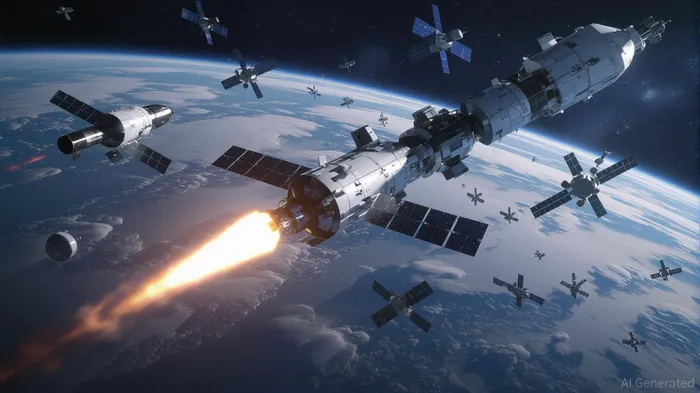
The broader catalyst for this surge lies in SpaceX's strategic pivot toward Starlink as a revenue engine. By 2025, Starlink had surpassed 8,400 satellites in orbit, accounting for over 65% of all operational satellites globally. This rapid expansion is supported by Falcon 9's reusability, with over 94% of 2024 launches using previously flown boosters, slashing marginal costs and enabling aggressive deployment timelines. The December 2025 launches further solidify Starlink's position as a cornerstone of SpaceX's financial model, with the satellite internet service now generating over 70% of the company's revenue.
Market Response to the Launch Surge
The market's reaction to SpaceX's 2025 activities reflects a broader transformation in the aerospace sector. The global space economy, valued at $630 billion in 2025, is projected to reach $2 trillion by 2040, driven by reduced launch costs and increased satellite demand. SpaceX's reusable rocket technology has been a key driver, reducing launch costs by 90% over two decades and enabling competitors like Rocket LabRKLB-- and Blue Origin to enter the market.
Investor sentiment has also shifted in response to SpaceX's dominance. The company's valuation, estimated at $446 billion as of October 2025, reflects confidence in its ability to scale Starlink and Starship operations. This valuation surge has spilled over into the broader aerospace sector, with venture capital investments in space startups reaching $4.5 billion in 2025-a fourfold increase compared to 2024. Defense-related applications, such as the Pentagon's Golden Dome program, have further fueled capital flows, with companies like K2 Space securing $15 million in funding to develop satellite manufacturing solutions.
Investment Opportunities in the Space Infrastructure Ecosystem
The December 2025 launches highlight three key investment areas within the space infrastructure ecosystem:
Satellite Internet and Connectivity:
Starlink's expansion is reshaping the satellite communications market, which is growing at a 40% annual rate. With over 8.5 million subscribers globally, Starlink's recurring revenue model offers a compelling case for investors seeking scalable, long-term returns. Competitors like Amazon's Project Kuiper and OneWeb are also advancing their constellations, but SpaceX's first-mover advantage and operational efficiency position it as the sector's dominant player.Reusable Launch Systems:
The Falcon 9's reusability has redefined the economics of space access, reducing costs to as low as $25 million per launch. This innovation has spurred demand for on-demand launch services, with the global space launch market projected to grow from $14.67 billion in 2024 to $78.02 billion by 2035. Investors can capitalize on this trend by targeting companies developing next-generation propulsion systems or launch infrastructure, such as private spaceports.Commercial Space Stations and Microgravity Applications:
Beyond satellite internet, the development of commercial space stations is emerging as a high-growth niche. Axiom Space's $350 million Series C funding in 2024 and Blue Origin's Orbital Reef project signal a shift toward orbital habitats for research, manufacturing, and tourism. These ventures are supported by government partnerships and private capital, creating opportunities for investors in aerospace engineering and life-support systems.
Conclusion
SpaceX's 2025 launch surge, exemplified by the December missions, is a catalyst for the aerospace sector's next phase of growth. By leveraging reusable rocket technology and strategic government contracts, the company is not only reshaping satellite infrastructure but also redefining the economics of space access. For investors, the opportunities lie in sectors where SpaceX's innovations intersect with scalable demand-namely, satellite internet, launch services, and commercial space habitats. As the space economy accelerates toward $2 trillion by 2040, those who align with these trends stand to benefit from a transformative decade of innovation and capital returns.

Delivering real-time insights and analysis on emerging financial trends and market movements.
Latest Articles
Stay ahead of the market.
Get curated U.S. market news, insights and key dates delivered to your inbox.




Comments
No comments yet