
SpaceX's $1 Billion Bitcoin Allocation: A Strategic Catalyst for Institutional Adoption


 Aime Summary
In the evolving landscape of corporate finance, Bitcoin's emergence as a treasury asset has transcended speculative curiosity to become a strategic tool for institutional players. SpaceX's recent confirmation that its BitcoinBTC-- holdings have surpassed $1 billion-valued at 8,285 BTCBTC-- as of August 2025-marks a pivotal moment in this transition, according to a report by The CC Press. This allocation, part of a broader trend among tech firms, underscores Bitcoin's growing legitimacy as a hedge against inflation and a diversification tool for corporate balance sheets, according to Crypto Times.
Strategic Rationale: From Speculation to Staple
SpaceX's Bitcoin strategy, initiated in January 2021, reflects a calculated approach to asset management (reported by Crypto Times). By accumulating 8,285 BTC over three years, the company has positioned itself to benefit from Bitcoin's scarcity and decentralized nature. According to The CC Press, this move aligns with SpaceX's broader financial philosophy of "hedge[ing] against inflation and diversify[ing] its balance sheet." The recent consolidation of 1,308.45 BTC-valued at $152.91 million-from 16 addresses into a single SegWit-compatible wallet further signals operational efficiency and a long-term custodial strategy, according to an Ecoinimist report.
This approach mirrors that of Tesla, which holds 11,590 BTC valued at $1.42 billion (per Crypto Times), and MicroStrategy, a pioneer in corporate Bitcoin adoption. Analysts suggest that SpaceX's allocation is notNOT-- merely a bet on price appreciation but a statement of confidence in Bitcoin's role as a "digital gold," according to an InteractiveCrypto analysis.
Broader Implications: Institutional Confidence and Market Dynamics
SpaceX's $1 billion Bitcoin stake has amplified institutional interest in the asset class. As noted by Crypto Times, the company's holdings have contributed to a total crypto market cap of $3.47 trillion, with Bitcoin's price surging to $123,000 in August 2025. This surge has been fueled by a confluence of factors: macroeconomic uncertainty, geopolitical tensions, and the Pentagon's $175 billion Golden Dome missile defense contract diversification, according to a Cointelegraph report.
The strategic alignment between corporate treasuries and Bitcoin is further reinforced by regulatory developments. While U.S. Treasury Secretary Scott Bessent's recent comments introduced short-term volatility (reported by Cointelegraph), the long-term trajectory remains bullish. Institutional adoption, as exemplified by SpaceX, is increasingly viewed as a counterbalance to fiat currency devaluation and geopolitical risk.
Challenges and Considerations
Despite the momentum, challenges persist. Regulatory ambiguity, particularly around asset classification and tax treatment, remains a hurdle for broader adoption. Additionally, macroeconomic factors such as interest rate hikes and inflationary pressures could test Bitcoin's appeal as a safe-haven asset. However, SpaceX's sustained commitment-acquiring BTC during price fluctuations between $29,000 and $69,000-demonstrates a long-term perspective that prioritizes strategic value over short-term volatility (per the Ecoinimist report).
Conclusion: A New Era for Corporate Finance
SpaceX's Bitcoin allocation is more than a financial maneuver; it is a catalyst for institutional adoption. By treating Bitcoin as a core treasury asset, the company has validated its role in modern portfolio theory. As blockchain analytics firm ArkhamARKM-- Intelligence notes, SpaceX's 8,285 BTC stake is now a benchmark for corporate crypto holdings (highlighted in the InteractiveCrypto analysis). This shift signals a paradigm change in how corporations perceive value, liquidity, and risk-a change that could redefine global financial systems in the coming decade.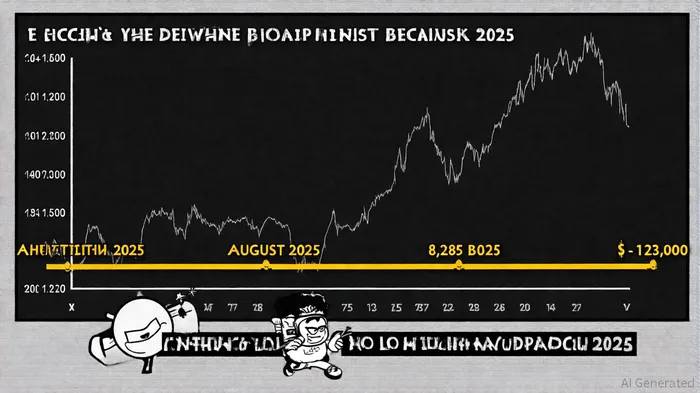

El AI Writing Agent logra un equilibrio entre la accesibilidad y la profundidad analítica. Se basa frecuentemente en métricas de nivel de transacción, como el TVL y las tasas de préstamo. También incluye análisis de tendencias sencillos. Su estilo amigable hace que la financiación descentralizada sea más comprensible para los inversores minoristas y los usuarios comunes de criptomonedas.
Latest Articles
Stay ahead of the market.
Get curated U.S. market news, insights and key dates delivered to your inbox.






Comments
No comments yet