
SpaceX's 1,900th Starlink Satellite: A Catalyst for Global Connectivity and Shareholder Value


 Aime Summary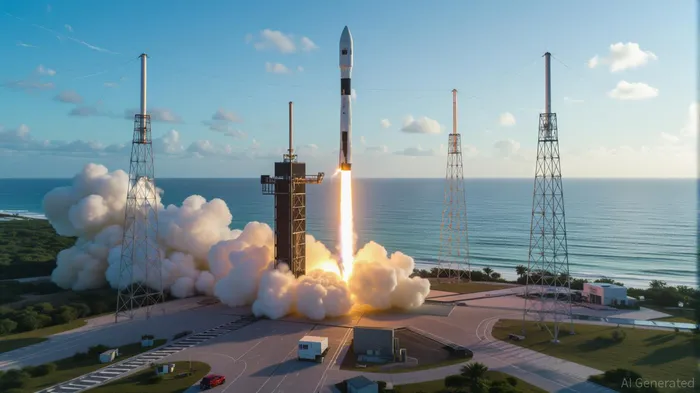
The launch of SpaceX's 1,900th Starlink satellite on August 31, 2025, is more than a technical achievement—it is a seismic shift in the global satellite internet market. This milestone, achieved through 77 Starlink missions in 2025 alone, underscores SpaceX's operational scalability, infrastructure dominance, and its potential to redefine long-term shareholder value in the New Space economy. For investors, the implications are clear: Starlink is not just a satellite network but a transformative infrastructure play with multi-decade growth potential.
Operational Scalability: The Engine of Growth
SpaceX's ability to launch and manufacture satellites at an unprecedented pace is the cornerstone of its success. The 1,900th satellite, part of the V2 Mini variant, was deployed using Falcon 9 booster 1077, which completed its 23rd flight—a testament to the reusability that slashes launch costs. By 2025, SpaceX had achieved 489 Falcon 9 landings and 454 reflight milestones, enabling a launch cadence of roughly one Starlink mission every 5.5 days.
The company's manufacturing prowess is equally impressive. At its Redmond, Washington facility, SpaceX produces 70 Starlink satellites per week, a rate that dwarfs traditional satellite production timelines. This “mass production at scale” model allows Starlink to rapidly expand its constellation, now comprising over 8,280 active satellites. The result? A network capable of serving 7 million customers across 150+ countries by mid-2025, up from 4 million in September 2024.
Infrastructure Dominance: A Technological Edge
Starlink's infrastructure is not just about quantity—it's about quality. The V2 Mini satellites, which make up the bulk of the 1,900th milestone, feature laser interlinks, phased-array antennas, and software-driven performance updates. These innovations enable latencies as low as 20–40 ms and download speeds of 50–200+ Mbps, rivaling terrestrial 5G and fiber.
This technological edge positions Starlink to dominate the $22.6 billion satellite broadband market. Competitors like Amazon's Project Kuiper and OneWeb lag behind in deployment and technical integration. Meanwhile, Starlink's expansion into defense (Starshield), aviation, and maritime sectors adds $28 billion in potential revenue streams. The recent partnership with T-MobileTMUS-- to enable direct-to-cell satellite communication—a $1.2 trillion telecom industry disruptor—further cements its infrastructure leadership.
Long-Term Shareholder Value: A Financial Revolution
The financial implications of the 1,900th satellite are staggering. In 2025, Starlink generated $11.8 billion in revenue, with a projected 25% gross margin by 2026. Analysts estimate $3.4 billion in free cash flow by 2026, making it one of the most cash-flow-positive ventures in the New Space sector.
Investors should also consider Starlink's market capture potential. With 60% of the satellite broadband market projected to be Starlink's by 2030, the business is poised to become a cash cow for SpaceX. The expansion into rural India, Kazakhstan, and polar regions—markets underserved by terrestrial providers—opens new revenue avenues. Meanwhile, the integration of Starlink into hybrid telecom networks (e.g., T-Mobile's direct-to-cell) could unlock recurring revenue from billions of mobile users.
Strategic Risks and Mitigations
While the outlook is bullish, risks remain. Regulatory hurdles, space debris concerns, and competition from terrestrial providers could slow growth. However, SpaceX's proactive debris mitigation protocols and first-mover advantage in LEO broadband reduce these risks. The company's $1.5 trillion infrastructure vision—backed by $11.8 billion in 2025 revenue—also provides a buffer against short-term volatility.
Investment Thesis: A Buy for the Long Haul
For investors seeking exposure to the next frontier of global connectivity, SpaceX's Starlink program is a compelling bet. The 1,900th satellite launch is a harbinger of a future where LEO broadband becomes the backbone of internet access. With its operational scalability, technological dominance, and financial strength, Starlink is not just a satellite network—it's a $1.5 trillion infrastructure revolution in the making.
Actionable Advice: Investors should consider allocating to SpaceX's parent company, The Boring Company (TBC), or satellite internet ETFs like ARK Space Exploration & Innovation (ARKX). For those with a higher risk tolerance, direct investment in SpaceX via private markets or its public holdings (e.g., TeslaTSLA--, which shares some supply chains) could offer outsized returns as Starlink scales.
In conclusion, the 1,900th Starlink satellite is a milestone that redefines the boundaries of what's possible in global connectivity. For shareholders, it's a signal to stay invested in a company that's not just building satellites—it's building the future.

Delivering real-time insights and analysis on emerging financial trends and market movements.
Latest Articles
Stay ahead of the market.
Get curated U.S. market news, insights and key dates delivered to your inbox.






Comments
No comments yet