
Why SpacePay's SPY Token is Poised to Outperform in 2025's Crypto-Commerce Boom


 Aime Summary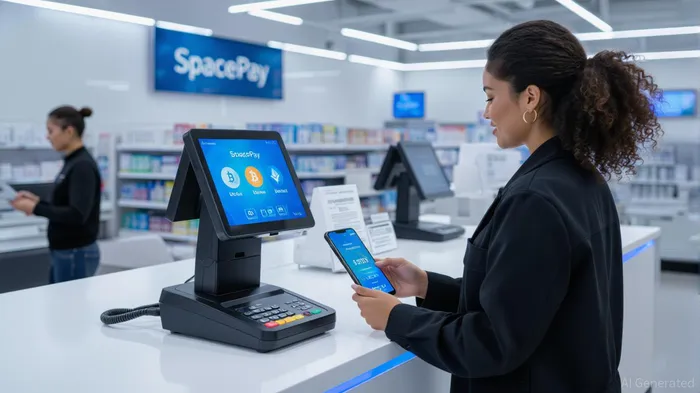
The crypto-commerce landscape in 2025 is no longer a speculative frontier—it's a rapidly maturing market driven by real-world adoption, regulatory clarity, and infrastructure innovation. At the forefront of this transformation is SpacePay's SPY token, a project uniquely positioned to capitalize on the convergence of macroeconomic trends, sustainable tokenomics, and a disruptive payment ecosystem. For investors seeking exposure to the next phase of crypto's evolution, SPY offers a compelling case rooted in utility, scalability, and alignment with global financial shifts.
Real-World Utility: From Luxury Cars to Everyday Retail
SpacePay's value proposition is anchored in its ability to bridge the gap between crypto's speculative nature and its practical use in daily transactions. By 2025, the platform has secured partnerships with major brands like Volkswagen Singapore (VGS), which now accepts BitcoinBTC-- and EthereumETH-- for vehicle purchases and aftersales services. This mirrors broader trends in the automotive sector, where companies like TeslaTSLA-- and FerrariRACE-- have already embraced crypto for high-value transactions.
But SpacePay's reach extends beyond luxury goods. The platform's Android-based point-of-sale (POS) integration allows merchants to accept over 325 crypto wallets without replacing existing hardware. This low-cost, high-efficiency model has attracted small and medium-sized businesses (SMBs), which benefit from a flat 0.5% transaction fee—a stark contrast to traditional processors like Stripe or PayPalPYPL--, which charge 2%–4%. For a merchant with $40,000 in monthly sales, this translates to $800 in monthly savings, a critical advantage in an inflationary environment.
The automotive sector's embrace of crypto is not coincidental. As traditional payment processors face rising operational costs and regulatory scrutiny, crypto-based solutions like SpacePay offer a scalable alternative. The platform's ability to instantly convert crypto into fiat for merchants also mitigates volatility risks, making it an attractive option for businesses wary of price swings.
Sustainable Tokenomics: Aligning Incentives for Long-Term Growth
A project's tokenomics often determine its long-term viability, and SpacePay's $SPY token is designed with a focus on demand-driven utility and controlled supply dynamics. The token's total supply of 34 billion is allocated across strategic categories:
- 20% for public sale
- 17% for user rewards
- 18% for strategic partnerships
- 10% for development
- 5% for the founding team
Notably, the founding team's 5% allocation is significantly lower than the 20%+ seen in many crypto projects, signaling a commitment to decentralization. A 12% reserve fund further ensures flexibility for future opportunities or challenges.
Token holders benefit from governance rights, revenue-sharing from transaction fees, and early access to new features. This structure ties SPY's value directly to the platform's operational success, creating a flywheel effect: as more merchants adopt SpacePay, transaction volumes rise, increasing revenue and, by extension, token demand.
The presale, which has already raised $1.3 million, reflects strong investor confidence. With a tiered pricing model, early participants are incentivized to join, while newcomers can still enter at reasonable rates. Analysts project SPY's price could range from $0.0021 to $0.0250 over the next five years, depending on adoption rates and regulatory developments.
Disruptive Infrastructure: Leveraging Ethereum's Ecosystem
SpacePay's payment infrastructure is built on Ethereum's robust ecosystem, a critical advantage in an era where blockchain interoperability and scalability are paramount. By enabling users to transact with Ethereum, Bitcoin, Binance Coin, and stablecoins like USDTUSDC-- and USDCUSDC--, the platform avoids forcing users into a single token. Instead, it fosters a multi-chain future where crypto is as versatile as traditional fiat.
The Android-based POS integration is another game-changer. Unlike competitors that require costly hardware upgrades, SpacePay's solution works with millions of existing Android terminals, reducing barriers to adoption. This approach aligns with macroeconomic trends in 2025, where SMBs and governments prioritize cost-effective, low-complexity solutions.
Regulatory clarity is also accelerating adoption. Governments are drafting concrete rules for crypto payments, reducing legal risks for businesses. For example, Singapore's recent framework for crypto-asset service providers has spurred innovation in the region, where SpacePay's partnerships with VGS and local retailers are gaining traction.
Macro Alignment: Crypto as a Mainstream Payment Tool
The macroeconomic case for SPY is equally compelling. With 400 million crypto owners globally, demand for practical use cases in physical stores is surging. Traditional payment processors, meanwhile, are raising fees and facing operational bottlenecks, creating a vacuum that SpacePay is filling with its 0.5% fee model.
Moreover, the broader Ethereum ecosystem is evolving. As Ethereum's layer-2 solutions and EIP-4844 upgrades reduce transaction costs, the network becomes more attractive for everyday payments. SpacePay's integration with Ethereum positions it to benefit from these advancements, further solidifying its role in the crypto-commerce boom.
Investment Thesis: A Token with Utility and Scalability
For investors, SPY represents a rare combination of real-world utility, sustainable tokenomics, and macroeconomic alignment. The presale offers an entry point to participate in a project that is not only addressing crypto's adoption challenges but also reshaping the payments landscape.
However, risks remain. Regulatory shifts, market volatility, and competition from larger players could impact growth. Yet, SpacePay's focus on low-cost, high-utility infrastructure and its alignment with Ethereum's ecosystem provide a strong buffer against these headwinds.
In a market where most crypto projects struggle to move beyond speculation, SPY stands out by turning digital assets into a spendable, spendable currency. As 2025 unfolds, the token's performance will likely reflect the broader success of crypto-commerce—a sector poised for explosive growth.
Final Takeaway: For investors seeking exposure to the next phase of crypto's evolution, SpacePay's SPY token offers a compelling case. Its real-world partnerships, sustainable tokenomics, and disruptive infrastructure position it to outperform in a market increasingly defined by utility and scalability.

Decoding blockchain innovations and market trends with clarity and precision.
Latest Articles
Stay ahead of the market.
Get curated U.S. market news, insights and key dates delivered to your inbox.






Comments
No comments yet