
Spacecoin Partners With World Liberty Financial to Expand DeFi via Satellite Internet
 Aime Summary
- World Liberty Financial and Spacecoin have partnered to develop financial solutions using satellite internet in areas with limited infrastructure according to reports.
- The collaboration includes a token swap and aims to combine DeFi with space-based internet to expand access to financial services as reported.
- World Liberty's USD1USD1-- stablecoin will serve as the settlement layer on Spacecoin's satellite network, enabling cross-border remittances and decentralized lending according to MEXC.
World Liberty Financial and satellite startup Spacecoin have announced a strategic partnership to integrate decentralized finance with satellite internet, creating a hybrid infrastructure for financial access in remote regions. The collaboration involves a token swap and the deployment of USD1 stablecoin as a settlement instrument on Spacecoin's satellite network as detailed.
The initiative is designed to serve users in areas with unreliable or unaffordable terrestrial internet by combining decentralized internet and financial infrastructure. Spacecoin's satellites enable data transmission and financial transactions without relying on traditional service providers according to MEXC.
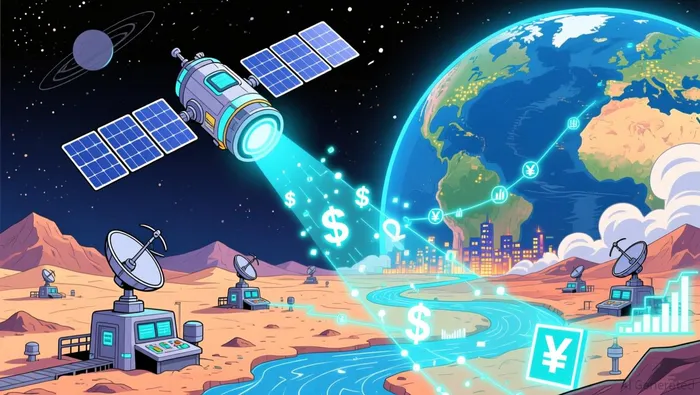
The partnership also aims to expand access to DeFi services, including micropayments and cross-border remittances, by leveraging USD1's dollar-backed stability. Zak Folkman of World Liberty emphasized the importance of building infrastructure for real-world payments and settlements in low-connectivity environments according to CoinGabb.
What is the Strategic Value of the Partnership?
The collaboration between World Liberty FinancialWLFI-- and Spacecoin represents a new approach to financial inclusion by combining DeFi with physical infrastructure. By using satellite internet, the project reduces reliance on traditional banking systems and addresses gaps in both connectivity and financial access. This integration allows users to perform transactions even in regions with limited internet according to AInvest.
USD1 is positioned as a stable asset for use in decentralized financial systems, particularly in areas where local currencies are volatile. The stablecoin has seen a market capitalization of approximately $3.27 billion, supported by real-world adoption and partnerships according to RareEvo.
What Are the Challenges and Risks Involved?
Despite the strategic benefits, the initiative faces several challenges. These include regulatory risks, the costs of maintaining satellite infrastructure, and the challenge of user adoption in remote areas. The project will need to navigate evolving cryptocurrency regulations and demonstrate practical value for end users according to Yahoo Finance.
The Spacecoin network also faces technical and financial hurdles in scaling its satellite internet infrastructure to support widespread financial transactions. While the project has launched three satellites, long-term success will depend on the ability to maintain and expand its network according to Bitget.
What is the Tokenomics of the SPACE Token?
Spacecoin's native token, SPACE, serves as the payment and coordination layer for the network. The token has a capped supply of 21 billion units, drawing comparisons to Bitcoin's design according to MEXC.
The SPACE token will be used to incentivize satellite operators, facilitate transactions, and secure the network through staking. The token is planned for listing on both centralized and decentralized exchanges, including Binance Alpha and OKX, to enhance market access according to Intellectia.
Analysts suggest that the token could potentially reach $1 if adoption and usage grow significantly. The airdrop has already been completed, with 50 million tokens allocated to early participants according to CoinGabb.
The token is designed as an ERC-20 on the EthereumETH-- network, making it compatible with a wide range of DeFi platforms and services according to Bitget.
What is the Project's Revenue Vision and Timeline?
Spacecoin aims to achieve $1 billion in annual revenue by 2031 by capturing a share of the satellite communications market. This vision is supported by a growing demand for decentralized internet services in remote and underserved regions according to MEXC.
The Token Generation Event (TGE) for SPACE is scheduled for January 23, with an initial circulating supply of 2.15 billion tokens. The controlled release is intended to manage volatility and align incentives for long-term growth according to MEXC.
The project's roadmap includes expanding its satellite network, integrating DeFi applications, and forming strategic partnerships to drive adoption in emerging markets according to Bitget.
What is the Regulatory and Market Landscape?
World Liberty Financial is actively pursuing a U.S. banking license for a national trust bank focused on stablecoin operations. The project has also expanded into international markets, with Pakistan signing a memorandum of understanding to explore USD1 applications according to Yahoo Finance.
The broader crypto industry is seeing increased regulatory scrutiny, particularly for stablecoins and DeFi platforms. Spacecoin and World Liberty will need to demonstrate compliance with evolving regulations while maintaining their decentralized approach according to MEXC.
The partnership represents a bold experiment in merging DeFi with physical infrastructure. By using satellite internet and blockchain-based payments, the initiative seeks to redefine financial access in regions where traditional systems are limited according to AInvest.

La combinación de la sabiduría tradicional en el comercio con las perspectivas más avanzadas relacionadas con las criptomonedas.
Latest Articles
Stay ahead of the market.
Get curated U.S. market news, insights and key dates delivered to your inbox.


AInvest
PRO
AInvest
PRO



Comments
No comments yet