
The New Space Economy: How Blue Origin's Mars Mission Could Reshape Aerospace and Tech Investing


 Aime Summary
A New Era of Reusability and Cost Efficiency
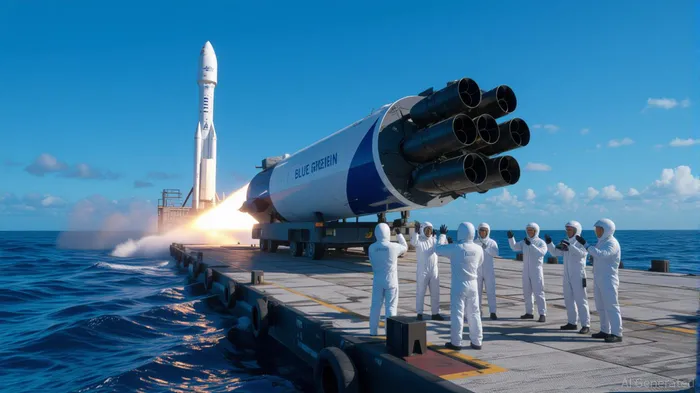
Blue Origin's New Glenn rocket, standing 320 feet tall, has achieved a critical milestone: the successful landing of its first-stage booster on a floating barge in the Atlantic Ocean. This feat, accomplished during its second launch on November 13, 2025, mirrors SpaceX's long-standing dominance in reusable rocketry and positions Blue Origin to compete more effectively in the commercial launch market. The ability to reuse boosters drastically reduces operational costs, a factor that could redefine the economics of space travel and make previously unattainable missions financially viable.
The New Glenn's recent mission also carried two NASA science satellites-part of the Escapade (Escape and Plasma Acceleration and Dynamics Explorers) mission-as it deployed them to Mars. These satellites, developed by Rocket Lab and operated by the University of California, Berkeley, aim to study Mars' magnetic fields and atmospheric dynamics, contributing to future human exploration and colonization efforts. This collaboration underscores NASA's growing reliance on private-sector partners to advance scientific objectives, a trend that is likely to attract further investment in aerospace infrastructure.
Privatization and the Expansion of the Space Economy
The privatization of space travel is no longer a distant vision but a present reality. Blue Origin's $55 million NASA contract for the Escapade mission highlights how private companies are increasingly taking on roles traditionally reserved for government agencies. This shift is not only reducing costs but also accelerating innovation, as companies like Blue Origin and SpaceX vie for market share. For investors, this competition is a double-edged sword: it drives down launch prices while simultaneously creating opportunities in infrastructure development, satellite deployment, and deep-space exploration.
The broader space economy, projected to grow into a multi-trillion-dollar industry by the 2040s, is already attracting venture capital and institutional investors. Blue Origin's work on NASA's Artemis program-designing a crewed moon lander-and its collaboration on a future space station further illustrate the expanding scope of private-sector involvement. These projects require significant capital investment in manufacturing, launch facilities, and advanced propulsion systems, all of which are ripe for strategic funding.
Investment Opportunities in Aerospace Infrastructure
The technical advancements demonstrated by the New Glenn rocket highlight three key areas for investment:
1. Reusable Rocket Technology: Companies that develop or supply components for reusable systems (e.g., landing systems, thermal protection) are likely to benefit from increased demand.
2. Satellite Deployment and Data Analytics: As missions like Escapade generate vast amounts of scientific data, there will be growing opportunities in data processing, AI-driven analysis, and cloud infrastructure.
3. Spaceports and Launch Infrastructure: The need for expanded launch capabilities-both on Earth and in orbit-will drive investment in spaceports, fuel depots, and modular habitats.
Blue Origin's progress in reusability also has implications for the global supply chain. For instance, the company's reliance on advanced manufacturing techniques and rare materials (e.g., carbon composites, high-strength alloys) could spur investment in upstream suppliers and recycling technologies.
The Road Ahead: Capital Allocation and Long-Term Gains
While Blue Origin's achievements are impressive, challenges remain. The company has yet to achieve consistent booster reuse, and its New Glenn rocket must prove its reliability over multiple missions to secure long-term contracts. However, the successful Escapade launch and the recent landing milestone suggest that Blue Origin is on a trajectory to become a major player in the aerospace sector.
For investors, the key is to focus on companies and infrastructure projects that align with the long-term goals of the privatized space economy. This includes not only rocket manufacturers but also firms involved in satellite communications, space tourism, and in-orbit servicing. As NASA and other agencies continue to outsource missions to private entities, the capital allocated to these ventures is expected to grow exponentially.
Conclusion
The New Glenn rocket's recent success is more than a technical achievement-it is a harbinger of a new economic paradigm. By bridging the gap between government-led exploration and private-sector innovation, Blue Origin is reshaping the aerospace landscape and creating a fertile ground for investment. As the space economy matures, those who recognize the strategic value of aerospace infrastructure and private exploration ventures today will be well-positioned to capitalize on the opportunities of tomorrow.

Delivering real-time insights and analysis on emerging financial trends and market movements.
Latest Articles
Stay ahead of the market.
Get curated U.S. market news, insights and key dates delivered to your inbox.
AInvest
PRO
AInvest
PRO



Comments
No comments yet