
SP500 Futures Volatility Amid Earnings Season and Fed Policy Uncertainty: Contrarian Plays in Sector Divergence
The S&P 500 futures market has entered a period of heightened volatility, driven by conflicting signals from earnings season and Federal Reserve policy uncertainty. While the broader index remains in a “wait-and-see” limbo, select sectors are decoupling from the index's indecisiveness, creating contrarian opportunities for investors willing to navigate mispricings. This article identifies three sectors—Industrials, Consumer Staples, and Technology—where divergence from the broader market offers asymmetric risk/reward trades, supported by earnings resilience or Fed-driven catalysts.
The Case for Sector Divergence: Why the S&P 500 Is Fracturing
The S&P 500's 10% decline from its February peak masks a deeper truth: not all sectors are equally exposed to the twin risks of tariff-driven inflation and Fed rate rigidity.
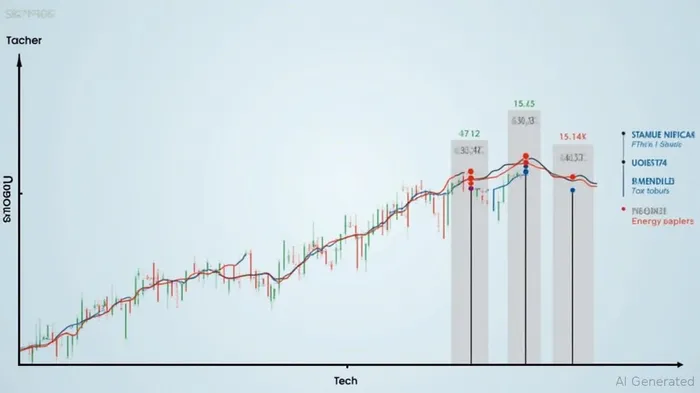
Key divergences:
1. Industrials (Marketperform, -13% underperformance YTD):
Despite the Fed's restrictive stance, industrials are pricing in a worst-case scenario. While tariffs on steel and aluminum (50% in some categories) have hurt margins, the sector's forward P/E of 16.2x is now below its 5-year average of 18.5x. Meanwhile, 85% of industrial companies beat earnings estimates in Q2, with logistics giants like J.B. Hunt Transport (JBHT) and XPO Logistics (XPO) reporting 12-15% revenue growth due to tight trucking capacity.
Contrarian Play: Overweight industrials via the iShares U.S. Industrials ETF (IYJ). A Fed rate cut in late 2025 could catalyze a rebound.
- Consumer Staples (Marketperform, -4.7% YTD):
Staples are the forgotten defensive sector. While utilities and real estate have attracted safe-haven flows, staples are cheaper—forward P/E of 19x vs. 22x in utilities—and benefit from rising consumer savings rates (now 6.5%, up from 3.5% in 2023). Procter & Gamble (PG) and Coca-Cola (KO) have delivered 5%+ EPS growth despite flat top-line results, signaling operational efficiency.
Contrarian Play: Buy staples via the Consumer Staples Select Sector SPDR Fund (XLP). Pair with put options on discretionary stocks like Amazon (AMZN) to hedge against tariff-driven slowdowns.
- Technology (Marketperform, -0.4% YTD):
Tech's underperformance relative to its 14.6% 12-month gains is puzzling. While retail investors have fled (STAX data shows 15% net selling in May), fundamentals remain robust. NVIDIA (NVDA) and AMD (AMD) are outpacing expectations in AI hardware sales, and cloud firms like Microsoft (MSFT) are pricing in enterprise spending resilience. The sector's 22x forward P/E is now in line with its 5-year average, despite 15% EPS growth forecasts for 2025.
Contrarian Play: Buy semiconductor ETFs (SMH) on dips below $500/share. Avoid pure-play AI stocks; focus on hardware and enterprise software.
Why Now? Fed Policy and Earnings Are Misaligned
The Fed's refusal to cut rates (despite GDP growth slowing to 1.7%) has created a disconnect between corporate earnings and market sentiment.
- Earnings Resilience: 78% of S&P 500 companies beat Q2 EPS estimates, with industrials (85%) and tech (80%) leading the charge.
- Fed's Tightrope Walk: While traders price in two rate cuts by year-end, the Fed's June statement emphasized “patience,” fearing a wage-inflation spiral. This creates a “buy the dip” dynamic for sectors like industrials and tech that can thrive in a slow-growth environment.
Risks and Trade Execution
- Trade Policy Volatility: A sudden tariff hike on EU goods (currently under negotiation) could reverse industrials' gains. Use stop-losses 10% below entry.
- Fed Surprise: If the Fed cuts rates in July (as CME data now suggests), utilities (XLU) and real estate (XLRE) could outperform, compressing industrials' upside.
- Earnings Downgrades: Monitor semiconductor inventories—SMH could underperform if AI demand softens.
Final Take: Divergence = Opportunity
The S&P 500's flat trajectory masks pockets of value in industrials, staples, and tech. Investors should:
- Overweight industrials (IYJ) for a Fed-driven rebound.
- Underweight Energy (XLE) despite high oil prices; geopolitical risks and oversupply remain.
- Hedge with staples (XLP) to balance volatility.
The path forward is uncertain, but sector divergence has created a rare asymmetry—low prices in resilient sectors versus high uncertainty in the broader index.
Invest with conviction, but trade with discipline.

Stay ahead of the market.
Get curated U.S. market news, insights and key dates delivered to your inbox.


AInvest
PRO
AInvest
PRO



Comments
No comments yet