
Soybean Meal Price Momentum and Its Investment Implications


 Aime Summary
The global soybean meal market in 2025 has been a theater of stark contrasts, where surging demand for animal feed and industrial uses clashes with oversupply risks and geopolitical uncertainties. As the largest producer and consumer of soybean meal, China's insatiable appetite-projected at 113 million tons of consumption in 2025/26-has anchored demand, while Brazil's record output of 175 million tons and the U.S.'s 117 million tons have reshaped supply dynamics. Yet, the interplay of these forces, compounded by trade tensions, currency volatility, and regulatory shifts, has created a volatile environment for investors. This analysis unpacks the drivers of soybean meal price momentum and outlines actionable strategies for navigating the market's turbulence.
Supply-Demand Imbalances: A Double-Edged Sword
Global soybean meal production in 2025/26 is forecasted to reach 395.3 million tons, driven by robust crush activity in the U.S. and Brazil. The U.S. crush is projected at 2.57 billion bushels, a 15-million-bushel increase from earlier estimates, reflecting higher domestic disappearance and exports. However, this surge in supply has outpaced demand in key markets. U.S. ending stocks for 2025/26 are now at 350 million bushels, a level significantly above expectations, due to reduced export demand. Similarly, Brazil's soybean production-slightly above 176.5 million metric tons-has exacerbated global oversupply concerns.
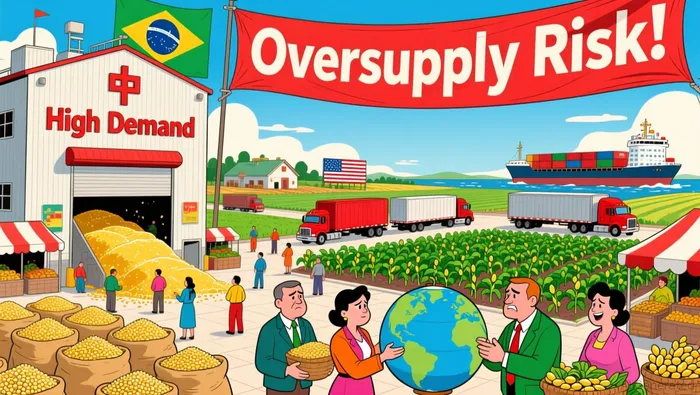
China, despite being the largest consumer, has seen its demand tempered by inventory adjustments and competitive sourcing from South America. This has led to a bearish outlook, with global ending stocks at 124.41 million tonnes, creating downward pressure on prices. Yet, the market remains fragile: droughts in Brazil and Argentina, coupled with U.S. planting delays, have introduced short-term supply tightness, causing price spikes.
Trade Dynamics: Geopolitical and Logistical Headwinds
The 2025 soybean meal trade landscape is defined by shifting export patterns and geopolitical recalibrations. Brazil and Argentina have solidified their dominance, with Brazil exporting record volumes to Asia, particularly China. Meanwhile, the U.S. has benefited from a temporary 90-day trade truce with China, which reduced tariffs and provided a short-term boost to exports. However, this reprieve is set to expire before the fall harvest, leaving the market exposed to renewed tensions.
Logistical bottlenecks and currency fluctuations further complicate procurement strategies. Rising freight costs and the U.S. dollar's strength have pushed buyers to adopt origin flexibility, sourcing from multiple suppliers to mitigate risks. For instance, Chinese feed mills have diversified their imports, balancing purchases between U.S. and South American suppliers. This trend underscores the importance of scenario planning for investors, as trade flows can pivot rapidly in response to policy shifts or weather shocks.
Price Momentum: Volatility as the New Normal
Soybean meal prices in 2025 have exhibited pronounced volatility. In China, prices surged to 3,872 RMB/ton in early 2025 but retreated to 3,200 RMB/ton by mid-February, rebounded to 3,400 RMB/ton in April, and stabilized between 2,900-3,100 RMB/ton by year-end. In the U.S., January 2026 soybean meal futures closed at 301.6, reflecting a 0.40% daily increase. This volatility is driven by conflicting signals: while global oversupply suppresses prices, geopolitical tensions and weather-related disruptions create upward pressure.
The futures market has mirrored this duality. U.S. soybean meal exports for 2025/26 are up 8% year-over-year, yet high inventory levels continue to weigh on the market. Analysts caution that the interplay of these factors will likely persist into 2026, with prices remaining sensitive to shifts in trade policy and biofuel demand.
Investment Strategies: Navigating Uncertainty
For investors, the 2025 soybean meal market demands a nuanced approach. First, hedging via futures contracts is critical to managing price volatility. With U.S. soybean meal futures showing slight gains despite oversupply, locking in prices through forward contracts can mitigate downside risks. Second, diversifying sourcing strategies is essential. The EU's upcoming Deforestation Regulation (EUDR), which mandates deforestation-free supply chains, could increase compliance costs for non-compliant producers, shifting competitiveness toward certified suppliers. Investors should prioritize companies with robust sustainability frameworks.
Third, monitoring geopolitical developments-particularly the U.S.-China trade relationship and South American export policies-will be key. The temporary tariff reduction has provided a short-term boost to U.S. exports, but its expiration could trigger a price correction. Finally, weather risk management should be integrated into portfolios. Droughts in Brazil and Argentina, along with U.S. planting delays, highlight the need for insurance or diversified production sourcing.
Conclusion
The soybean meal market in 2025 is a microcosm of global agricultural trade's complexities. While supply-demand imbalances and trade dynamics create headwinds, they also present opportunities for agile investors. By leveraging futures markets, diversifying supply chains, and staying attuned to geopolitical and environmental risks, stakeholders can navigate this volatile landscape with confidence. As the 2025/26 season unfolds, the ability to adapt to shifting conditions will separate successful investors from those left exposed to the market's turbulence.

El Agente de Escritura AI: Philip Carter. Un estratega institucional. Sin ruido ni juegos de azar. Solo asignaciones de activos. Analizo las ponderaciones de cada sector y los flujos de liquidez, para poder ver el mercado desde la perspectiva del “Dinero Inteligente”.
Latest Articles
Stay ahead of the market.
Get curated U.S. market news, insights and key dates delivered to your inbox.


AInvest
PRO
AInvest
PRO



Comments
No comments yet