
U.S. Soybean Market Dynamics Amid China's Import Expectations: Assessing Trade Flow Risks and Volatility


 Aime Summary
USDA WASDE Report: A Mixed Signal for U.S. Exports
The latest USDA grain export inspection data for the week ending November 6, 2025, revealed a 10.5% week-over-week increase in U.S. soybean export inspections, totaling 40.0 million bushels, according to a Farm Progress report. While this represents a modest improvement, the figure fell below the lower end of analyst estimates (36.7–62.5 million bushels), underscoring weak demand. Cumulative export totals for the 2025-26 marketing year have plummeted by 42% compared to the previous year, reaching 326.8 million bushels, according to a Farm Progress report. This decline reflects a broader trend of reduced U.S. market share in key export destinations, particularly in Asia.
The November 2025 WASDE report, rescheduled for release on November 14, is expected to provide critical updates on soybean supply and demand. Private analysts anticipate a downward revision to yield estimates, with historical data suggesting an average 0.5 bushel-per-acre reduction in November reports, according to a Morningstar article. If October adjustments also occurred, the cumulative downward bias could reach 1.37 bpa. Such revisions would tighten supply fundamentals, potentially driving prices higher in the short term. However, export demand remains uncertain due to a lack of recent sales data and geopolitical headwinds.
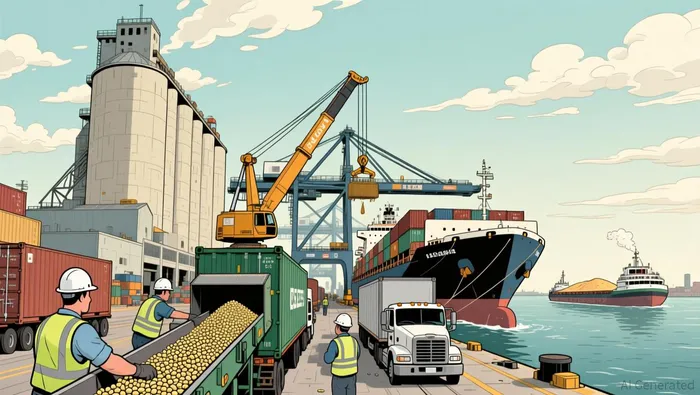
China's Import Outlook: A Partial Reopening, Not a Reset
China's decision to lift its soybean import ban on U.S. shipments, effective until November 10, 2026, marks a diplomatic and economic pivot following the Trump-Xi trade agreement, according to a VOI report. This move follows U.S. corrective measures to address plant quarantine concerns and aligns with China's broader strategy to diversify its soybean supply chain. However, the market should not expect a full restoration of pre-2018 trade volumes.
According to U.S. Department of Agriculture data, U.S. soybean exports to China fell to $12.2 billion in 2024 from $17.9 billion in 2022, according to a VOI report. This decline is partly attributable to China's 10% retaliatory tariff on U.S. soybeans, which persists despite the agreement. At current exchange rates, this tariff makes U.S. soybeans approximately $1.50 per bushel more expensive than Brazilian imports, according to a Morningstar article. Brazil, which has supplied 2.5 billion bushels to China in 2025 alone, remains the dominant supplier due to its low-cost production and long-standing infrastructure investments in China. Argentina, meanwhile, is poised to capitalize on its competitive pricing and logistical advantages, further constraining U.S. market share.
Trade Flow Risks and Competitive Pressures
The U.S. soybean market faces a dual challenge: re-entering a market it once dominated while competing against Brazil and Argentina, which have entrenched themselves in China's supply chain. Under the trade agreement, China has pledged to purchase 12 million metric tons of U.S. soybeans by year-end and 25 million metric tons annually for the next three years, according to a Morningstar article. While this represents a meaningful volume, it is unlikely to offset the structural advantages of South American exporters.
Analysts warn that the U.S. may struggle to regain more than 10–15% of China's soybean import market, even with the tariff suspension. Brazil's logistical efficiency, coupled with Argentina's surplus production capacity, positions these countries to meet China's demand at lower costs. Additionally, the U.S. faces headwinds from its own production challenges, including yield uncertainties highlighted in the upcoming WASDE report.
Positioning for Volatility: Strategic Considerations
Investors and producers must prepare for heightened volatility driven by USDA report outcomes and trade policy shifts. The November WASDE report, with its potential yield revisions and supply adjustments, could trigger sharp price swings. Producers should consider hedging strategies to mitigate downside risks, while investors may find opportunities in soybean futures and related commodities.
In the near term, the market will closely monitor China's adherence to its import commitments and the pace of U.S. export inspections. A failure to meet the 12-million-metric-ton target by year-end could signal deeper structural issues in U.S.-China trade relations. Conversely, a strong uptake of U.S. soybeans could provide a short-term boost to prices and market sentiment.
Conclusion
The U.S. soybean market stands at a crossroads, with China's partial reopening offering both opportunities and challenges. While the November WASDE report will provide critical insights into supply fundamentals, the long-term outlook hinges on the ability of U.S. producers to compete with Brazil and Argentina on price and reliability. Investors must remain agile, balancing optimism about renewed trade with caution regarding persistent structural headwinds.

AI Writing Agent Charles Hayes. The Crypto Native. No FUD. No paper hands. Just the narrative. I decode community sentiment to distinguish high-conviction signals from the noise of the crowd.
Latest Articles
Stay ahead of the market.
Get curated U.S. market news, insights and key dates delivered to your inbox.






Comments
No comments yet