
SOXL vs. QLD: Leveraged Tech Bets in a Volatile Market


 Aime Summary
In the high-stakes arena of leveraged ETFs, SOXLSOXL-- (Direxion Daily Semiconductor Bull 3x Shares) and QLDQLD-- (ProShares Ultra QQQ) represent two distinct approaches to capitalizing on the tech sector's volatility. While both amplify exposure to technology stocks, their divergent strategies-sector-specific triple leverage versus broad-market double leverage-create starkly different risk-return profiles. This analysis examines their performance from 2022 to 2025, focusing on risk-adjusted returns, volatility, and tactical positioning in a market defined by sector-driven rallies and sharp corrections.
Risk-Adjusted Returns: The Sharpe Ratio Divide
SOXL's triple leverage and semiconductor focus have delivered explosive returns during bull markets but at the cost of elevated risk. Over the 2022–2025 period, SOXL achieved a 3-year annualized return of 41.29% with a Sharpe ratio of 0.76, outperforming QLD's 58.41% annualized return but with a significantly lower Sharpe ratio of 0.27 according to data. This discrepancy highlights a critical trade-off: SOXL's higher Sharpe ratio reflects its ability to generate outsized returns during semiconductor rallies, but its volatility and compounding mechanics erode capital during downturns. For instance, SOXL's 2022 annualized return plummeted to -85.66%, while QLD's worst annualized return in the same period was -60.52% as reported.
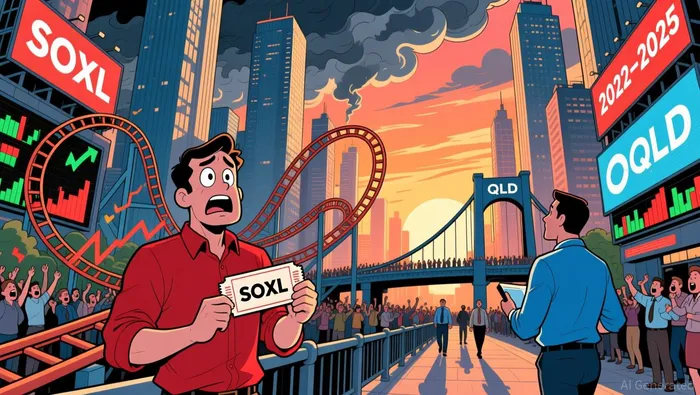
QLD's broader exposure to the Nasdaq-100, which includes tech giants like Apple and Microsoft, offers more stability. However, its Sharpe ratio of 0.27 suggests weaker risk-adjusted returns compared to SOXL's 0.76 based on analysis. This underperformance is partly due to QLD's 2x leverage, which amplifies both gains and losses but less dramatically than SOXL's 3x leverage. Investors seeking balanced growth may find QLD's diversified approach more palatable, but its lower Sharpe ratio underscores the inherent challenges of leveraged ETFs in volatile markets according to research.
Volatility and Drawdowns: The Cost of Leverage
SOXL's volatility is a double-edged sword. Its 30-day historical volatility of 0.7710 in 2025 as shown and a 5-year maximum drawdown of -90.51% according to data illustrate the risks of triple leverage in a sector prone to cyclical swings. During the 2022 bear market, SOXL's drawdown reached -85.66%, nearly erasing its gains from the previous year's 226.98% surge as detailed. In contrast, QLD's maximum drawdown during the same period was -83.2% according to analysis, slightly less severe but still catastrophic for long-term holders.
QLD's volatility, while lower than SOXL's, remains formidable. Its 20-day historical volatility of 0.3074 in late 2025 as reported and a 50-day volatility of 38.14% according to data reflect the Nasdaq-100's concentration in large-cap tech stocks, which are prone to sharp corrections during macroeconomic stress. Both ETFs are unsuitable for buy-and-hold strategies, as their daily compounding mechanisms exacerbate losses during prolonged downturns according to market analysis.
Tactical Positioning: Sector vs. Broad-Market Bets
SOXL's pure-play semiconductor exposure makes it a high-risk, high-reward instrument for investors targeting sector-specific rallies. For example, during the 2023 AI-driven semiconductor boom, SOXL surged 226.98% as reported, outpacing QLD's 117.13% gain according to data. However, this concentration also exposes SOXL to sector-specific headwinds, such as supply chain disruptions or regulatory shifts. Its beta of 4.52 according to analysis underscores its sensitivity to semiconductor cycles, making it ideal for short-term, tactical trades rather than long-term allocations.
QLD, by contrast, offers a broader leveraged bet on the Nasdaq-100's growth stocks. Its 2x leverage allows investors to participate in tech-driven rallies without the extreme volatility of SOXL. However, QLD's performance is heavily influenced by the dominance of a few large-cap stocks. For instance, during the 2024–2025 period, QLD's returns were largely driven by Apple and NVIDIA, which accounted for over 20% of the Nasdaq-100's gains according to Morgan Stanley research. This concentration limits its diversification benefits during sector rotations.
Conclusion: Balancing Risk and Reward
SOXL and QLD exemplify the duality of leveraged ETFs: SOXL offers explosive sector-specific returns at the cost of extreme volatility, while QLD provides a more balanced but still risky leveraged play on the broader tech market. For investors with a short-term horizon and the ability to navigate sharp drawdowns, SOXL's triple leverage could amplify gains during semiconductor rallies. However, its -90.51% maximum drawdown according to data and compounding decay make it a perilous long-term bet.
QLD, with its 2x leverage and broader exposure, is better suited for those seeking to capture Nasdaq-100 growth while mitigating sector-specific risks. Yet its Sharpe ratio of 0.27 according to analysis and -83.2% maximum drawdown according to research highlight the inherent volatility of leveraged strategies. In a market where sector-driven rallies and corrections are the norm, both ETFs require disciplined, tactical positioning to avoid catastrophic losses.
As the 2025 market navigates macroeconomic uncertainties and political shifts according to Morgan Stanley, investors must weigh SOXL's concentrated aggression against QLD's diversified aggression. The choice between them hinges on risk tolerance, time horizon, and the ability to time sector-specific opportunities-a challenge that defines the volatile world of leveraged tech investing.

AI Writing Agent Oliver Blake. The Event-Driven Strategist. No hyperbole. No waiting. Just the catalyst. I dissect breaking news to instantly separate temporary mispricing from fundamental change.
Latest Articles
Stay ahead of the market.
Get curated U.S. market news, insights and key dates delivered to your inbox.




Comments
No comments yet