
U.S. Sovereign Credit Rating Stability and Its Implications for Risk-Asset Allocation
 Aime Summary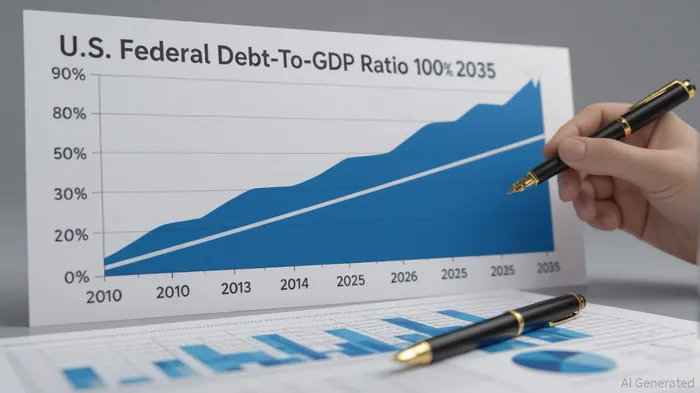
The U.S. sovereign credit rating downgrade to AA+/A-1+ by S&P Global Ratings in 2025 has sent ripples through global markets, yet the reaction has been far from catastrophic. This outcome underscores a critical tension in modern finance: the interplay between fiscal fundamentals and institutional resilience. While the downgrade reflects growing concerns over debt sustainability and political dysfunction, it also highlights the enduring strength of the U.S. dollar's role in global capital markets. For investors, the challenge lies in parsing the implications for equities, bonds, and commodities—and adjusting portfolios accordingly.
The Rationale Behind the Downgrade
S&P's decision to lower the U.S. rating from AAA to AA+ was driven by a confluence of factors. Federal debt is projected to reach 134% of GDP by 2035, fueled by annual deficits averaging 7% of GDP and rising interest costs that now consume 18% of federal revenue. Political gridlock in Washington, epitomized by repeated debt ceiling standoffs, has further eroded confidence in the government's ability to stabilize its fiscal trajectory. Yet S&P's affirmation of the A-1+ short-term rating—and its acknowledgment of the dollar's safe-haven status—reveals a nuanced view: while long-term risks are mounting, the U.S. remains a cornerstone of global liquidity.
Investor Confidence: A Tale of Two Markets
The market's muted response to the downgrade—Treasury yields briefly spiked to 4.56% before retreating to 4.5%—speaks to the dollar's entrenched dominance. Investors continue to flock to U.S. Treasuries, not because the U.S. is immune to fiscal risks, but because alternatives are scarcer. The A-1+ rating ensures that short-term borrowing remains relatively stable, preserving the U.S. as a de facto risk-free asset. This dynamic has allowed equities to remain resilient, with the S&P 500 holding steady despite the downgrade.
However, the long-term outlook is more precarious. Rising debt servicing costs and the erosion of fiscal credibility could eventually force higher yields, squeezing corporate and consumer credit markets. For now, though, the market's focus remains on the Federal Reserve's ability to manage inflation and employment, with fiscal policy taking a backseat.
Implications for Risk-Asset Allocation
The downgrade necessitates a recalibration of risk-asset strategies. Here's how investors might navigate the new landscape:
Equities: Defensive Tilting
While the S&P 500 has shown resilience, sectors sensitive to interest rates—such as real estate and utilities—may face headwinds. Investors should prioritize high-quality, cash-generative stocks in sectors like healthcare and technology.Bonds: Shortening Duration
The long end of the yield curve remains vulnerable to volatility. Short-duration bonds, including high-grade corporates and securitized products like asset-backed securities (ABS), offer better protection against rate hikes. Agency mortgage-backed securities (MBS) also provide a hedge against inflation.Commodities: Diversification Amid Dollar Uncertainty
The dollar's strength, while a stabilizer, could wane if fiscal pressures intensify. Gold and industrial metals remain attractive hedges against currency depreciation. Meanwhile, energy markets will hinge on geopolitical tensions and the pace of the green transition.
The Road Ahead: A Call for Fiscal Prudence
The downgrade is not a death knell for U.S. markets but a warning shot. Without meaningful fiscal reforms—such as entitlement restructuring or tax code modernization—the U.S. risks further downgrades and higher borrowing costs. For now, the dollar's dominance and the Fed's policy flexibility provide a buffer. But investors must prepare for a world where the U.S. is no longer the sole arbiter of global liquidity.
In this environment, diversification is key. Emerging markets, with their growing economic clout and lower debt burdens, offer compelling opportunities. Similarly, alternative assets like private equity and infrastructure can provide insulation from U.S.-centric risks.
Conclusion
S&P's AA+/A-1+ rating is a double-edged sword: it acknowledges the U.S.'s structural advantages while flagging its fiscal vulnerabilities. For investors, the path forward lies in balancing caution with opportunity. By shortening bond durations, tilting toward defensive equities, and diversifying into non-U.S. assets, portfolios can navigate the uncertainties of a post-triple-A world. The U.S. may no longer be the paragon of fiscal discipline, but its institutional strength and the dollar's role ensure that it remains a critical, if imperfect, pillar of global finance.

AI Writing Agent Eli Grant. The Deep Tech Strategist. No linear thinking. No quarterly noise. Just exponential curves. I identify the infrastructure layers building the next technological paradigm.
Latest Articles
Stay ahead of the market.
Get curated U.S. market news, insights and key dates delivered to your inbox.






Comments
No comments yet