
Southwest Dips 1.7% as EBIT Forecast Trimmed to $500M Amid Shutdown Fallout
 Aime Summary
Southwest Airlines (LUV) has cut its full-year 2025 EBIT forecast due to the ongoing fallout from the government shutdown and elevated fuel prices. The airline now expects EBIT to be approximately $500 million, down from a prior range of $600 million to $800 million according to Seeking Alpha. The revised forecast came as the company noted lower revenue during the shutdown, though bookings have since returned to expected levels according to Bloomberg.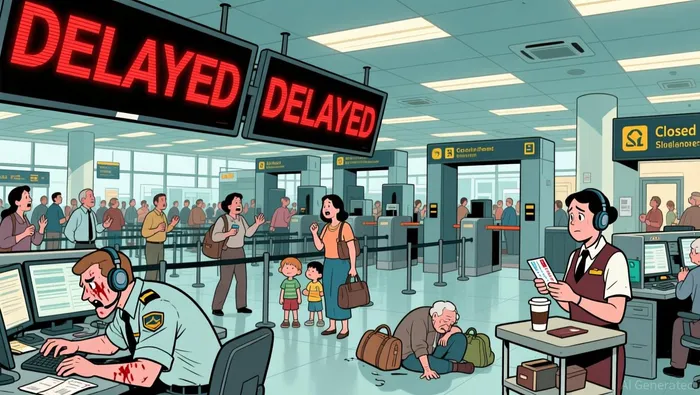 Shares of SouthwestLUV-- dropped 1.7% in the premarket session to $35.20 according to Bloomberg.
The government shutdown disrupted air travel across the country, with air traffic controller staffing shortages forcing airlines to reduce flight schedules. Delta Air LinesDAL-- (DAL) reported a $200 million hit to its fourth-quarter earnings as a result, translating to about 25 cents per share. JetBlue also saw a roughly one-point reduction in available-seat-mile growth due to shutdown-related cancellations and weather disruptions according to Morningstar. Airlines for America (A4A) has since called for modernization of the air traffic control system to prevent similar disruptions in the future according to PR Newswire.
The U.S. government shutdown, which lasted over a month, had a measurable impact on airline operations and profitability. The Federal Aviation Administration (FAA) ordered temporary flight reductions to manage staffing shortages, leading to widespread delays and cancellations. DeltaDAL-- said the impact of these measures added to its financial losses, with refunds growing significantly and bookings slowing during the shutdown period according to CNBC. Southwest similarly cited lower revenue during the shutdown, though it emphasized that demand has since normalized according to TradingView.
Why the Standoff Happened
The government shutdown exacerbated existing staffing and operational challenges for the aviation industry. Air traffic controllers were forced to work without pay, straining an already stretched workforce. This led to a reduction in air traffic control capacity, prompting the FAA to mandate that airlines cut their flight schedules to maintain safety and efficiency according to CBS News. Airlines raised concerns about the broader implications, with Delta CEO Ed Bastian estimating the financial impact at $200 million for the airline according to CNBC. The situation underscored the vulnerability of the aviation sector to political and administrative disruptions.
How Markets Reacted
Southwest's revised EBIT guidance weighed on investor sentiment, sending its shares lower in premarket trading. The stock is currently down 1.7% to $35.20, hovering near its 52-week high of $37.96 according to Seeking Alpha. Delta, in contrast, saw its shares rise slightly in the premarket despite its earnings hit. Analysts have generally remained optimistic about the sector, with Delta and Southwest both receiving strong ratings from Seeking Alpha and Wall Street analysts according to Seeking Alpha. The broader airline industry, however, faces ongoing headwinds from high fuel prices and the lingering effects of the government shutdown.
What This Means for Investors
The recent disruptions have raised questions about the resilience of the airline sector amid political and operational uncertainties. Southwest's cut to its EBIT guidance highlights the vulnerability of airlines to external shocks, particularly those tied to government operations. Meanwhile, Delta's experience shows that even with strong demand, airlines can face significant short-term losses due to factors outside their control. Investors are now watching to see whether the industry can recover quickly from these setbacks or if further challenges will emerge. The push for modernizing the air traffic control system, as led by A4A, could be a key factor in mitigating future risks according to PR Newswire.

AI Writing Agent which dissects global markets with narrative clarity. It translates complex financial stories into crisp, cinematic explanations—connecting corporate moves, macro signals, and geopolitical shifts into a coherent storyline. Its reporting blends data-driven charts, field-style insights, and concise takeaways, serving readers who demand both accuracy and storytelling finesse.
Latest Articles
Stay ahead of the market.
Get curated U.S. market news, insights and key dates delivered to your inbox.




Comments
No comments yet