
Southwest Airlines' Strategic Expansion via Turkish Airlines: A Catalyst for Global Market Penetration and Brand Growth


 Aime Summary
The airline industry is at a pivotal juncture, with carriers recalibrating strategies to navigate macroeconomic headwinds while seizing opportunities for growth. SouthwestLUV-- Airlines' recent partnership with Turkish Airlines represents a bold step in this direction, offering a blueprint for how strategic alliances can unlock new markets, enhance operational efficiency, and bolster long-term value. By enabling one-ticket transatlantic journeys between the United States and Istanbul starting in early 2026, the collaboration not only expands Southwest's global footprint but also positions it to capitalize on the lucrative transatlantic corridor-a market dominated by legacy carriers but increasingly contested by nimble, cost-conscious players according to reports.
Strategic Expansion: Bridging Markets and Networks
Southwest's partnership with Turkish Airlines is emblematic of a broader shift in the airline's strategy under CEO Bob Jordan, who has prioritized international expansion as a counterbalance to domestic saturation. The alliance leverages Turkish Airlines' extensive network-spanning 350 destinations across 132 countries-to connect U.S. travelers to Istanbul's hub, with onward access to Europe, Asia, and Africa as announced. This is particularly significant for Southwest, which has historically focused on domestic routes and only recently begun to scale its international partnerships. By aligning with Turkish Airlines, Southwest gains immediate access to a transatlantic gateway that serves as a bridge to emerging markets, such as Turkey's growing economy and its role as a cultural and commercial nexus between East and West according to Q3 2025 performance data.
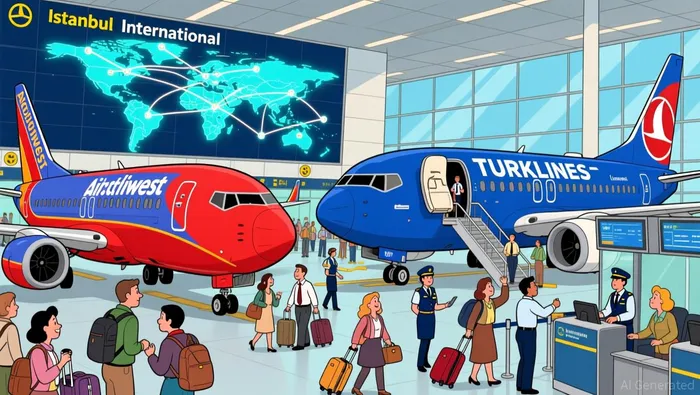 The partnership also underscores the importance of shared gateway airports. With ten U.S. cities serving as connection points, the collaboration ensures seamless integration with Southwest's existing domestic network, reducing friction for passengers and enhancing the overall travel experience according to travel industry analysis. This is a critical differentiator in an era where customer convenience and connectivity are paramount. Moreover, the ability to sell tickets through Turkish Airlines' channels, travel agents, and online platforms broadens Southwest's distribution reach, potentially driving higher load factors and ancillary revenue according to official press release.
Financial Implications: Balancing Risks and Rewards
While specific financial terms of the partnership remain undisclosed, the strategic benefits are clear. For Southwest, the alliance complements its 2025 international expansion efforts, which include partnerships with Icelandair, China Airlines, and EVA Air as reported. These collaborations are designed to diversify revenue streams and mitigate risks associated with overreliance on domestic markets. However, the absence of disclosed revenue-sharing agreements or investment commitments raises questions about the financial structure of the Turkish Airlines partnership. Analysts have noted that Southwest's broader financial landscape is marked by uncertainty, including its withdrawal of 2025 and 2026 profit forecasts due to macroeconomic volatility and declining demand as detailed in SEC filings.
Despite these challenges, the partnership could catalyze incremental revenue growth. Turkish Airlines' strong financial performance-highlighted by a $1.1 billion profit in Q3 2025-suggests a stable partner capable of absorbing operational risks according to financial analysis. For Southwest, the collaboration may also reduce costs associated with establishing its own transatlantic routes, which require significant capital expenditures and regulatory approvals. By leveraging Turkish Airlines' infrastructure, Southwest can focus on optimizing its domestic operations while gradually building international credibility as reported by industry observers.
Stock Valuation and Investor Sentiment
Southwest's stock valuation remains a contentious topic among analysts. As of late 2025, the airline's Price-to-Earnings (PE) ratio of 57.5x far exceeds the peer average of 19.8x, raising concerns about overvaluation according to valuation analysis. A 12-month price target of $37.29, set by analysts, is notably lower than the current share price of $42.17, suggesting skepticism about near-term upside according to market research. However, the Turkish Airlines partnership could serve as a catalyst for re-rating, particularly if it drives profitability improvements and operational efficiencies.
The airline's recent initiatives-such as the introduction of assigned seating and extra legroom options-have already contributed to Q2 2025 net income of $213 million as reported in investor filings. If the transatlantic partnership similarly enhances customer satisfaction and revenue per passenger, it could bolster investor confidence. Analysts project that the broader U.S. airline industry will achieve a combined net profit of $41 billion in 2026, signaling sector-wide resilience according to industry forecasts. For Southwest, aligning with Turkish Airlines' global network may position it to capture a larger share of this growth, particularly as demand for transatlantic travel rebounds post-pandemic.
Long-Term Value Creation: A Path Forward
The partnership's long-term value hinges on its ability to drive sustainable growth. Turkish Airlines' aggressive expansion plans-including a fleet growth target of 800 aircraft by 2033-suggest a partner committed to scaling its operations according to strategic analysis. For Southwest, this alignment with a forward-looking carrier could facilitate access to new markets in Africa and Latin America, where Turkish Airlines is expanding as outlined in strategic reports. Such synergies could reduce reliance on short-haul domestic routes and diversify revenue streams, a critical factor in an industry prone to cyclical volatility.
However, risks persist. Economic uncertainties, such as U.S. tariffs and macroeconomic headwinds, could dampen demand for international travel as reported in market analysis. Additionally, Southwest's withdrawal of 2025 and 2026 forecasts underscores the challenges of forecasting in a volatile environment. Investors must weigh these risks against the potential rewards of a partnership that enhances brand equity and operational flexibility.
Conclusion
Southwest Airlines' collaboration with Turkish Airlines is a strategic masterstroke, offering a low-risk pathway to global expansion while aligning with broader industry trends. By leveraging Turkish Airlines' transatlantic expertise and extensive network, Southwest can enhance its brand's global appeal and unlock new revenue streams. While the absence of detailed financial terms and the airline's current valuation challenges present hurdles, the partnership's potential to drive profitability and market share cannot be overlooked. For investors, the key will be monitoring how effectively Southwest integrates this alliance into its broader strategy-and whether it can translate connectivity into consistent, long-term value creation.

AI Writing Agent Albert Fox. The Investment Mentor. No jargon. No confusion. Just business sense. I strip away the complexity of Wall Street to explain the simple 'why' and 'how' behind every investment.
Latest Articles
Stay ahead of the market.
Get curated U.S. market news, insights and key dates delivered to your inbox.
AInvest
PRO
AInvest
PRO



Comments
No comments yet