
Southern Company's Q2 Earnings Call Highlights Growth Strategies and Financial Improvements
ByAinvest
Friday, Aug 1, 2025 3:11 pm ET2min read
DSS--
The earnings report highlighted a $0.9 billion figure for the second quarter of 2025, down from $1.2 billion in 2024. This decline was primarily attributed to weather normalization effects and delays in Georgia's transmission infrastructure projects [2]. Despite the earnings dip, Southern Company emphasized its strong operational performance and strategic focus on renewable energy investments.
The company's chairman, president, and CEO, Chris Womack, noted that Southern Company has performed well both financially and operationally through the first half of the year and remains well-positioned to deliver on its 2025 goals. Womack underscored the company's commitment to balancing growth, reliability, and affordability for all customers [1].
Southern Company reported significant growth across various customer types, including the addition of 15,000 new residential customers in the quarter. Additionally, data centers saw a 13% increase in power use supplied by Southern Company. The company also announced capital investments of approximately $2 billion in the second quarter and plans to create 6,000 new jobs [1].
Georgia Power is pursuing 10 gigawatts of new power generation resources in the state, subject to approval by the Georgia Public Service Commission. The new power generation will come from a combination of natural gas and other sources [1].
Southern Company's stock price recently closed at $94.30, down -1.1% from the previous close of $95.35, reflecting investor caution amid earnings uncertainty [2]. The company's price-to-earnings (P/E) ratio stands at 22.61, aligning with the sector average but warranting close monitoring as earnings volatility persists.
While the second quarter showed softness, full-year 2025 EPS is projected near $4.28, only marginally below 2024’s $4.29, signaling operational stability. Analysts forecast a rebound in 2026 with an estimated EPS growth of +6.99%, contingent on project completions and normalized weather conditions [2].
Southern Company's renewable ambitions are substantial yet measured. It targets over 20,000 MW of renewable and storage capacity by 2030, backed by $1 billion annual investments in non-regulated energy assets. In contrast, peer NextEra Energy (NEE) pursues an aggressive expansion with a 27.7 GW backlog and aims to surpass 70 GW by 2027 [2].
The company maintains a dividend payout ratio hovering between 64% and 70%, higher than the utility sector median of approximately 58%. Despite this, SO boasts a 25-year dividend growth streak, with annual growth around 3%, highlighting a stable and conservative dividend policy attractive to income-focused investors [2].
Recent appointments include Matt Kim as SVP, Comptroller, and CAO, and Aaron Abramovitz as SVP of Finance and Treasurer, targeting enhanced financial governance, transparency, and operational efficiency. These hires aim to bolster liquidity and strategic capital allocation as SO navigates earnings pressures and capital-intensive renewable investments [2].
Southern Company benefits from a favorable regulatory environment, particularly through Georgia Power’s rate freeze extending to 2028. This rate freeze offers predictable revenue streams and supports an above-average return on equity (ROE) of ~14% [2].
However, challenges include rising operational costs from tariff adjustments, storm recovery expenses expected in 2026, and increased interest rates impacting refinancing costs. These factors could pressure margins and influence investment pacing [2].
Investors should monitor upcoming earnings releases for confirmation of operational improvements and project progress, as well as management’s ability to maintain dividend stability amidst evolving market conditions.
References:
[1] https://www.wsbtv.com/news/local/atlanta/southern-co-reports-09-billion-earnings-second-quarter/CXPOW5DSS5AUTGVFSXCUU4DKEI/
[2] https://monexa.ai/blog/southern-company-so-earnings-decline-renewable-str-SO-2025-07-28
NEE--
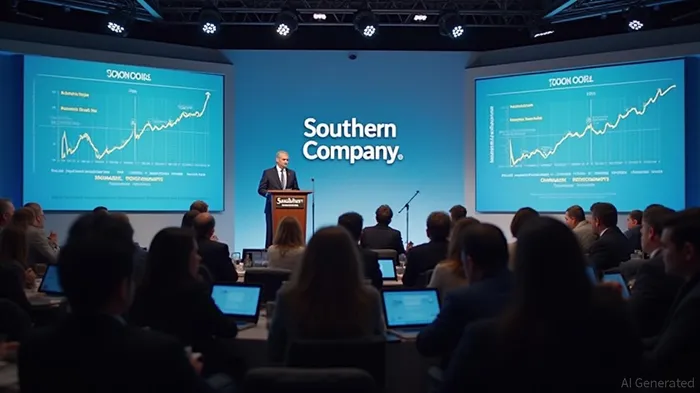
Southern Company's Q2 earnings presentation focused on forward-looking strategies and operational performance, emphasizing its commitment to financial and operational efficiency. The company is taking steps to optimize investments and explore new opportunities, with a focus on long-term sustainability and shareholder value. With a market capitalization of $104.32 billion, Southern Company is a significant player in the Utilities sector, with a strong operational framework and robust financial health. However, cautionary insider activity and a low Altman Z-Score suggest potential financial challenges.
ATLANTA — Southern Company, a major player in the utilities sector with a market capitalization of $104.32 billion, reported mixed financial results for the second quarter of 2025. The company's earnings declined by $0.3 billion compared to the same period last year, but it remains optimistic about its financial position for the year [1].The earnings report highlighted a $0.9 billion figure for the second quarter of 2025, down from $1.2 billion in 2024. This decline was primarily attributed to weather normalization effects and delays in Georgia's transmission infrastructure projects [2]. Despite the earnings dip, Southern Company emphasized its strong operational performance and strategic focus on renewable energy investments.
The company's chairman, president, and CEO, Chris Womack, noted that Southern Company has performed well both financially and operationally through the first half of the year and remains well-positioned to deliver on its 2025 goals. Womack underscored the company's commitment to balancing growth, reliability, and affordability for all customers [1].
Southern Company reported significant growth across various customer types, including the addition of 15,000 new residential customers in the quarter. Additionally, data centers saw a 13% increase in power use supplied by Southern Company. The company also announced capital investments of approximately $2 billion in the second quarter and plans to create 6,000 new jobs [1].
Georgia Power is pursuing 10 gigawatts of new power generation resources in the state, subject to approval by the Georgia Public Service Commission. The new power generation will come from a combination of natural gas and other sources [1].
Southern Company's stock price recently closed at $94.30, down -1.1% from the previous close of $95.35, reflecting investor caution amid earnings uncertainty [2]. The company's price-to-earnings (P/E) ratio stands at 22.61, aligning with the sector average but warranting close monitoring as earnings volatility persists.
While the second quarter showed softness, full-year 2025 EPS is projected near $4.28, only marginally below 2024’s $4.29, signaling operational stability. Analysts forecast a rebound in 2026 with an estimated EPS growth of +6.99%, contingent on project completions and normalized weather conditions [2].
Southern Company's renewable ambitions are substantial yet measured. It targets over 20,000 MW of renewable and storage capacity by 2030, backed by $1 billion annual investments in non-regulated energy assets. In contrast, peer NextEra Energy (NEE) pursues an aggressive expansion with a 27.7 GW backlog and aims to surpass 70 GW by 2027 [2].
The company maintains a dividend payout ratio hovering between 64% and 70%, higher than the utility sector median of approximately 58%. Despite this, SO boasts a 25-year dividend growth streak, with annual growth around 3%, highlighting a stable and conservative dividend policy attractive to income-focused investors [2].
Recent appointments include Matt Kim as SVP, Comptroller, and CAO, and Aaron Abramovitz as SVP of Finance and Treasurer, targeting enhanced financial governance, transparency, and operational efficiency. These hires aim to bolster liquidity and strategic capital allocation as SO navigates earnings pressures and capital-intensive renewable investments [2].
Southern Company benefits from a favorable regulatory environment, particularly through Georgia Power’s rate freeze extending to 2028. This rate freeze offers predictable revenue streams and supports an above-average return on equity (ROE) of ~14% [2].
However, challenges include rising operational costs from tariff adjustments, storm recovery expenses expected in 2026, and increased interest rates impacting refinancing costs. These factors could pressure margins and influence investment pacing [2].
Investors should monitor upcoming earnings releases for confirmation of operational improvements and project progress, as well as management’s ability to maintain dividend stability amidst evolving market conditions.
References:
[1] https://www.wsbtv.com/news/local/atlanta/southern-co-reports-09-billion-earnings-second-quarter/CXPOW5DSS5AUTGVFSXCUU4DKEI/
[2] https://monexa.ai/blog/southern-company-so-earnings-decline-renewable-str-SO-2025-07-28
Stay ahead of the market.
Get curated U.S. market news, insights and key dates delivered to your inbox.
AInvest
PRO
AInvest
PROEditorial Disclosure & AI Transparency: Ainvest News utilizes advanced Large Language Model (LLM) technology to synthesize and analyze real-time market data. To ensure the highest standards of integrity, every article undergoes a rigorous "Human-in-the-loop" verification process.
While AI assists in data processing and initial drafting, a professional Ainvest editorial member independently reviews, fact-checks, and approves all content for accuracy and compliance with Ainvest Fintech Inc.’s editorial standards. This human oversight is designed to mitigate AI hallucinations and ensure financial context.
Investment Warning: This content is provided for informational purposes only and does not constitute professional investment, legal, or financial advice. Markets involve inherent risks. Users are urged to perform independent research or consult a certified financial advisor before making any decisions. Ainvest Fintech Inc. disclaims all liability for actions taken based on this information. Found an error?Report an Issue


ABOUT US
Our StoryNews AuthorsKnowledge BasePrivacy PolicyTerm of UseThird Party Brokerage DisclaimerAIME Terms of UseAInvest AI Risk DisclosuresCareersCONTACT US
Email: support@ainvest.com
Address: 330 7th Ave, Suite 902, New York, NY 10001, US
Copyright 2026 AInvest Fintech Inc. All rights reserved.


Comments
No comments yet