
South Korean President Lee Jae-myung Meets Chaebols to Boost Market Confidence
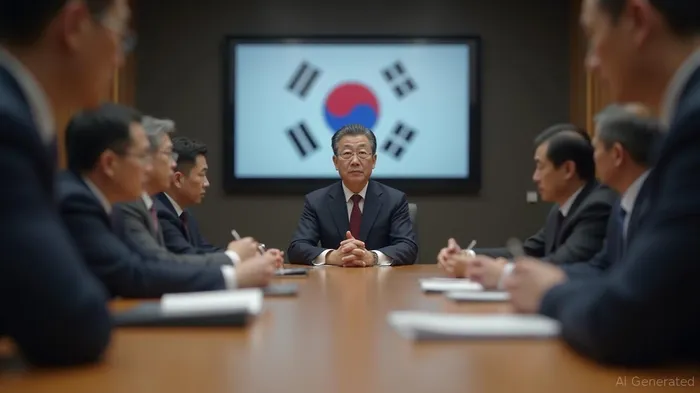
South Korean President Lee Jae-myung convened a meeting with the heads of the country’s largest conglomerates, known as chaebols, to address public distrust and restore market confidence. This gathering marked the first time the new president engaged with these powerful business leaders since taking office. The meeting was a delicate balancing act for Lee, who sought to appeal to the economic clout of the chaebols while reassuring them on trade negotiations and signaling his intent to curb their outsized influence in Asia’s fourth-largest economy.
During the meeting, Lee emphasized the need for the chaebols to help alleviate the lingering skepticism surrounding their operations. He stated, “Our economy can no longer sustain growth through unfair competition, special privileges for, or exploitation of some actors like it did in the past.” The chaebols, which include Samsung Group, SK Group, Hyundai Motor Group, LG GroupLPL--, and Lotte Group, have long been a key engine of growth for the South Korean economy, giving them broad sway over business and society.
Lee has pledged to rewrite the commercial code to weed out the rubber-stamping of corporate decisions by directors. The revised code aims to strengthen the duty of company boards to shareholders, improve corporate governance, and tackle the so-called Korea discount that has been a long-standing grievance among global investors. However, ahead of his trip to Canada to attend the Group of Seven summit, Lee found many executives at the meeting expressing more immediate concern about the impact of trade protectionism.
SK Group Chairman Chey Tae-won highlighted the intensifying U.S.-China rivalry as one of the key risks facing businesses in South Korea, along with weak domestic demand, subdued investment sentiment, and an aging population. Samsung Electronics Co. Executive Chairman Jay Y. Lee went further, comparing the current environment to the Asian financial crisis of the late 1990s. South Korea remains a critical player in global supply chains, producing everything from smartphones and semiconductors to ships and EVs, making its economy heavily dependent on trade to power growth with exports equivalent in size to more than 40% of gross domestic product.
Hyundai Motor, one of the world’s biggest automakers, has pledged to invest $21 billion in the U.S., a move that Lee can flag to Trump should they meet in Canada. However, carmakers may face yet another hike in duties after Trump said he was considering raising auto tariffs even higher than the recently introduced 25% level to support the industry in the U.S. With the deadline for imposing reciprocal tariffs approaching early next month, Trump is keen to show progress in reaching deals with key economies that have large trade surpluses with the U.S.
Talks between Washington and Seoul have been held back by the leadership vacuum and domestic political unrest before Lee’s election win. The president's initiative to engage with the chaebols underscores the government's commitment to addressing economic challenges through collaborative efforts. By working together, the government and the private sector can create a more resilient and trustworthy business environment, which is essential for long-term economic prosperity. The meeting also served as a platform for the president to listen to the concerns of business leaders and to discuss potential solutions to the challenges they face.
The call for action by President Lee is a significant step towards addressing the public's distrust of the chaebols and restoring market confidence. The president's engagement with business leaders and his acknowledgment of trade fears demonstrate his commitment to fostering a more stable and trustworthy economic environment. As South Korea continues to navigate the complexities of the global economy, the collaboration between the government and the private sector will be crucial in overcoming these challenges and achieving sustainable growth.

Stay ahead of the market.
Get curated U.S. market news, insights and key dates delivered to your inbox.


AInvest
PRO
AInvest
PRO



Comments
No comments yet