
South Korean Exports Accelerate — But Petrochemicals Still Bleed
 Aime Summary
- South Korea’s export prices rose 7.8% year-over-year in January 2026, up from 5.0% in the prior month.
- This marks a significant acceleration in export price growth, potentially reflecting stronger global demand for South Korean goods.
- While positive, the data should be interpreted alongside structural challenges in sectors like petrochemicals and industrial output.
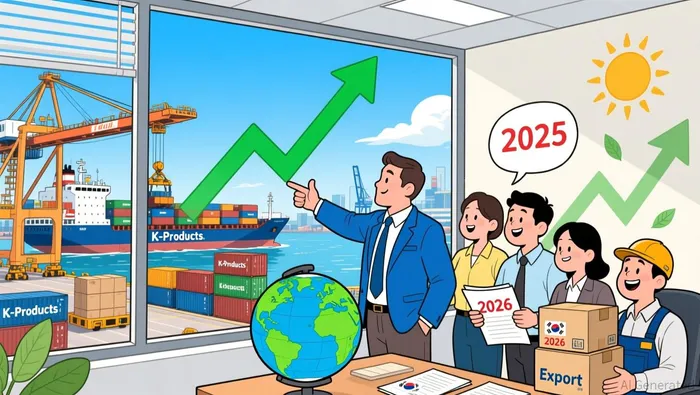
South Korea's export price index surged to 7.8% year-over-year in January 2026, a notable jump from the 5.0% growth rate reported the previous month. This acceleration signals stronger export performance and reflects a broad-based uptick in demand for South Korean goods. However, the underlying dynamics remain complex, with some sectors—particularly petrochemicals—experiencing operating losses and structural imbalances due to global oversupply and weak demand.
The recent rise in export prices contrasts with broader challenges in South Korea’s industrial and manufacturing sectors. For instance, South Korea’s petrochemical industry saw operating losses increase from 1.1 trillion won in 2024 to 1.5 trillion won in 2025, largely due to collapsing product spreads and inventory losses. Meanwhile, the global industrial environment is showing early signs of a potential upswing, with BofA citing a new global industrial cycle that could boost 2026 earnings by up to 25%. This suggests that South Korea’s export performance could be part of a broader global trend.
Investors are closely watching export price data for signals of South Korea’s external demand resilience and pricing power. As a key export-dependent economy, South Korea’s export performance has historically been a leading indicator of global trade conditions and manufacturing activity. A sustained rise in export prices could support the Korean won and indirectly influence monetary policy decisions at the Bank of Korea, although no policy changes have been announced based on this data point alone. Additionally, the performance of South Korea's tech sector—particularly in AI-linked memory chips—has further fueled domestic investor optimism and driven capital inflows.
While the export price growth is encouraging, it should be interpreted alongside the mixed signals from other parts of the economy. For example, South Korean stock markets have seen a sharp rally, with the Kospi index surging more than 30% in early 2026. This is largely driven by strong performance in AI-linked memory firms like Samsung and SK Hynix, but the gains have also led to profit-taking, with foreign investors turning net sellers in January. Meanwhile, the global steel market is experiencing divergent trends, with hot-rolled coil prices outpacing rebar due to slower construction activity.
Looking ahead, investors should monitor upcoming data releases, including the February export price index, as well as South Korea’s industrial production and trade balance figures. These will provide more clarity on the sustainability of current export trends and whether structural overcapacity issues—especially in petrochemicals—are easing or worsening. Policy developments, including government-led efforts to reduce ethylene capacity to address oversupply, will also be key to watch.
In the broader global context, South Korea’s export data fits into a picture of uneven global recovery and sectoral imbalances. While some segments—like semiconductors and AI-linked memory chips—are seeing strong growth, others, like construction materials and petrochemicals, are facing downward pressure. For investors, this means a nuanced approach to exposure in South Korean equities, balancing the short-term optimism of rising export prices with the longer-term structural challenges in key industries.

Stay ahead of the market.
Get curated U.S. market news, insights and key dates delivered to your inbox.


AInvest
PRO
AInvest
PRO



Comments
No comments yet