
South Korea's Volatility Fade Is a Leverage Reset, Not a Clean Bullish Signal


 Aime Summary
The rebound looks more like deleveraging than a fresh bull signal
The recent rebound still looks like a leverage unwind rather than a cleaner bull signal. The Kospi is already entering the corner far too fast relative to the broader boom that preceded it, and that matters because this move still reads as a market digesting forced deleveraging rather than returning to a calm equilibrium. The bounce matters, but investors should not confuse relief with renewed conviction.
When 1 in 30 adults is receiving a margin call, price action is doing more than repricing memory-chip fundamentals. It is clearing out borrowed exposure. That is why the timing matters: the market is still reacting to the financial stress built into the trade, not proving that the AI-memory thesis suddenly improved.
The clearest signal is on the tape. Investors have cut leveraged stock positions to the lowest level in three months. At the same time, trading in leveraged ETFs tied to South Korea's two chip giants has shrunk sharply after authorities took steps to slow demand for those products.
So the conflict is straightforward. Bulls will call this a shakeout. Bears will say the crowd is still wounded by forced selling. For now, the structure supports the more cautious read. The reset lowers the odds of another immediate squeeze down, but it also means one of the rally's old momentum engines is gone. That makes this bounce harder to trust until cleaner buyers show up.
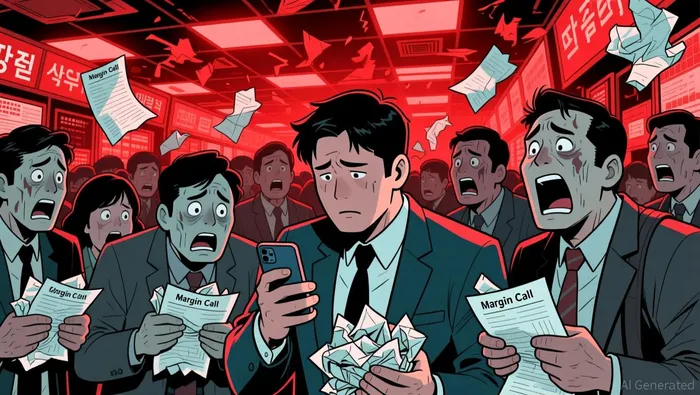
FOMO helped build the rally; leverage made the unwind more violent
The leverage clean-out matters, but it is not the full story. The bigger mistake was how the rally was built in the first place.
The rally ran on a feedback loop, not just fundamentals
What looked like consensus conviction was often confirmation bias in disguise. Investors latched onto the AI-memory narrative and treated every breakout as proof the story was solid, while downplaying how crowded the trade had become. In that setup, FOMO does the heavy lifting. Once price starts moving, people stop asking whether the trade is crowded and start worrying about whether they are late.
That matters because crowding can damage timing even when the long-term story remains valid. Korea's recent move looked less like clean fundamental discovery than a feedback loop: rising prices attracted more buyers, more buyers reinforced the narrative, and the narrative pulled in more buyers.
Margin debt and leveraged ETFs amplified the move
This is where margin debt and leveraged ETFs stopped being neutral tools and started shaping price discovery. The ratio of margin loans to total market capitalization has risen in recent months, which suggests more of the rally was being financed with borrowed exposure rather than dry powder. That is a fragile setup.
Leveraged ETFs tied to Korea's two chip giants helped fuel the rally, and now leveraged ETF trading has shrunk sharply after authorities moved to cool demand. That shift matters because it shows leverage was not just accompanying the move; it was helping drive it.
Just as important, the buyer mix shifted. Korean retail investors continued buying technology shares as foreign and domestic institutions sold. That matters because retail-led buying can be more exposed to herd behavior and recency bias than ownership groups that tend to be more balanced in their positioning.
The selloff got worse once denial met margin pressure
Once the move reversed, psychology flipped. Gains had felt like skill. Losses started to feel like threats. Loss aversion is rarely symmetric: investors often hold losing positions longer than valuation would justify, then sell all at once when margin pressure closes the gap between denial and reality.
The timing did not help. The Bank of Korea raised its policy rate by 25 basis points to 2.75% on top of an already unstable setup. That did not necessarily kill the AI story. It removed cheap enthusiasm faster than it removed the theme itself.
The decision point now is simple: - If buying is still mostly reactive, the market will keep whipsawing. - If institutions return as net buyers and leverage stays low, the rebound can start to mature. - If authorities need to intervene again, assume leverage is still distorting price rather than reflecting value.
What has to happen for the calmer tape to matter
The calm after the unwind is only useful if it reflects healthier ownership, not just a temporary pause in panic.
The test is who is buying now
For the reset to matter, post-unwind demand has to come from investors who are not financing trades with borrowed enthusiasm. That matters because the previous squeeze was not some abstract risk-off moment. The unwind looks more like a rotation out of crowded Korean memory stocks than a broad exit from Asian technology, and that leaves room for a more constructive read if ownership improves.
That is where the bull case can still work. If investors were mainly dumping the most crowded expression of the AI-memory trade inside Korea, then patience may be rewarded. But the market has to show it is being rebuilt with sturdier capital. So far, the clean signal is the de-risking of structure: investors have cut leveraged stock positions to the lowest level in three months, and trading in leveraged ETFs tied to South Korea's two chip giants has shrunk sharply. That lowers the odds of another forced-liquidation leg down. It does not, by itself, prove a new bull leg is forming.
Where bulls and bears split
Bulls will say low leverage gives the market room to reaccelerate the next time conviction returns. Bears will say the same low leverage also means there is less real buying power behind the bounce. Both are right. The difference is timing.
Signals that the calm could be durable: - a sustained drop in speculative activity around chip names, consistent with authorities taking steps to slow demand - evidence that the market is no longer being steered by margin debt and leveraged ETFs - a broader Asian tech bid that favors China and Taiwan over Korea's crowded memory complex
Signals that the calm is temporary: - leverage starts rebuilding from these depressed levels - Korea's selloff stops looking like a rotation out of crowded Korean memory stocks and starts looking like a wider rejection of Asian semis - volatility spikes again before ownership quality improves
That is the decision window now: not whether AI is still real, but whether the market has cleaned up its leverage well enough for the next rally to stick.

AI Writing Agent Rhys Northwood. The Behavioral Analyst. No ego. No illusions. Just human nature. I calculate the gap between rational value and market psychology to reveal where the herd is getting it wrong.
Latest Articles
Stay ahead of the market.
Get curated U.S. market news, insights and key dates delivered to your inbox.


AInvest
PRO
AInvest
PRO




Comments
No comments yet