
South Korea's Trade Crossroads: Navigating U.S. Tariffs and Regional Realignments
The U.S. trade war with South Korea has created a seismic shift in regional commerce, reshaping supply chains and pricing dynamics. With tariffs now at the center of bilateral tensions, consumer staples and manufacturing sectors face divergent pressures. Meanwhile, rising Chinese exports to South Korea—driven by U.S. trade barriers—threaten to undercut local firms even as they create opportunities for logistics plays. This analysis explores the risks and rewards for investors.
Consumer Staples: A Race to the Bottom
South Korean consumer staples firms like CJ CheilJedang (CJJIF) and Lotte (LOT) face a dual challenge: falling domestic demand and rising competition from Chinese imports. U.S. tariffs have incentivized Chinese manufacturers to redirect goods to South Korea, where they can now compete at lower prices. This dynamic, supported by the Bank of Korea's (BoK) Q1 2025 GDP contraction (-0.1%) and its 2025 GDP forecast of 0.8%, suggests weak local demand will amplify price pressures.
The BoK's March 2025 Monetary Policy Report highlights how household debt (102% of GDP) and political instability have dampened consumer spending. With Chinese goods flooding the market, South Korean staples firms face margin squeezes, even as they maintain dividend yields (2.5%-3%).
Investment Play: Short the South Korea Consumer Staples ETF (KLETR). Its constituents, including food and beverage giants, are vulnerable to both external competition and domestic stagnation.
Manufacturing: The Tariff Double Whammy
The manufacturing sector is split between sectors hit by U.S. tariffs and those adapting to global realignment:
1. Automotive & Semiconductors: Hyundai (HYMTF) and Kia face 25% tariffs on U.S. exports, while Samsung Electronics (SSNLF) and SK Hynix (SKMNF) grapple with 15%-25% semiconductor duties. The BoK's April 2025 report notes that automotive production fell sharply in Q1, while semiconductors held up due to AI-driven demand.
- Steel & Aluminum: POSCOPKX-- (PKX) and Hyundai Steel face 25% tariffs on 253 U.S.-bound products. The BoK warns that this sector's contraction could drag on overall industrial output.
Investment Play: Avoid auto stocks like Hyundai Motor and focus on tech leaders like Samsung, which benefit from long-term AI trends.
Regional Realignments: The Logistics Play
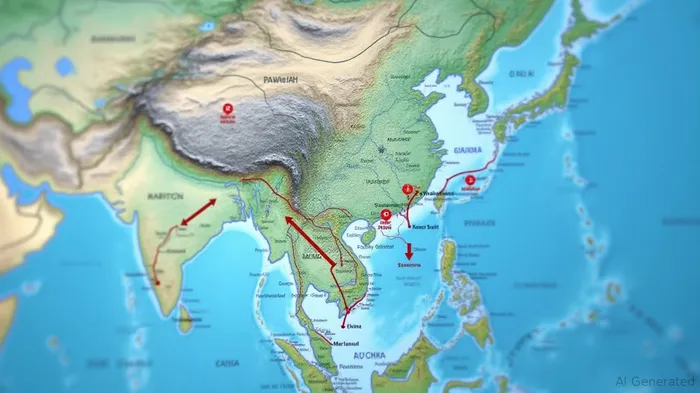
As South Korean firms pivot away from the U.S., they're rerouting trade through Southeast Asia, Japan, and the Indo-Pacific. This shift creates opportunities in regional logistics and infrastructure:
- Ports & Rail: South Korea's Busan Port is expanding capacity to handle rerouted cargo, while rail links to China and ASEAN are growing.
- Cross-Border Infrastructure: Companies like Hyundai Heavy Industries (HHICF) and Daewoo Engineering (DEG) are positioned to profit from projects in the Mekong Delta and Indonesia.
The BoK's February 2025 report highlights that logistics investments could offset manufacturing declines, with ESG-focused infrastructure attracting capital.
Investment Play: Go long on regional logistics firms or ETFs like the MSCI Asia Infrastructure ETF (FEAR).
Key Risks and Timing
- July 8 Deadline: U.S.-South Korea trade negotiations could resolve tariffs, but delays favor Chinese exporters.
- Monetary Policy: The BoK's rate cuts (now at 2.5%) aim to stabilize growth but risk inflating asset bubbles.
Conclusion: Short Staples, Long Logistics
South Korea's trade realignment is a tale of two sectors: consumer staples are trapped in a price war, while logistics and tech-driven manufacturing offer resilience. Investors should:
1. Short KLETR to capitalize on margin erosion and weak demand.
2. Long regional infrastructure plays (e.g., Hyundai Heavy, IGF) to capture rerouted trade flows.
The U.S.-South Korea trade deadline in July will test these strategies, but the structural shift in trade flows is here to stay.

Stay ahead of the market.
Get curated U.S. market news, insights and key dates delivered to your inbox.




Comments
No comments yet