
South Korea's Top Banks to Meet Tether and Circle on Stablecoin Partnerships
 Aime Summary
South Korea’s top banks are reportedly moving closer to forming partnerships with Tether and CircleCRCL--, the issuers of two of the world's largest stablecoins. Executives from Shinhan, Hana, KB FinancialKB--, and Woori Bank are set to meet with representatives from both companies to explore the integration of dollar-pegged and won-pegged stablecoins into the country’s financial ecosystem [1][2]. These discussions mark a significant step in South Korea’s broader effort to establish a domestic stablecoin market, a priority under President Lee Jae-myung’s administration [3].
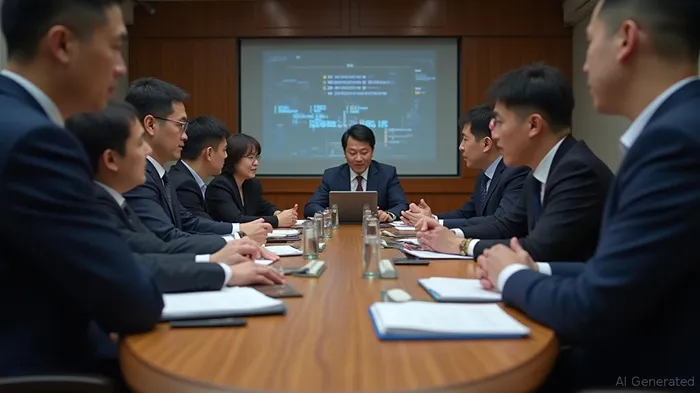
The meetings, which are expected to take place in the coming days, involve top-level executives including Shinhan Financial GroupSHG-- CEO Jin Ok-dong, Hana Financial Group CEO Ham Young-joo, KB Financial’s Chief Digital & IT Officer Lee Chang-kwon, and Woori Bank President Jeong Jin-wan [4]. Hana’s Ham will meet with Circle President Heath Tarbert and a Tether representative on the same day, while others will hold separate talks with either company [5]. These interactions highlight the growing institutional interest in stablecoins for both domestic and international transactions [6].
The potential collaboration comes amid increasing regulatory efforts to formalize the legal framework for stablecoins in South Korea. The Financial Services Commission (FSC) has indicated it is preparing to introduce regulations for won-pegged stablecoins in October as part of the second phase of the Virtual Asset User Protection Act [6]. This regulatory shift aims to establish clearer guidelines on collateral requirements, issuance standards, and internal controls for stablecoin providers, which are currently governed by more general cryptocurrency laws [6].
President Lee Jae-myung has been a vocal advocate for the development of a sovereign stablecoin market. During his campaign, he emphasized the importance of building a domestic digital currency ecosystem to reduce reliance on foreign-pegged tokens and to maintain South Korea’s monetary sovereignty [6]. The government’s recent decision to pause the development of a central bank digital currency (CBDC) has further shifted the focus toward private-sector-led stablecoin initiatives [6].
The central bank, however, has not fully endorsed the movement. The Bank of Korea has expressed concerns about the potential effects of private stablecoins, particularly those pegged to the won, on foreign exchange management and capital controls [6]. Governor Rhee Chang-yong has warned that such tokens could interfere with monetary policy if not regulated effectively [6]. Nevertheless, the central bank has not ruled out the concept and has called for a well-structured regulatory framework to mitigate any risks [6].
Private companies are also stepping into the space. For instance, fanC has partnered with Initech to test KRWIN, a won-pegged stablecoin currently in limited use [6]. This initiative demonstrates the private sector’s willingness to experiment with digital currency solutions even in the absence of formal regulations [6].
Tether and Circle, already dominant in the global stablecoin market, are expanding their influence in Asia through strategic engagements with South Korean financial institutionsFISI--. Tether has previously worked with governments in Uzbekistan and Guinea to explore blockchain-based payment solutions, while Circle has focused on engaging with regulators in the U.S. and beyond [6]. Their meetings with South Korean banks reflect an effort to gain early access to a market that is showing strong institutional and regulatory momentum [6].
The reported developments highlight South Korea’s growing role in the global stablecoin conversation. With regulators, private firms, and major banks all showing interest, the country is positioning itself as a potential leader in the adoption and integration of digital currencies. If the partnerships with Tether and Circle materialize, South Korea could see a transformation in how digital value is transferred, both within its borders and across international financial systems [6].
Source:
[1] Shinhan, Hana, Woori, KB Financial Said to Meet Tether ... (https://www.coindesk.com/business/2025/08/22/south-korea-s-top-banks-said-to-meet-tether-circle-on-stablecoin-partnerships-report)
[2] Tether, Circle to Meet South Korea's Top Banking CEOs as ... (https://finance.yahoo.com/news/tether-circle-meet-south-korea-120404706.html)
[3] Heads of major S. Korean financial groups to meet ... (https://en.yna.co.kr/view/AEN20250821006400320)
[4] Tether and Circle to meet South Korea's Big Four Banks ... (https://www.bitcoininsider.org/article/283847/tether-and-circle-meet-south-koreas-big-four-banks-over-stablecoins)
[5] Tether, Circle To Meet South Korea's Biggest Banks On ... (https://financefeeds.com/tether-circle-to-meet-south-koreas-biggest-banks-on-stablecoin-plans/)
[6] Tether, Circle to meet top South Korean Bank execs: Report (https://www.coinglass.com/ko/newsflash)

Stay ahead of the market.
Get curated U.S. market news, insights and key dates delivered to your inbox.
AInvest
PRO
AInvest
PRO



Comments
No comments yet