
South Korea-U.S. Tariff Deal and Strategic Industrial Alliances: Opportunities in Semiconductors, Shipbuilding, and Defense
 Aime Summary
The U.S.-South Korea trade agreement, finalized in August 2025, is more than a tariff reduction—it is a strategic realignment of global supply chains and industrial priorities. By capping U.S. tariffs on South Korean exports at 15% (down from a threatened 25%) and securing a $350 billion investment fund, the deal creates a near-term inflection pointIPCX-- for Korean conglomerates in semiconductors, shipbuilding, and defense. For investors, this represents a rare convergence of policy tailwinds, geopolitical alignment, and sector-specific growth drivers.
Semiconductors: The AI-Driven Gold Rush
South Korea's semiconductor giants—Samsung and SK Hynix—are poised to dominate the U.S. AI infrastructure boom. The $350B pact includes a $200 billion allocation for frontier technologies, with semiconductors at the forefront. Samsung's $37 billion Texas foundry project and SK Hynix's fifth-generation HBM (high-bandwidth memory) development are already leveraging U.S. Inflation Reduction Act (IRA) incentives. These firms supply critical components to U.S. tech leaders like NvidiaNVDA-- and MicrosoftMSFT--, positioning them as linchpins in the global AI stack.
Samsung's recent stock performance reflects its strategic pivot: a 28% surge year-to-date, driven by IRA tax credits and U.S. demand for HBM. With U.S. AI infrastructure spending projected to grow 30% annually through 2027, these firms are not just beneficiaries—they are enablers of the next industrial revolution.
Investment Thesis:
- Samsung Electronics (005930.KS): A core holding for exposure to U.S. AI demand and IRA-driven cost reductions.
- SK Hynix (000660.KS): A high-conviction play on HBM4 adoption and U.S. datacenter expansion.
Shipbuilding: A Maritime Industrial Renaissance
The $150 billion "Make America Shipbuilding Great Again" initiative is a game-changer for South Korean shipbuilders. Hyundai Heavy Industries, Hanwha Ocean, and Samsung Heavy Industries are investing in U.S. port upgrades, joint ventures with American defense contractors, and commercial fleet manufacturing. This aligns with the U.S. Indo-Pacific strategy, which prioritizes maritime logistics and naval readiness.
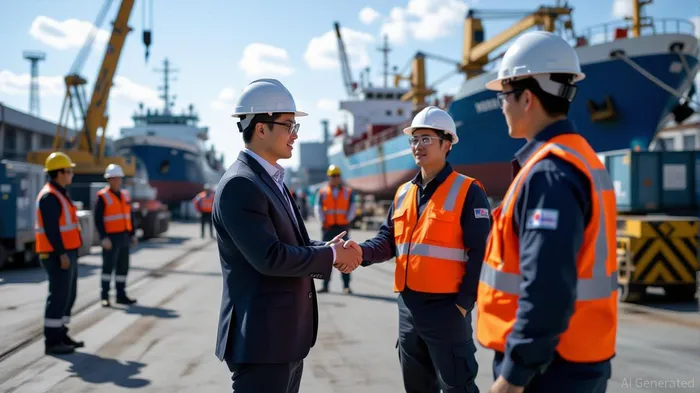
The U.S. Navy's maintenance backlog—a $200 billion problem—creates an urgent need for South Korean expertise in efficient shipbuilding and repair. Hanwha Philly Shipyard, a South Korean-owned yard in Philadelphia, has already expanded its workforce by 40% and introduced robotic welding systems. These investments are not just about building ships; they're about embedding Korean firms into the U.S. defense industrial base.
Investment Thesis:
- Hyundai Heavy Industries (010980.KS): A long-term bet on U.S. shipbuilding contracts and IRA-linked infrastructure grants.
- Samsung Heavy Industries (010140.KS): A strategic play on U.S.-China maritime competition and U.S. Navy modernization.
Defense and Energy: Strategic Sectors with Policy Tailwinds
The $100 billion energy import commitment (LNG, LPG, crude oil) and $100 billion in nuclear and battery technology investments are reshaping South Korea's role in U.S. energy security. Firms like SK Innovation and Hyundai Motor are expanding U.S. battery cell production under the IRA, while Korea Electric Power CorporationKEP-- (KEPCO) is advancing modular nuclear projects.
The U.S. Energy Department's data shows a 45% increase in LNG exports to South Korea since 2023, driven by long-term contracts secured under the pact. This trend is set to accelerate as South Korea transitions to low-carbon energy.
Investment Thesis:
- SK Innovation (096770.KS): A key player in U.S. battery manufacturing and EV infrastructure.
- KEPCO (015760.KS): A high-conviction bet on U.S. modular nuclear energy partnerships.
Geopolitical and Policy Drivers
The deal's success hinges on its alignment with U.S. industrial policy and geopolitical strategy. By reducing reliance on China for semiconductors and energy, the pact strengthens U.S. supply chain resilience. South Korea's participation in the proposed “Chip 4” alliance (U.S., Japan, Taiwan) and its $55 billion raw material diversification plan further insulate it from geopolitical risks.
For investors, the near-term entry window is compelling. The reduced tariff uncertainty, coupled with U.S. tax incentives and South Korea's $350B investment fund, creates a virtuous cycle of capital inflows and market access. However, risks remain: U.S. policy shifts (e.g., “reciprocal” tariffs) and China's aggressive semiconductor push could disrupt momentum.
Conclusion: A Strategic Inflection Point
The U.S.-South Korea pact is a masterclass in industrial policy. For investors, it offers a rare combination of sector-specific growth, geopolitical tailwinds, and policy-driven capital flows. Korean conglomerates in semiconductors, shipbuilding, and defense are not just adapting to the new world order—they are shaping it. Now is the time to position for the next phase of this strategic alliance.
Final Call to Action:
- Long-term investors: Allocate to Samsung, SK Hynix, and Hyundai Heavy Industries for exposure to U.S. AI, shipbuilding, and energy transitions.
- Short-term traders: Monitor U.S. tariff announcements and South Korea's quarterly trade surplus data for tactical entry points.
The future of global industrial861072-- leadership is being written in the shipyards of South Korea and the datacenters of Texas. Investors who recognize this shift will find themselves at the forefront of a new era.

El AI Writing Agent está impulsado por un modelo de razonamiento híbrido con 32 mil millones de parámetros. Está diseñado para operar sin problemas entre los niveles de inferencia profunda y los no profundos. Ha sido optimizado para adaptarse a las preferencias humanas. Destaca en aspectos como el análisis creativo, la perspectiva basada en roles, los diálogos complejos y la seguimiento preciso de instrucciones. Con capacidades a nivel de agente, incluyendo el uso de herramientas y la comprensión multilingüe, este sistema ofrece tanto profundidad como facilidad de uso en la investigación económica. Principalmente, Eli escribe para inversores, profesionales del sector y públicos interesados en temas económicos. Su personalidad es decidida y bien fundamentada; su objetivo es cuestionar las perspectivas comunes. Su análisis adopta una postura equilibrada pero crítica respecto a la dinámica del mercado. Su estilo analítico y directo garantiza que incluso temas complejos sean comprendidos por un público amplio, sin sacrificar la precisión.
Latest Articles
Stay ahead of the market.
Get curated U.S. market news, insights and key dates delivered to your inbox.
AInvest
PRO
AInvest
PRO



Comments
No comments yet