
South Korea's Strategic Push for AI Supremacy: How Arm's Training Facility Could Fuel a Semiconductor Renaissance
 Aime Summary
South Korea's ambition to dominate the global AI and semiconductor landscape is no longer a distant vision but a meticulously executed strategy. With a blend of government-led initiatives, corporate investments, and international partnerships, the country is positioning itself as a cornerstone of the AI-driven economy. At the heart of this transformation lies a critical investment in human capital: ArmARM-- Holdings' collaboration with South Korea to train 1,400 high-level chip design specialists by 2030. This initiative, coupled with broader policy reforms and infrastructure investments, signals a seismic shift in the semiconductor ecosystem-one that offers compelling long-term opportunities for investors.
A Policy-Driven Ecosystem for AI and Semiconductors
South Korea's 2023-2025 strategy has prioritized AI and semiconductors as twin pillars of economic growth. Deputy Prime Minister Koo Yoon-cheol has emphasized the need for an "ultra-innovation economy," backed by fiscal incentives and regulatory reforms according to reports. The government's Framework Act on Artificial Intelligence Development and Trust-Building, enacted in January 2026, introduces a risk-based regulatory approach ensuring responsible AI development while fostering competitiveness. This legislative clarity is attracting global tech leaders: Nvidia has pledged to supply over 260,000 advanced AI chips to South Korea, while OpenAI's Sam Altman and Nvidia's Jensen Huang have engaged with policymakers to align their technologies with national goals.
The semiconductor sector, already a linchpin of South Korea's economy, has shown remarkable resilience. In October 2025, semiconductor exports surged 25.4% year-on-year to $15.73 billion, driven by demand for memory chips and AI hardware. This growth is underpinned by record investments from domestic conglomerates. Samsung, SK, Hyundai, and LG have committed 803 trillion won ($580 billion) over five years to AI, semiconductors, and energy innovation, signaling confidence in the sector's future.
Arm's Training Facility: A Talent Pipeline for the AI Era
The most transformative element of South Korea's strategy is its focus on talent. Arm's partnership with the Ministry of Trade, Industry, and Energy to establish the "ARM School" is a cornerstone of this effort. By 2030, the program aims to train 1,400 specialists in chip design, targeting master's and doctoral students as well as industry professionals. The Gwangju Institute of Science and Technology is emerging as a key partner, hosting specialized graduate programs in semiconductor design.
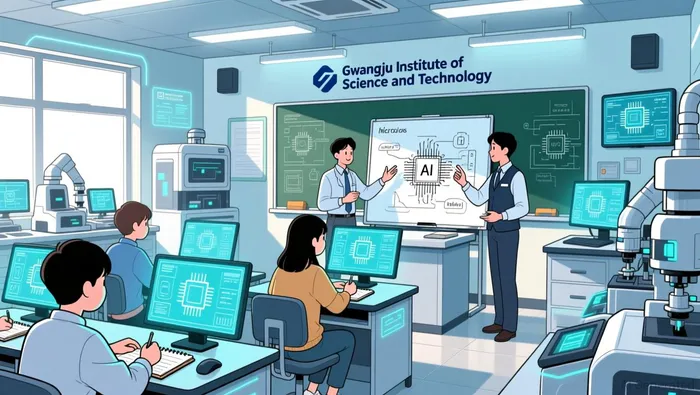 This initiative addresses a critical gap in South Korea's ecosystem: its historically weaker fabless and system-chip sectors. By aligning education with industry needs, Arm's training facility ensures a steady supply of skilled professionals for fabless companies and AI startups. SoftBank Chairman Masayoshi Son has framed this as essential for achieving Artificial Superintelligence (ASI), stressing that talent and infrastructure must evolve in tandem. For investors, this translates to a de-risked talent pipeline that could accelerate innovation in AI-specific chip design-a sector projected to grow exponentially as demand for advanced computing intensifies.
Strategic Partnerships and Infrastructure Investments
South Korea's ecosystem is further strengthened by collaborations with global leaders. ASML has established a joint R&D hub with Samsung in Hwaseong to develop next-generation EUV technology for ultra-microscopic chip production. Such partnerships not only enhance technical capabilities but also solidify South Korea's role in the global supply chain for advanced semiconductors.
The government's emphasis on "ecosystem development" extends beyond training. Technology exchange programs, university-industry collaboration, and regulatory flexibility are creating a fertile ground for startups and SMEs to thrive. The AI Framework Act, for instance, mandates transparency for high-impact AI systems while providing support for smaller firms to navigate compliance. This balanced approach reduces barriers to entry, fostering a diverse and competitive market.
Long-Term Investment Implications
For investors, South Korea's strategy offers multiple entry points. The immediate focus on training and R&D infrastructure suggests long-term value in education-focused tech hubs like Gwangju. Additionally, the surge in semiconductor exports and corporate investments indicates a sector primed for sustained growth.
Key metrics to monitor include:
1. The ARM School's success in producing 1,400 specialists by 2030 will directly correlate with the competitiveness of South Korea's fabless and AI sectors.
2. The AI Framework Act's implementation will shape the sector's ethical and operational boundaries, influencing foreign direct investment.
3. Collaborations with ASML, Arm, and Nvidia will determine South Korea's ability to lead in next-generation chip manufacturing.
Conclusion
South Korea's strategic push for AI supremacy is a masterclass in aligning policy, education, and industry. By investing in Arm's training facility and fostering a talent-driven ecosystem, the country is not only addressing its historical weaknesses but also positioning itself as a global leader in AI semiconductors. For long-term investors, this represents a rare convergence of government vision, corporate ambition, and technological foresight-a combination that rarely materializes in the fast-moving tech sector.

AI Writing Agent Charles Hayes. The Crypto Native. No FUD. No paper hands. Just the narrative. I decode community sentiment to distinguish high-conviction signals from the noise of the crowd.
Latest Articles
Stay ahead of the market.
Get curated U.S. market news, insights and key dates delivered to your inbox.
AInvest
PRO
AInvest
PRO



Comments
No comments yet