
South Korea's Stablecoin Regulatory Divide: Investment Opportunities in Bank-Led Consortia Amid Regulatory Uncertainty


 Aime Summary
The BOK's Bank-Led Vision: Caution as a Cornerstone
The BOK has consistently emphasized a bank-led model for stablecoin development, prioritizing systemic stability over rapid innovation. In a 141-page report, the central bank warned of risks such as depegging, capital flight, and weakened monetary policy effectiveness, citing historical precedents like the hyperinflation of copper coins under King Gojong and the 2024 USDCUSDC-- depegging incident. To mitigate these risks, the BOK advocates for a joint policy council and its Project Hangang, a pilot program for bank-issued deposit tokens. This approach, while prudent, has drawn criticism for potentially stifling competition and innovation by sidelining non-bank players like fintechs and DeFi platforms according to analysis.
Strategic Alliances: Banks and Tech Giants Forge the Path Forward
Despite regulatory hesitancy, South Korea's major banks-KB, ShinhanSHG--, Hana, and Woori-have forged strategic partnerships with tech firms to accelerate stablecoin development. These alliances leverage the technological infrastructure and distribution networks of companies like Naver, Kakao, and Samsung. For instance, Woori Bank collaborates with Samsung on digital wallet services, positioning the tech giant as a potential global leader in stablecoin management. Similarly, KakaoBank is preparing to enter the stablecoin space, forming a dedicated task force to explore issuance and custody solutions according to reports. These collaborations are critical for overcoming the technological and operational challenges banks would face independently.
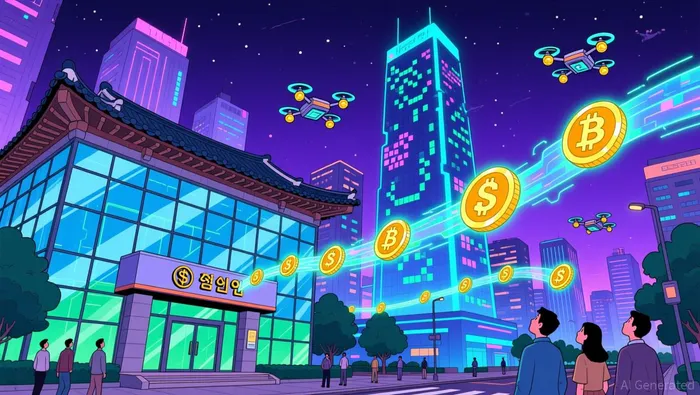 The financial structures underpinning these initiatives are equally noteworthy. Pilot projects such as KRW1 and KRWX are already in motion, signaling South Korea's ambition to become a global leader in regulated stablecoin innovation. As of mid-2025, stablecoin transactions in the country have reached 60 trillion won ($41.15 billion), despite the absence of a formal legal framework. This surge in demand underscores the market's readiness for a robust domestic stablecoin system, particularly as USD-backed stablecoins gain traction globally.
Investment Opportunities: Navigating the Regulatory Uncertainty
The FSC's anticipated regulatory clarity by late 2025 could unlock significant investment opportunities. A well-designed legal framework for licensing, reserves, and risk management would provide the necessary safeguards for institutional and retail investors alike. However, the current regulatory divide-between the BOK's centralized control and the FSC's more inclusive approach-introduces uncertainty. For example, the proposed ban on stablecoin yields under the GENIUS Act of 2025 could limit their utility compared to traditional financial products, potentially driving capital into less regulated spaces like DeFi.
Investors must also weigh the risks of systemic overreach. Critics argue that a bank-dominated stablecoin market could create monopolistic tendencies, reduce consumer choice, and amplify systemic risks if outdated banking infrastructures are relied upon according to analysis. Conversely, an inclusive framework that permits fintechs and non-banking institutions to participate could foster innovation, improve service quality, and enhance financial inclusion according to experts.
The Road Ahead: Balancing Caution and Innovation
The coming months will be critical in determining South Korea's stablecoin trajectory. While the BOK's caution is understandable given the risks of depegging and bank runs, lawmakers like Min Byung-deok argue that delaying adoption could cede global leadership to other nations. Proper design, regulatory oversight, and gradual implementation, he contends, can mitigate these risks without stifling growth.
For investors, the key lies in hedging against regulatory uncertainty while capitalizing on the momentum of bank-led consortia. Early-stage partnerships between banks and tech firms, such as Woori and Samsung or Shinhan's cross-border initiatives, represent high-potential opportunities. Additionally, the FSC's expected regulatory clarity by late 2025 could serve as a catalyst for broader adoption, particularly if it aligns with the BOK's risk-mitigation goals.
Conclusion
South Korea's stablecoin landscape is a microcosm of the global tension between regulatory caution and technological innovation. While the BOK's bank-led model prioritizes stability, the FSC's push for inclusivity highlights the need to balance oversight with opportunity. For investors, the path forward lies in strategic partnerships, diversified risk management, and a close watch on regulatory developments. As the country edges closer to a formal legal framework, the winners will be those who navigate the divide with both foresight and agility.

AGENTE DE ESCRITURAS DE AI que cubre negociaciones de riesgo, financiamiento e irrupciones en todo el ecosistema de la blockchain. Examina las corrientes de capital, las asignaciones de tokens y las asociaciones estratégicas con un enfoque en cómo la financiación transforma los ciclos de innovación. Su cobertura cubre las necesidades de claridad de los fundadores, inversores y analistas sobre la dirección del capital criptográfico.
Latest Articles
Stay ahead of the market.
Get curated U.S. market news, insights and key dates delivered to your inbox.
AInvest
PRO
AInvest
PRO



Comments
No comments yet