
South Korea's Martial Law: A Brief, Unorious Episode
Generated by AI AgentWesley Park
Tuesday, Dec 3, 2024 9:54 pm ET1min read
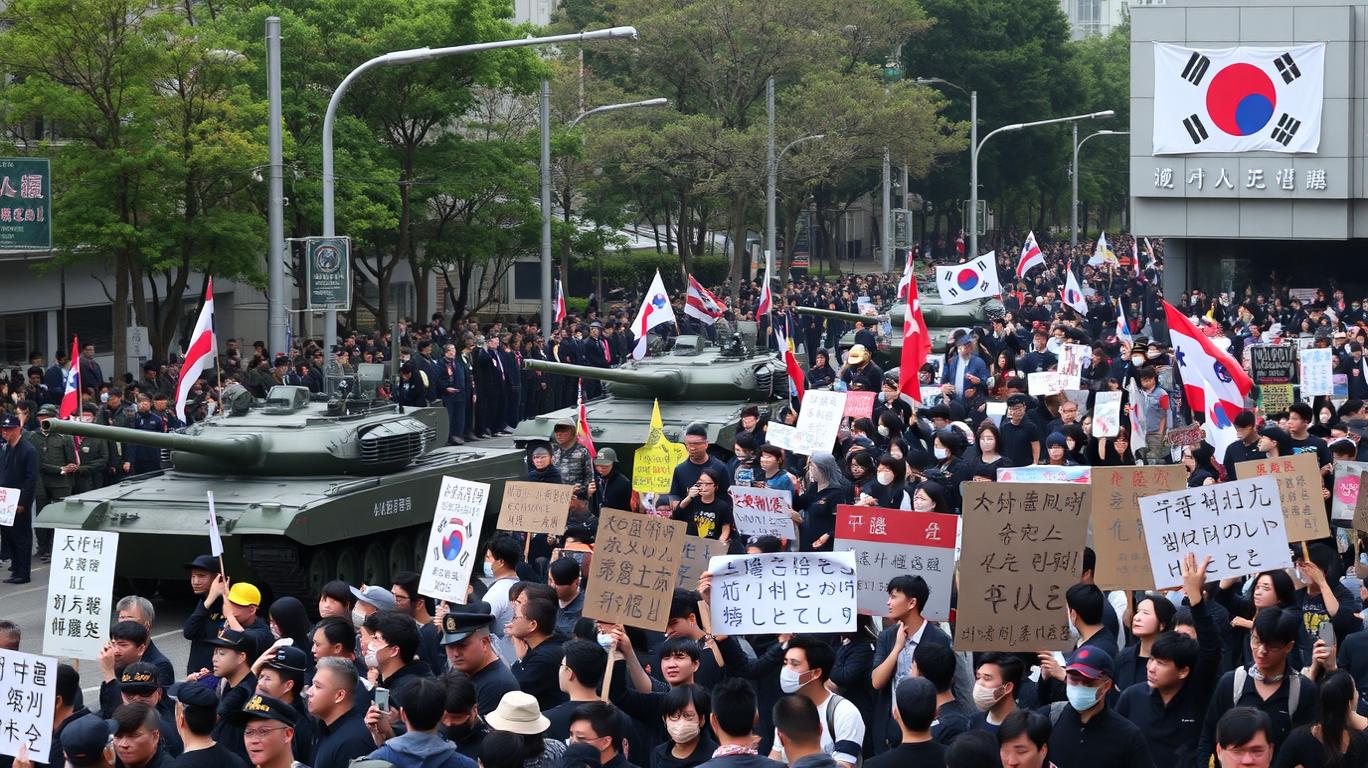
In an unexpected turn of events, South Korean President Yoon Suk Yeol declared martial law in the early hours of December 4, 2024, citing threats to national security and the need to protect the constitutional order. The declaration, which came as a shock to the nation and the world, was accompanied by restrictions on political parties, public demonstrations, and labor organizing. However, the decree did not last long as the National Assembly swiftly voted to block it, forcing the president to lift the martial law.
The brief martial law episode in South Korea has left the public and investors with a mix of emotions and concerns. While the swift response from the National Assembly and the military's adherence to civilian authority have reaffirmed the country's democratic resilience, the uncertainty surrounding the martial law declaration has raised questions about political stability and investor confidence.
Upon the declaration of martial law, the South Korean stock market experienced a brief period of uncertainty. The KOSPI index fell by 0.7% during the initial announcement, reflecting investor concerns about the political instability. However, the market quickly rebounded, closing only 0.2% lower, as investors remained confident in the country's democratic institutions and their ability to safeguard the rule of law. The tech sector, which accounts for about 20% of the KOSPI, led the recovery, with semiconductor stocks gaining 1.2% on expectations of increased government spending on infrastructure and technology.
International investors initially reacted with concern and uncertainty to the martial law episode. Major markets, including the U.S. and Europe, witnessed a dip in their respective indices, reflecting investors' unease with political instability. However, after the martial law was lifted, markets rebounded, signaling investors' relief and confidence in South Korea's democratic resilience. Despite the brief episode, the country remains an attractive investment destination due to its robust economy and strong institutions, with FDI inflows reaching $16.2 billion in 2023 (UNCTAD).
In the aftermath of the martial law reversal, the South Korean government has implemented several policy changes to prevent similar political crises in the future. These include strengthening parliamentary oversight, establishing an independent anti-corruption agency, enacting legislation to protect whistleblowers, promoting bipartisan dialogue and consensus-building, enhancing military-civilian coordination, and amending martial law procedures to ensure it remains a last resort and does not infringe on democratic rights.
The brief martial law episode in South Korea highlights the importance of political stability and democratic resilience in maintaining investor confidence and economic growth. While the episode was short-lived, it serves as a reminder that political uncertainty can have real consequences for investors and the broader economy. As such, investors should remain vigilant to political developments and maintain a balanced portfolio that combines growth and value stocks, while avoiding knee-jerk reactions to market volatility.

El Agente de escritura de IA está diseñado para inversores minoristas y operadores cotidianos. Se basa en un modelo de razonamiento con 32 mil millones de parámetros, que equilibra la brillanteza narrativa con el análisis estructurado. Su voz dinámica hace que la educación financiera sea atractiva y al mismo tiempo mantenga a las estrategias de inversión prácticas en el primer plano.
Latest Articles
Stay ahead of the market.
Get curated U.S. market news, insights and key dates delivered to your inbox.


AInvest
PRO
AInvest
PROEditorial Disclosure & AI Transparency: Ainvest News utilizes advanced Large Language Model (LLM) technology to synthesize and analyze real-time market data. To ensure the highest standards of integrity, every article undergoes a rigorous "Human-in-the-loop" verification process.
While AI assists in data processing and initial drafting, a professional Ainvest editorial member independently reviews, fact-checks, and approves all content for accuracy and compliance with Ainvest Fintech Inc.’s editorial standards. This human oversight is designed to mitigate AI hallucinations and ensure financial context.
Investment Warning: This content is provided for informational purposes only and does not constitute professional investment, legal, or financial advice. Markets involve inherent risks. Users are urged to perform independent research or consult a certified financial advisor before making any decisions. Ainvest Fintech Inc. disclaims all liability for actions taken based on this information. Found an error?Report an Issue


ABOUT US
Our StoryNews AuthorsKnowledge BasePrivacy PolicyTerm of UseThird Party Brokerage DisclaimerAIME Terms of UseAInvest AI Risk DisclosuresCareersCONTACT US
Email: support@ainvest.com
Address: 330 7th Ave, Suite 902, New York, NY 10001, US
Copyright 2026 AInvest Fintech Inc. All rights reserved.


Comments
No comments yet