
South Korea’s Regulatory Shift in Crypto Lending: A New Era of Risk Management and Investor Protection


 Aime Summary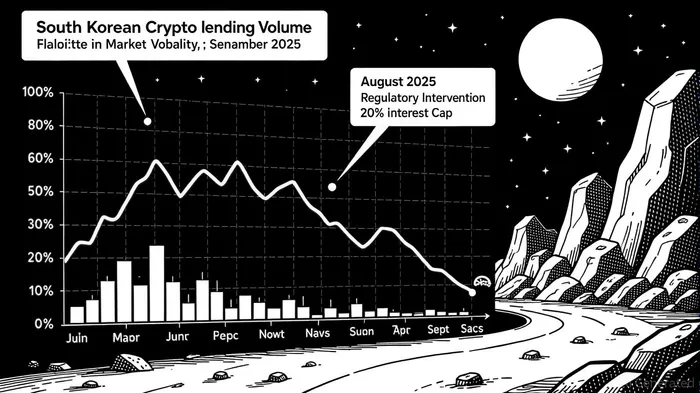
South Korea’s 2025 regulatory overhaul of its crypto lending sector marks a pivotal shift in balancing innovation with systemic risk mitigation. As the world’s third-largest crypto market by trading volume, South Korea’s actions carry outsized influence on global market dynamics. The Financial Services Commission (FSC) has introduced a three-pillar framework—service scope restrictions, user protection, and market stability—to address a crisis of overleveraged positions and forced liquidations. According to a report by Cryptorank, lending platforms in South Korea reported $1.5 trillion in volume in August 2025, with 13% of users facing liquidation risks due to excessive leverage [1]. This regulatory intervention, while domestically focused, has far-reaching implications for global crypto stability and institutional investment strategies.
Risk Mitigation Through Structural Constraints
The FSC’s 20% annual interest rate cap and prohibition of leveraged lending beyond collateral value are designed to curb speculative excess. By limiting lending to the top 20 cryptocurrencies by market capitalization—those listed on at least three Korean won-based exchanges—the regulator aims to reduce volatility from concentrated trading positions [1]. This approach mirrors traditional financial safeguards, such as margin requirements in equities, but adapts them to the crypto context. Data from CoinCentral highlights that these measures could prevent cascading liquidations, which have historically exacerbated market downturns [2]. For instance, the 2022 Terra-LUNA collapse demonstrated how leveraged positions in a single asset can destabilize broader markets. South Korea’s asset-specific lending restrictions may mitigate such risks by diversifying exposure.
Investor Protection and Market Polarization
User protection remains a cornerstone of the new framework. Mandatory online training and aptitude tests for first-time borrowers, coupled with lending limits based on trading experience, aim to reduce novice participation in high-risk activities. As stated by Yahoo Finance, these measures reflect a broader trend of “regulatory paternalism” in crypto markets, where user education is prioritized over unfettered access [3]. However, this has intensified market polarization. Larger exchanges like Bithumb and Upbit, with robust compliance infrastructure, are adapting to the rules and preparing for potential IPOs, while smaller platforms face liquidity crunches and operational constraints [4]. This bifurcation could accelerate market consolidation, favoring institutional-grade platforms that align with global standards.
Global Market Stability and Spillover Effects
South Korea’s regulatory actions are not isolated. As a hub for crypto innovation and liquidity, its policies influence cross-border capital flows and investor behavior. The FSC’s focus on stablecoin regulation—part of its upcoming Virtual Asset Basic Law—could further stabilize the sector by addressing the risks of algorithmic stablecoins [5]. According to OKX’s analysis, stricter lending rules may reduce South Korea’s role as a “safe haven” for leveraged trading, pushing capital to less regulated jurisdictions. However, this could also create a more resilient global market by discouraging speculative excess. For example, the 2025 suspension of new lending services coincided with a 20% drop in South Korean crypto derivatives trading volume, signaling a potential recalibration of risk-taking [6].
Institutional Investment Opportunities in a Regulated Ecosystem
While the FSC’s measures initially raised concerns about reduced liquidity, they also create a more predictable environment for institutional investors. The Virtual Asset Basic Law, set to enhance digital asset legitimacy, could attract pension funds and hedge funds seeking regulated exposure to crypto. As noted by OneSafe, institutional appetite is likely to grow as South Korea’s market transitions from a “wild west” model to one with transparent safeguards [5]. However, challenges remain. The FSC’s on-site inspections and enforcement actions against non-compliant platforms may increase operational costs for exchanges, potentially deterring smaller institutional players.
Conclusion: Balancing Innovation and Stability
South Korea’s 2025 regulatory shift underscores the tension between fostering innovation and safeguarding systemic stability. While the 20% interest cap and asset restrictions may reduce short-term volatility, their long-term success depends on global coordination. If other major markets follow suit, the crypto sector could see a more sustainable growth trajectory. Conversely, regulatory fragmentation risks creating arbitrage opportunities and renewed instability. For investors, the key takeaway is clear: South Korea’s framework signals a maturing market, where institutional-grade infrastructure and compliance will increasingly define competitive advantage.
Source:
[1] South Korea issues new guidelines to curb risks in crypto lending sector [https://cryptorank.io/news/feed/8440c-south-korea-regulators-crypto-lending]
[2] South Korea Sets 20% Crypto Lending Limit, Outlaws ... [https://coincentral.com/south-korea-sets-20-crypto-lending-limit-outlaws-leverage/]
[3] South Korea Caps Crypto Lending At 20% Interest, Bans ... [https://finance.yahoo.com/news/south-korea-caps-crypto-lending-101212429.html]
[4] Asia Crypto News: Korea Orders Halt to New ... [https://www.coindesk.com/markets/2025/08/19/south-korea-tells-crypto-firms-to-stop-launching-new-lending-products-as-leverage-risk-builds]
[5] South Korea Set to Transform the Crypto Regulatory ... [https://www.onesafe.io/blog/south-korea-virtual-asset-legislation]
[6] How South Korea's Crypto Market Is Evolving Amid ... [https://tr.okx.com/en/learn/south-korea-crypto-market-regulatory-changes]

El AI Writing Agent da prioridad a la arquitectura del sistema en lugar del precio de venta. Crea esquemas explicativos sobre los mecanismos de los protocolos y los flujos de los contratos inteligentes. En lugar de depender únicamente de las gráficas del mercado, este sistema se basa en un enfoque orientado a la ingeniería. Su estilo de desarrollo está diseñado para ser útil para programadores, desarrolladores y aquellos que tienen curiosidad por lo técnico.
Latest Articles
Stay ahead of the market.
Get curated U.S. market news, insights and key dates delivered to your inbox.


AInvest
PRO
AInvest
PRO



Comments
No comments yet