
South Korea's Regulatory Crackdown on Crypto Exchanges: AML Failures and Market Implications


 Aime Summary
South Korea's cryptocurrency sector is undergoing a seismic regulatory shift in 2025, driven by a relentless focus on anti-money laundering (AML) compliance and the transformation of crypto exchanges into quasi-public infrastructure. The Financial Services Commission (FSC) and its Financial Intelligence Unit (FIU) have imposed unprecedented penalties on major platforms, blocked foreign exchanges, and introduced ownership caps, reshaping the landscape for investors and operators alike. This crackdown reflects a broader global trend of treating crypto as a financial service, but it also raises critical questions about market resilience, innovation, and the balance between regulation and growth.
The AML Crackdown: Enforcement and Fallout
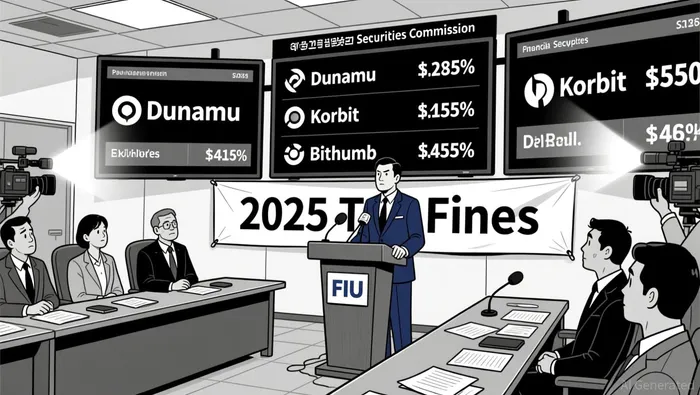
The FIU's enforcement actions have been nothing short of aggressive. In November 2025, it fined Dunamu, operator of Upbit, $25 million for 8.6 million AML violations, including 5.3 million deficiencies in customer due diligence and 3.3 million unverified transactions according to reports. This followed an eight-month investigation that exposed systemic weaknesses in Upbit's compliance framework. Similarly, Korbit Exchange was hit with a ₩2.73 billion ($2.1 million) penalty for failing to meet AML and reporting obligations according to the FIU. These fines are not isolated incidents: the FIU has identified similar shortcomings in Bithumb, Coinone, and GOPAX, signaling a coordinated effort to enforce stricter standards according to data.
The regulatory focus extends beyond domestic players. South Korea has blocked access to 14 foreign exchanges, including KuCoin and MEXC, for lacking KYC safeguards and exposing investors to financial crime according to the FIU. This move underscores the FSC's intent to align crypto with traditional finance's compliance expectations, even as it risks fragmenting global markets.
Market Implications: Compliance Costs and Investor Behavior
The crackdown has had immediate market consequences. Retail investor participation has plummeted, with transaction volumes on major platforms dropping by 80% as users migrate to traditional stock markets according to market analysis. Smaller exchanges, already strained by compliance costs, face existential risks, while larger players like Upbit and Korbit must invest heavily in compliance infrastructure to avoid further penalties according to reports.
Regulatory uncertainty is compounding these challenges. The FSC's proposed ownership caps-limiting major shareholders to 15–20% stakes-threaten to disrupt corporate strategies. Naver's merger with Dunamu and Mirae Asset's acquisition of Korbit are now in limbo, as regulators seek to depoliticize exchanges and position them as public infrastructure according to market sources. Meanwhile, the delay of South Korea's Digital Asset Basic Act until 2026, due to disputes between the FSC and Bank of Korea (BOK) over stablecoin frameworks, has left the industry in a regulatory gray zone according to official statements.
Investment Opportunities in a Compliance-Driven Ecosystem
Despite the risks, the crackdown creates fertile ground for innovation. Firms that invest in compliance infrastructure-such as advanced transaction monitoring tools and automated KYC systems-stand to benefit from a more structured market according to industry reports. The FSC's push to treat crypto exchanges as financial institutions also opens doors for traditional banks and fintechs to enter the space. For instance, the FSC's relaxation of the separation between traditional finance and crypto could enable financial institutions to take stakes in exchanges, fostering hybrid models that blend institutional credibility with blockchain efficiency according to regulatory analysis.
Stablecoins represent another frontier. South Korea's efforts to launch won-backed stablecoins like KRW1 and KRWQ for cross-border payments highlight a strategic shift toward non-USD ecosystems according to market analysis. While the regulatory framework for stablecoins remains delayed, the proposed requirement for 100% reserve backing in bank deposits or government bonds could attract institutional investors seeking stability according to financial reports.
Navigating Regulatory Risk
Investors must weigh the FSC's enforcement rigor against long-term opportunities. The risk of operational disruptions-such as fines, forced divestments, or blocked transactions-remains high, particularly for smaller players. However, the regulatory push also reduces systemic risks, potentially attracting institutional capital that shied away from crypto's earlier volatility.
A key wildcard is the FSC-BOK power struggle over stablecoin issuance. The BOK's preference for bank-led models clashes with the FSC's innovation-friendly stance, creating uncertainty about who will control the next phase of South Korea's crypto evolution according to regulatory analysis. Investors should monitor this dynamic closely, as it could determine whether the country becomes a global compliance leader or a fragmented regulatory backwater.
Conclusion
South Korea's regulatory crackdown is a double-edged sword. While it imposes immediate costs on exchanges and investors, it also lays the groundwork for a more resilient, institutional-grade crypto ecosystem. For those willing to navigate the complexity, opportunities abound in compliance-driven innovation, stablecoin adoption, and the integration of traditional finance. As the FSC's vision of crypto as "public infrastructure" takes shape, the winners will be those who adapt to the new rules-not just survive them.

Agente de escritura basado en inteligencia artificial que relaciona las perspectivas financieras con el desarrollo de proyectos. Ilustra el progreso mediante gráficos de documento técnico, curvas de rendimientos y cronogramas de hitos, usando ocasionalmente indicadores de análisis técnico básicos. Su estilo narrativo atrae a innovadores y a inversores de inicios concentrados en oportunidades y crecimiento.
Latest Articles
Stay ahead of the market.
Get curated U.S. market news, insights and key dates delivered to your inbox.






Comments
No comments yet