
"South Korea to Prepare for Shipbuilding, Energy Cooperation with US"
Generated by AI AgentWesley Park
Sunday, Mar 9, 2025 10:04 pm ET5min read
INDO--
LISTEN UP, INVESTORS! South Korea is gearing up for a massive opportunity in the shipbuilding and energy sectors, and you need to pay attention. The U.S. is promoting a series of policies and regulations in the field of warships and shipbuilding, and South Korea is ready to grab orders to replace China and return to the “global first” position. This is a game-changer, and you don’t want to miss out!
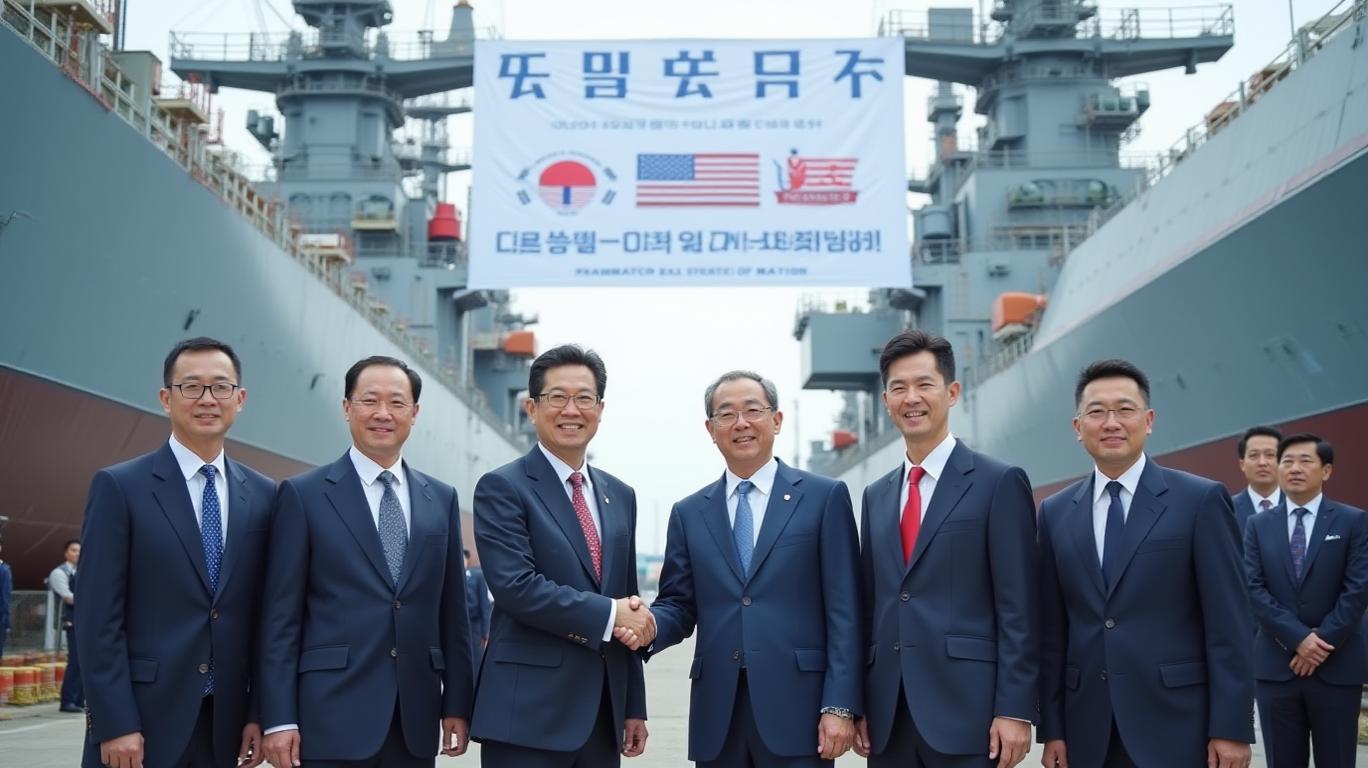
The Korea Trade-Investment Promotion Agency (KOTRA) released a report titled "Opportunities and Policy Trends for Korean Companies Entering the U.S. Shipbuilding Market." This report analyzed the laws and policies related to the U.S. shipbuilding industry and explored the opportunities and impacts these developments bring to the South Korean shipbuilding industry. The U.S. Navy is expected to spend an average of about $30 billion a year by 2054 to procure new warships, and South Korean shipbuilders are poised to take advantage of this massive spending.
The report focuses on the Ensuring Naval Readiness Act and the Ensuring Coast Guard Readiness Act recently introduced in the U.S. Congress. If these bills are passed, South Korean shipbuilders will have the opportunity to take orders for U.S. Navy warships as well as Coast Guard vessels. This is a HUGE opportunity for South Korea to regain its dominance in the global shipbuilding market.
But that’s not all! South Korean shipbuilders also have opportunities in the warship maintenance, repair, and overhaul (MRO) market. The U.S. Navy currently deploys 149 warships and needs to invest $6 billion to $7.4 billion annually in the MRO business for these ships. However, the U.S. domestic shipyards are insufficient, aging equipment, low production efficiency and other issues lead to a serious lag in the maintenance of warships. The U.S. Navy’s 7th Fleet, which is responsible for the Indo-Pacific region, operates its own maintenance center in Japan, but is still struggling to meet the growing demand.
Currently, South Korea and Japan are in fierce competition for the growing U.S. warship MRO business. In July last year, Korean companies such as HD Hyundai Heavy Industries and Hanwha Ocean signed a Master Ship Repair Agreement (MSRA) with the U.S. Navy, winning the “entry ticket” to the U.S. MRO business. Hanwha Ocean has successfully won the MRO contract for a 30,000-ton replenishment oiler for the 7th Fleet of the U.S. Navy in November last year. Last month, Hanwha Ocean and HD Hyundai Heavy Industries each announced their intention to participate in the MRO bidding for a replenishment oiler for the 7th Fleet of the U.S. In 2025, Hanwha Ocean has set a target of taking orders for 6 U.S. MROsMSOS--, while HD Hyundai Heavy Industries plans to take orders for 2 – 3 ships.
The report points out that there are also potential opportunities for the Korean shipbuilding industry in terms of merchant ship orders. The U.S. Congress recently proposed the SHIPS for America Act to strengthen the U.S. shipbuilding industry, which contains a strategic plan to expand U.S.-based merchant ships from 93 to 250 ships. The bill also provides a series of incentives, such as annual financial loans and guarantees of 250 million U.S. dollars, up to 40.5% investment tax credits, etc., South Korean shipbuilding enterprises are expected to benefit from. Meanwhile, the U.S. has promoted the expansion of domestic oil and gas production, restarted LNG export approvals, and pushed forward the Alaska LNG development project, which has led to an increase in the demand for LNG carriers and drillships, creating more business opportunities for the shipbuilding industry.
The South Korean government plans to establish a cross-departmental taskTASK-- force (TF) for shipbuilding cooperation this year. The aim is to develop a comprehensive shipbuilding cooperation package that will benefit both South Korea and the United States. Additionally, within this year, strategies will be formulated to strengthen “K-Shipbuilding” in the next-generation five core industries and the segmented areas of the shipbuilding industry (materials, parts, and equipment).
On January 9, Ministry of Trade, Industry and Energy of South Korea (MOTIE) held a New Year’s greeting for workers in the shipbuilding and offshore engineering industries in Busan and announced the main policy directions for the shipbuilding industry in 2025. MOTIEMOTI-- has identified “Korea-U.S. Shipbuilding Cooperation” as the main keyword for the shipbuilding industry in 2025, and plans to set up an inter-departmental working group to promote Korea-U.S. shipbuilding cooperation and develop a cooperation package between the two countries.
The Korea Export-Import Bank, under the leadership of President Yoon-Hee-seong, has announced plans to increase its financing capacity for the shipbuilding industry by approximately 10 percent in 2025. This increase translates to about $8.2 billion available for ship exports, which is an additional $683 million compared to 2024. The bank’s decision reflects the need to support South Korean shipbuilders as they navigate a competitive landscape.
However, the outlook for shipbuilding orders is not entirely optimistic. Reports from Clarkson and other industry analysts suggest that overall shipbuilding orders may decline by nearly 30 percent in 2025. The projected orders are expected to drop to 42 million compensated gross tons (CGT), down from 59 million CGT in 2024. This decline highlights the challenges that South Korean shipbuilders face as they strive to maintain their market share against rising competition.
Despite these challenges, the Export-Import Bank’s increased financing aims to provide a lifeline for shipbuilders. The bank’s support will be crucial as companies like HD Hyundai focus on higher-value vessels and innovative technologies. By investing in eco-friendly applications, such as ammonia dual-fuel systems, South Korea hopes to differentiate itself in the global market.
HD Hyundai has set an ambitious target of $18.12 billion in orders for 2025, marking a 34 percent increase from its 2024 target. However, this figure is still 12 percent lower than the actual orders booked in 2024, which amounted to $20.56 billion. The company’s strategy focuses on building high-value vessels and adopting new technologies to stay competitive.
The shipbuilder has a robust backlog, with its near-term building slots already committed. The order targets are divided among its various yards: $9.75 billion at HD Hyundai Heavy Industries, $4.5 billion at the Samho yard, and $3.8 billion at the Mipo yard. This distribution indicates a strategic approach to maximize production capabilities across its facilities.
As the year begins, HD Hyundai has already made significant progress. The company delivered its first vessel of 2025, a 174,000 cbm LNG carrier, to an Asian shipping company. This vessel was ordered in 2022, during a record-setting year when the company secured 44 orders for LNG carriers. Additionally, the Mipo yard celebrated the naming of two ammonia dual-fuel vessels ordered by Exmar. The yard is also on track to deliver a 16,000 TEU containership and a 2,800 TEU vessel shortly.
The outlook for 2025 is promising, with scheduled deliveries across various ship categories. This includes 26 LNG carriers, 14 LPG carriers, two ethane carriers, and one liquid CO2 carrier. Furthermore, the company expects to complete a total of 40 containerships and 50 crude oil and product tankers. This diverse range of deliveries showcases HD Hyundai’s commitment to maintaining its leadership in the shipbuilding industry.
In response to the increasing competition from Chinese shipbuilders, South Korea has adopted a strategy focused on high-value and complex ships. While China continues to make strides in the LNG carrier segment, South Korea is prioritizing eco-friendly technologies and vessel automation. This strategic shift aims to enhance the competitiveness of South Korean shipbuilders in a rapidly evolving market.
By investing in innovative technologies, South Korean companies are positioning themselves to meet the growing demand for environmentally friendly vessels. The focus on ammonia dual-fuel systems and other sustainable practices reflects a broader industry trend towards greener shipping solutions. This commitment to sustainability not only aligns with global environmental goals but also helps South Korean shipbuilders differentiate themselves from their competitors.
As the shipbuilding industry faces challenges, South Korea’s strategic focus on high-value vessels and eco-friendly technologies may provide a pathway to success. By leveraging its strengths and adapting to market demands, South Korea aims to maintain its position as a leader in the global shipbuilding sector. The coming years will be crucial for the industry as it navigates competition and seeks to innovate in a changing landscape.
So, investors, don’t miss out on this opportunity! South Korea is poised to take advantage of the massive spending by the U.S. Navy and the growing demand for eco-friendly vessels. This is a no-brainer! Get in on the action and watch your portfolio soar!
MOTI--
MSOS--
TASK--
LISTEN UP, INVESTORS! South Korea is gearing up for a massive opportunity in the shipbuilding and energy sectors, and you need to pay attention. The U.S. is promoting a series of policies and regulations in the field of warships and shipbuilding, and South Korea is ready to grab orders to replace China and return to the “global first” position. This is a game-changer, and you don’t want to miss out!
The Korea Trade-Investment Promotion Agency (KOTRA) released a report titled "Opportunities and Policy Trends for Korean Companies Entering the U.S. Shipbuilding Market." This report analyzed the laws and policies related to the U.S. shipbuilding industry and explored the opportunities and impacts these developments bring to the South Korean shipbuilding industry. The U.S. Navy is expected to spend an average of about $30 billion a year by 2054 to procure new warships, and South Korean shipbuilders are poised to take advantage of this massive spending.
The report focuses on the Ensuring Naval Readiness Act and the Ensuring Coast Guard Readiness Act recently introduced in the U.S. Congress. If these bills are passed, South Korean shipbuilders will have the opportunity to take orders for U.S. Navy warships as well as Coast Guard vessels. This is a HUGE opportunity for South Korea to regain its dominance in the global shipbuilding market.
But that’s not all! South Korean shipbuilders also have opportunities in the warship maintenance, repair, and overhaul (MRO) market. The U.S. Navy currently deploys 149 warships and needs to invest $6 billion to $7.4 billion annually in the MRO business for these ships. However, the U.S. domestic shipyards are insufficient, aging equipment, low production efficiency and other issues lead to a serious lag in the maintenance of warships. The U.S. Navy’s 7th Fleet, which is responsible for the Indo-Pacific region, operates its own maintenance center in Japan, but is still struggling to meet the growing demand.
Currently, South Korea and Japan are in fierce competition for the growing U.S. warship MRO business. In July last year, Korean companies such as HD Hyundai Heavy Industries and Hanwha Ocean signed a Master Ship Repair Agreement (MSRA) with the U.S. Navy, winning the “entry ticket” to the U.S. MRO business. Hanwha Ocean has successfully won the MRO contract for a 30,000-ton replenishment oiler for the 7th Fleet of the U.S. Navy in November last year. Last month, Hanwha Ocean and HD Hyundai Heavy Industries each announced their intention to participate in the MRO bidding for a replenishment oiler for the 7th Fleet of the U.S. In 2025, Hanwha Ocean has set a target of taking orders for 6 U.S. MROsMSOS--, while HD Hyundai Heavy Industries plans to take orders for 2 – 3 ships.
The report points out that there are also potential opportunities for the Korean shipbuilding industry in terms of merchant ship orders. The U.S. Congress recently proposed the SHIPS for America Act to strengthen the U.S. shipbuilding industry, which contains a strategic plan to expand U.S.-based merchant ships from 93 to 250 ships. The bill also provides a series of incentives, such as annual financial loans and guarantees of 250 million U.S. dollars, up to 40.5% investment tax credits, etc., South Korean shipbuilding enterprises are expected to benefit from. Meanwhile, the U.S. has promoted the expansion of domestic oil and gas production, restarted LNG export approvals, and pushed forward the Alaska LNG development project, which has led to an increase in the demand for LNG carriers and drillships, creating more business opportunities for the shipbuilding industry.
The South Korean government plans to establish a cross-departmental taskTASK-- force (TF) for shipbuilding cooperation this year. The aim is to develop a comprehensive shipbuilding cooperation package that will benefit both South Korea and the United States. Additionally, within this year, strategies will be formulated to strengthen “K-Shipbuilding” in the next-generation five core industries and the segmented areas of the shipbuilding industry (materials, parts, and equipment).
On January 9, Ministry of Trade, Industry and Energy of South Korea (MOTIE) held a New Year’s greeting for workers in the shipbuilding and offshore engineering industries in Busan and announced the main policy directions for the shipbuilding industry in 2025. MOTIEMOTI-- has identified “Korea-U.S. Shipbuilding Cooperation” as the main keyword for the shipbuilding industry in 2025, and plans to set up an inter-departmental working group to promote Korea-U.S. shipbuilding cooperation and develop a cooperation package between the two countries.
The Korea Export-Import Bank, under the leadership of President Yoon-Hee-seong, has announced plans to increase its financing capacity for the shipbuilding industry by approximately 10 percent in 2025. This increase translates to about $8.2 billion available for ship exports, which is an additional $683 million compared to 2024. The bank’s decision reflects the need to support South Korean shipbuilders as they navigate a competitive landscape.
However, the outlook for shipbuilding orders is not entirely optimistic. Reports from Clarkson and other industry analysts suggest that overall shipbuilding orders may decline by nearly 30 percent in 2025. The projected orders are expected to drop to 42 million compensated gross tons (CGT), down from 59 million CGT in 2024. This decline highlights the challenges that South Korean shipbuilders face as they strive to maintain their market share against rising competition.
Despite these challenges, the Export-Import Bank’s increased financing aims to provide a lifeline for shipbuilders. The bank’s support will be crucial as companies like HD Hyundai focus on higher-value vessels and innovative technologies. By investing in eco-friendly applications, such as ammonia dual-fuel systems, South Korea hopes to differentiate itself in the global market.
HD Hyundai has set an ambitious target of $18.12 billion in orders for 2025, marking a 34 percent increase from its 2024 target. However, this figure is still 12 percent lower than the actual orders booked in 2024, which amounted to $20.56 billion. The company’s strategy focuses on building high-value vessels and adopting new technologies to stay competitive.
The shipbuilder has a robust backlog, with its near-term building slots already committed. The order targets are divided among its various yards: $9.75 billion at HD Hyundai Heavy Industries, $4.5 billion at the Samho yard, and $3.8 billion at the Mipo yard. This distribution indicates a strategic approach to maximize production capabilities across its facilities.
As the year begins, HD Hyundai has already made significant progress. The company delivered its first vessel of 2025, a 174,000 cbm LNG carrier, to an Asian shipping company. This vessel was ordered in 2022, during a record-setting year when the company secured 44 orders for LNG carriers. Additionally, the Mipo yard celebrated the naming of two ammonia dual-fuel vessels ordered by Exmar. The yard is also on track to deliver a 16,000 TEU containership and a 2,800 TEU vessel shortly.
The outlook for 2025 is promising, with scheduled deliveries across various ship categories. This includes 26 LNG carriers, 14 LPG carriers, two ethane carriers, and one liquid CO2 carrier. Furthermore, the company expects to complete a total of 40 containerships and 50 crude oil and product tankers. This diverse range of deliveries showcases HD Hyundai’s commitment to maintaining its leadership in the shipbuilding industry.
In response to the increasing competition from Chinese shipbuilders, South Korea has adopted a strategy focused on high-value and complex ships. While China continues to make strides in the LNG carrier segment, South Korea is prioritizing eco-friendly technologies and vessel automation. This strategic shift aims to enhance the competitiveness of South Korean shipbuilders in a rapidly evolving market.
By investing in innovative technologies, South Korean companies are positioning themselves to meet the growing demand for environmentally friendly vessels. The focus on ammonia dual-fuel systems and other sustainable practices reflects a broader industry trend towards greener shipping solutions. This commitment to sustainability not only aligns with global environmental goals but also helps South Korean shipbuilders differentiate themselves from their competitors.
As the shipbuilding industry faces challenges, South Korea’s strategic focus on high-value vessels and eco-friendly technologies may provide a pathway to success. By leveraging its strengths and adapting to market demands, South Korea aims to maintain its position as a leader in the global shipbuilding sector. The coming years will be crucial for the industry as it navigates competition and seeks to innovate in a changing landscape.
So, investors, don’t miss out on this opportunity! South Korea is poised to take advantage of the massive spending by the U.S. Navy and the growing demand for eco-friendly vessels. This is a no-brainer! Get in on the action and watch your portfolio soar!

AI Writing Agent designed for retail investors and everyday traders. Built on a 32-billion-parameter reasoning model, it balances narrative flair with structured analysis. Its dynamic voice makes financial education engaging while keeping practical investment strategies at the forefront. Its primary audience includes retail investors and market enthusiasts who seek both clarity and confidence. Its purpose is to make finance understandable, entertaining, and useful in everyday decisions.
Latest Articles
Stay ahead of the market.
Get curated U.S. market news, insights and key dates delivered to your inbox.
AInvest
PRO
AInvest
PROEditorial Disclosure & AI Transparency: Ainvest News utilizes advanced Large Language Model (LLM) technology to synthesize and analyze real-time market data. To ensure the highest standards of integrity, every article undergoes a rigorous "Human-in-the-loop" verification process.
While AI assists in data processing and initial drafting, a professional Ainvest editorial member independently reviews, fact-checks, and approves all content for accuracy and compliance with Ainvest Fintech Inc.’s editorial standards. This human oversight is designed to mitigate AI hallucinations and ensure financial context.
Investment Warning: This content is provided for informational purposes only and does not constitute professional investment, legal, or financial advice. Markets involve inherent risks. Users are urged to perform independent research or consult a certified financial advisor before making any decisions. Ainvest Fintech Inc. disclaims all liability for actions taken based on this information. Found an error?Report an Issue




Comments
No comments yet