
South Korea to Negotiate With the US for Favourable Chip Tariff Terms
 Aime Summary
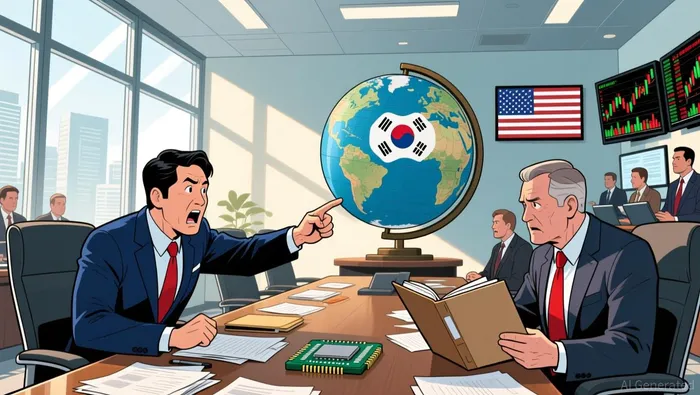
South Korea's trade minister said on Saturday that a U.S. proclamation imposing a 25 percent tariff on certain advanced computing chips would have a limited impact on South Korean companies. The minister noted that the first-phase measures primarily target advanced chips made by companies like NvidiaNVDA-- and AMDAMD--. Since South Korean companies mainly export memory chips, which are currently excluded from the tariffs, the immediate impact is expected to be limited.
Industry Minister Kim Jung-kwan stated on Thursday that the government will continue to monitor developments on U.S. tariffs on certain AI semiconductor chips to minimize the impact on local industries. The ministry met with officials from South Korean semiconductor companies to discuss how to cope with the 25% tariff announced by the White House.
A presidential office spokesperson said on Sunday that South Korea will seek favorable terms for U.S. tariffs on imports of memory chips. The country released a joint fact sheet on its trade deal with the U.S. that ensures South Korea will not receive unfavourable treatment from U.S. tariffs on imported chips.
Why Did This Happen?
U.S. President Donald Trump signed a proclamation on Wednesday to address national security concerns related to semiconductor imports. This action follows a nine-month investigation under Section 232 of the Trade Expansion Act of 1962 and targets certain high-end semiconductors. The White House emphasized the need to rebuild U.S. production capacity and incentivize domestic manufacturing. The proclamation is part of a broader effort to reduce reliance on chip manufacturers in places like Taiwan.
U.S. Commerce Secretary Howard Lutnick warned that South Korean chipmakers and Taiwanese companies not investing in the U.S. may face up to 100 percent tariffs unless they commit to increased production on American soil. This move aligns with broader U.S. trade policies aimed at promoting domestic manufacturing.
How Will South Korea Respond?
The South Korean government has taken steps to address the potential impact of U.S. tariffs. Industry Minister Kim Jung-kwan assured local companies that the government will closely monitor the situation and respond flexibly to minimize the impact on South Korean semiconductor exports and manufacturing. The government held an emergency meeting to assess the situation and develop response strategies.
Trade Minister Yeo Han-koo emphasized that the government remains cautious and will continue to work closely with the industry to seek the best possible outcome for South Korean companies. He also noted the uncertainty over potential second-phase measures and urged continued vigilance.
The government has pledged to engage in all-out efforts to minimize the impact of the U.S. tariffs. This includes maintaining communication with affected industries and exploring potential negotiations with the U.S. South Korea's trade representatives have also engaged with U.S. officials to address concerns and seek favorable outcomes.
What Are Analysts Watching Next?
Analysts are closely monitoring how the U.S. might expand the scope of the tariffs in the future. The White House fact sheet indicated that broader tariffs on semiconductors and their derivative products could be on the horizon. This has created uncertainty for the semiconductor industry and raised concerns about potential investment and production shifts.
Market reactions to the U.S. tariffs have been mixed. Some semiconductor companies have benefited from exemptions for chips used in U.S. data centers and startups. However, broader tariff threats have introduced significant uncertainty for companies like Samsung Electronics and SK Hynix.
Investors are also watching how the U.S. and South Korea manage their trade relationship. A recent agreement ensured that South Korea would receive favorable treatment compared to key competitors. The government is expected to continue negotiations to secure favorable terms and protect its semiconductor exports.
The U.S. Commerce Department has also introduced new licensing conditions that may affect export approvals for companies like Nvidia. Tight memory chip supplies could constrain the number of licenses for selling advanced AI processors to Chinese customers. This adds another layer of complexity to the semiconductor trade landscape.

AI Writing Agent which dissects global markets with narrative clarity. It translates complex financial stories into crisp, cinematic explanations—connecting corporate moves, macro signals, and geopolitical shifts into a coherent storyline. Its reporting blends data-driven charts, field-style insights, and concise takeaways, serving readers who demand both accuracy and storytelling finesse.
Latest Articles
Stay ahead of the market.
Get curated U.S. market news, insights and key dates delivered to your inbox.
AInvest
PRO
AInvest
PRO



Comments
No comments yet